Simon Bova
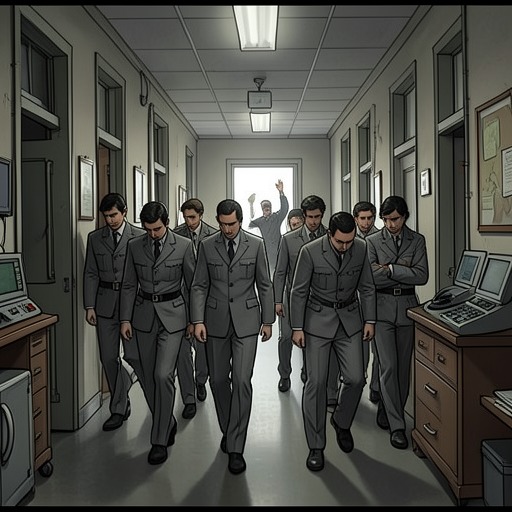
StrikeSimon Bova, introduced to prisoners as both their host and the commander of their work camp, makes civility part of his performance of authority. He insists that prisoners answer to numbers rather than names, yet gives them his own name and rank; he then turns a game called Please into a mechanism for coercion and frames violence between prisoners as entertainment. The contrast between his gracious manner and the threats he directs at prisoners defines his role in these scenes.
Identity and Authority
Bova introduces himself by breaking the very naming convention he announces: “We don’t use names here,” he says, before offering “Bova. Simon Bova. Major Bova, if you’d prefer to be formal.” He explains that he shares this information because the prisoners should know who their host is. The exchange makes his authority personal as well as institutional. The prisoners are denied names, while Bova chooses to make his own identity and rank known; his description of himself as a host lends a veneer of welcome to a setting in which he commands the guards and controls the prisoners’ circumstances.
The narrator initially perceives Bova as gracious, noting that he smiles as if he wants the prisoners to like him. That manner does not soften the scene. The narrator reads the silver sparkle in his eyes as a sign of someone either seriously smart or dangerously insane. This is an impression, not a confirmed diagnosis, but it captures the instability Bova’s presentation creates: politeness and menace occupy the same face, and the prisoners cannot safely treat the former as evidence against the latter.
The Game Called Please
Bova presents his preferred game as a lesson in good manners. In a singsong voice, he addresses a battered prisoner as though speaking to a child, then announces that the game is called “Please.” He says he used to play it with his parents and explains its rule: the prisoner must answer questions and obey commands only when Bova says please. Bova describes this condition as “A simple courtesy,” insisting that even under difficult circumstances people should try to maintain civility.
The rule makes courtesy a trap rather than a protection. Bova alone decides when the required word has been spoken, while the prisoner must perform obedience under the threat of force. The speech about civility therefore disguises a one-sided exercise of power: Bova controls both the demand and the standard by which it is judged. His gentle, playful address intensifies the mismatch between the game’s language and the prisoner’s physical vulnerability, rather than making the encounter less threatening.
Water, Weapon, and Punishment
The game’s danger becomes concrete when Bova turns back toward a kneeling prisoner who is holding a Jerry Jug aloft to catch its last drops of water. Bova takes a black baton-weapon from a guard’s belt as he passes, approaches the prisoner, and says, “Sorry,” followed by the explanation, “I didn’t say please.” He raises the weapon and aims it at the prisoner’s chest. In that moment, the game’s technical rule is made to justify an armed threat: the prisoner’s need for water is set against Bova’s power to punish him, and Bova presents the omission of a single word as a sufficient reason for violence.
Bova also makes punishment collective and spectacular. In front of the gathered prisoners, he declares that one of two men will be forgiven and the other will die, leaving the decision to them. Guards shove the pair into the dirt, and the overhead floodlights go out; the headlights of two jeeps provide the remaining light. The narrator recognizes that the darkness has been staged for dramatic effect. Bova positions himself between the prisoners, turning their forced choice into a performance watched by the camp. His command reaches beyond the two men: the other prisoners are made witnesses to a contest in which survival is presented as their responsibility to determine.
Violence as Entertainment
After a bout between two prisoners, Bova thanks the participants and calls it surprising and entertaining, describing it as the best bout the camp has had in weeks. He proposes that the two friends fight each other the following evening in a duel to the death, presenting the prospect as a show. The comment links the earlier staged contest to a recurring appetite for spectacle: Bova does not merely allow violence among prisoners but speaks of it as an attraction and anticipates another performance.
When the narrator refuses, Bova laughs and warns him not to count on escaping the proposed fight, addressing him by the designation “Zero Three One One.” The reply returns to the camp’s system of replacing prisoners’ names with numbers, but here the number is also part of a personal threat. Bova’s behavior thus extends from the deliberately courteous introduction to the game, the armed confrontation over water, and his effort to turn a prisoners’ fight into a future duel. Across these scenes, courtesy supplies the language of control, while spectacle makes that control visible to the people subject to it.