Scottie
StrikeScottie is a prisoner Tucker meets in the camp whose brief kindness becomes a decisive act of resistance—and whose execution makes the cost of his escape personal. First introduced during a rare, tightly limited opportunity for prisoners to speak, she later draws attention away from Tucker when Feit is searching the line. Feit eventually identifies her intervention and brings her before Tucker as leverage. Her story moves from a quiet introduction to an act of courage, then to an irreversible loss that Tucker believes he helped cause.
Identity and Introduction
Scottie first appears in a bunk beside Tucker. He notices that she is small, probably no taller than five feet, with long red hair that he imagines reaching her waist. Her appearance reminds him of his homeroom teacher at Arbortown High, an association that makes her recognizable to him before he knows anything about her. The impression is Tucker’s, not a fuller account of Scottie’s background; the scene introduces her through the details he can observe in the barracks.
Their first exchange takes place in whispers. Prisoners are communicating, but Scottie explains that the guards allow it only briefly. She tells Tucker that she has been at the camp about a week and was brought there from Los Angeles. Tucker says he is from Maine, and she remarks on the distance between his home and the place where they are held. The small exchange establishes both their separation from their former lives and the restrictions governing their present one: even learning each other’s names must fit into a narrow interval of permitted speech.
Scottie’s smile accompanies that first contact, and her later exchanges with Tucker retain the same economy. The available scenes do not give her a developed history beyond her imprisonment and arrival from Los Angeles. Instead, they show how quickly a limited acquaintance can acquire weight in a place where prisoners have little freedom to communicate or act openly.
Intervention at the Camp
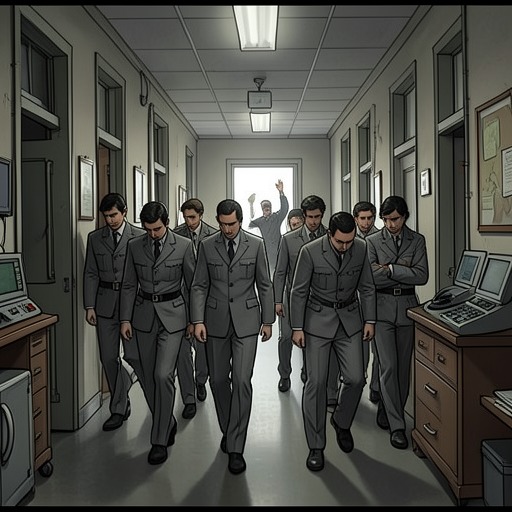
Scottie’s decisive intervention occurs when Feit and Major Bova move down the line toward Tucker, Tori, and Kent. As Feit is about to inspect a man among the prisoners, Scottie steps out of line and shouts, “It’s you, isn’t it!” She presses the accusation, yelling that they are looking for him and telling him to admit it. The man shouts back that the authorities are after her. Their confrontation becomes a fight among the prisoners, drawing attention away from the people Feit is approaching. Major Bova orders them to stop, sounding unusually frayed as the disturbance continues.
The diversion gives Tucker, Tori, and Kent an opportunity to drop behind a wooden structure and blend into the moving crowd. Tucker later sees that Scottie and the man she shoved are still present and have not been punished for the fight. He takes her hand, squeezes it, and mouths his thanks. Scottie smiles and winks back. In this sequence, her intervention is not a stated plan explained in advance; its purpose becomes clear later, when Feit tells Tucker that she caused the ruckus that let him slip away.
After the escape, Tucker makes the hand-over-heart gesture associated with the mysterious Sounders, wondering whether the prisoners might belong to the group. That moment records his suspicion, not proof of Scottie’s membership. When Feit later threatens her, Tucker says he knows she has nothing to do with the Sounders. The distinction matters: her help is established by what she does for Tucker, while the available evidence does not make her part of the resistance organization.
Feit’s Retaliation
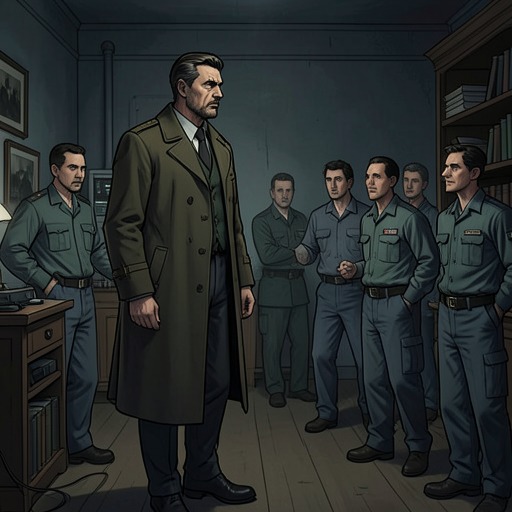
Scottie reappears in Feit’s custody, wearing an orange jumpsuit. Feit connects her arrival to the earlier escape, telling Tucker that she caused the disturbance and that it took him time to work out what had happened. Scottie looks confused and terrified as guards force her into a silver chair and clamp her wrists to its armrests. Tucker calls to her, but Feit says she cannot hear or see them. The scene turns Scottie’s earlier intervention into the basis for a threat against Tucker: Feit places the person who helped him in a position where Tucker must witness the danger she faces.
Tucker tries to protect her by insisting that she has nothing to do with the Sounders. Feit dismisses the claim and says that the confrontation is about Tucker, not Scottie; he adds that he could have put Tucker’s mother in the chair instead. His remark makes clear that Scottie has been brought into the encounter as a means of putting pressure on Tucker. Tori calls the treatment monstrous. Tucker recognizes that Scottie has helped him twice and that her life is now in his hands, but the scene offers him no safe way to undo Feit’s threat.
Feit presses his pad. Major Bova kicks the chair over, sending it back through the curtain of energy between the silver poles. Scottie opens her mouth to scream as white light envelops her; an instant later she is gone, and the chair returns upright and empty. The narration does not linger on a body or a formal declaration of death. Instead, the empty chair and Tucker’s immediate recognition of what he has witnessed establish the consequence. He describes Scottie as innocent and understands her disappearance as her death.
Loss and Narrative Significance
Scottie’s death changes the meaning of the gratitude Tucker had shown her. The hand squeeze and wink had been a brief acknowledgment between prisoners; in retrospect, they mark the human connection Feit exploits. Tucker says that he has witnessed death and devastation during the preceding weeks, yet this loss is different because Scottie risked her own life to help him. He cannot say with certainty whether he cried, but he is certain of the agony of believing himself responsible for an innocent person’s death. Tori’s anguished cry gives the loss a witness beyond Tucker, while his guilt makes its effect on him explicit.
Scottie’s role is concentrated rather than expansive: the evidence presents no independent account of her past, motives, or life beyond the camp. Her actions nevertheless shape the plot at two critical points. She helps Tucker evade Feit, and Feit later uses that same help to make her a hostage in the confrontation. The reversal gives her small act a grave consequence without turning it into evidence of an affiliation or plan the text does not establish. Scottie remains a prisoner who speaks to Tucker, intervenes when he is threatened, and pays for that intervention. Her empty chair leaves Tucker with no way to mistake the cost of the escape for an abstraction.