Tori Sleeper
StrikeTori Sleeper emerges as a companion who will not abandon her people and a fighter who refuses to let resistance become an excuse for murder. Her story repeatedly tests that distinction: she endures injury and captivity, chooses solidarity over separation, and challenges Tucker Pierce to judge the violence of his own side by the same standard he applies to its enemies. At the climax, with Captain Feit shooting at her, she aims at the nuclear device’s keypad rather than at Feit.
Introduction Under Fire
The book’s opening crisis places Tori in a military helicopter under attack, spinning out of control with five other people as it plunges toward the ground. She sits beside Tucker, while Kent Berringer and Stacy Pierce sit opposite them. One of Tori’s legs has been hit by a bullet. Tucker reaches for her uninjured leg, and she grips his arm for whatever comfort it can offer. Unable to see the helicopter’s altitude in the darkness, the group can only brace for impact. Tori meets that helplessness with surprising calm: “It can’t end like this.” The line does not remove the danger; it gives voice to her refusal to accept the group’s apparent fate as settled.
That first image establishes both her vulnerability and her capacity to stay present in danger. Her injury is concrete, not abstract: she is physically hurt, dependent on the company of others, and caught in a crisis none of them can control. Yet the moment is reciprocal. Tucker offers physical reassurance, and Tori holds on to him; her calm becomes part of the group’s shared effort to endure.
Recognition and Reunion
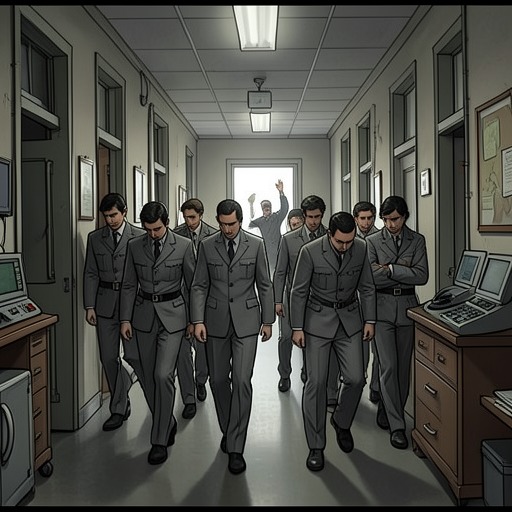
Later, Tucker watches prisoners escape from a dark barracks during a diversion, with Retro soldiers gathering two deep in the clearing. As the last prisoners reach the bus, he spots a girl he knows by her long, curly black hair: Tori. The recognition turns an operation he has been watching from the roof into a personal emergency. In the aftermath, Tucker points back toward the bus, which has been obliterated, unable at first to make sense of what has happened. Tori tells him, “You saved me,” then explains that once she saw him she would not leave: she boarded the bus and ran straight for its front door. The exchange makes their reunion an act of mutual commitment, not merely a lucky encounter. Tori’s decision to stay with the escape connects her survival to the choice to reach Tucker.
At the hospital, Tori leaves with Tucker and Kent. Outside, Kent pulls her into a bear hug, greeting her with the relief of someone who thought he would never see her again. Tori says she is good, then adds that she hates the Retros but loves their medicine. The remark holds two facts together without reconciling them: she can benefit from treatment provided by the enemy and still condemn the enemy. Her recovery does not erase the circumstances that made the treatment necessary.
The group’s status is also more complicated than a simple record of prisoners would suggest. When a soldier identifies Tucker, Tori, and Kent from a picture on her communication device, Tori challenges the claim that prisoners are not being recorded. The soldier explains that these are the ones they are watching out for. Tori’s question registers her suspicion of the system around them even as the answer reveals that someone inside it is monitoring their group with a protective purpose.
Loyalty Means Staying Together
When an air battle rages nearby and Tucker turns to find Kent and Tori running after him, he protests that they are following him toward a target everyone else is fleeing. Tori insists they are sticking to the plan: “We’re not splitting up. Not anymore.” She then makes the point unmistakable: “We’re going together.” Kent backs her up, but Tori states the commitment first and repeats it. The insistence carries more weight than simple tactical agreement. After danger has repeatedly scattered and threatened them, she treats staying together as part of what the group must now protect.
Her loyalty is not limited to keeping the group physically close. When Olivia explains that there is no time to persuade the future’s authorities before an attack wipes out the people of the past, Tucker must decide whether to help secure SYLO’s support. He looks to Tori; she takes his hand and squeezes it before saying, “The killing has to stop.” Her gesture accompanies a decision rather than replacing one. She supports action, but frames the urgency around preventing further deaths, not simply winning the next confrontation.
Challenging the Morality of Resistance
Tori’s clearest challenge to Tucker is that opposing the Retros does not automatically make their own violence righteous. When he defends not risking everything to help a man who seemed as good as dead, she says, “I’m not angry. I’m confused.” She compares their condemnation of the Retros’ invasion, undertaken to save themselves, with their own willingness to let people die in pursuit of their aims. Her argument makes the moral conflict harder to evade: if the Retros’ disregard for human life is grounds for condemnation, the resistance must face the lives lost through its own choices too.
Tori makes that accounting personal. She recalls the people killed when they sabotaged a Retro fleet and says she shot people herself, something she thinks about all the time. She asks what makes them better than the Retros. The question is not a claim that the two sides are identical in every respect; it is a demand that their resistance not treat its own casualties as morally invisible. When Tucker asks whether she would have acted differently before, she says that before these events she probably would have pushed it. Having seen how ugly people can become, she now wants to be better than an animal lashing out when cornered.
She also rejects the idea that preserving humanity requires surrender. Tori says she is willing to fight back, but refuses to sacrifice her humanity, because without it they would be just like the animals the Retros believe them to be. Later, she asks Tucker to promise that whatever they must do to survive, they will not cross one line: “Murder.” Together, her statements define a position that is neither passivity nor revenge. She accepts that survival can require fighting; she refuses to let survival justify killing without moral limits.
The SYLO Emblem: Enemy and Possible Salvation
Tori’s struggle with that distinction becomes visible when she stands before a rack of uniforms and touches the deep red camouflage as though it were more than cloth. She and Tucker remember SYLO’s invasion of Pemberwick Island: soldiers descending from helicopters, patrols in the streets, guards at the camp, and runaways being hunted. Tucker also recalls Captain Granger shooting a runner and SYLO gunships killing Mr. Sleeper at the rebel camp. Tori traces the rising-sun patch and its embroidered SYLO name. The uniform is thus not just equipment for the next mission; it bears the history of the force that destroyed lives, including a loss bound up with Tori’s own past.
After Kent gives the motto’s English meaning—“These guardians obediently protect us from the gates of hell”—Tori asks whether they see SYLO as the force that destroyed their lives or as their only chance at salvation. The question refuses an easy transformation of an old enemy into a clean ally. SYLO’s present usefulness cannot cancel its earlier violence, but past harm does not settle what must be done now. Tori’s willingness to consider cooperation is therefore not forgetfulness: it is a decision made with the emblem’s history still in view.
The Final Choice
That tension reaches its sharpest form inside the dome. As the dome shakes, Captain Feit turns and fires at Tori. She dives to the right and fires back—not at him, but at the nuclear device. Her shot strikes the keypad next to the countdown clock and fries it. The action gives physical form to the boundary she has argued for: even under direct attack, her answering shot is aimed at the weapon’s controls rather than at the person shooting at her. The evidence establishes the keypad’s destruction, not the ultimate effect on the device, but the choice of target is unmistakable.
Tori’s importance lies in the consistency between her speech and her actions. She recognizes that the resistance can reproduce the cruelty it opposes, insists that her companions remain together, and supports intervention to stop an offensive that would kill people in the past. When violence closes in on her, she still directs her weapon at the bomb’s keypad rather than at Feit. Her resistance is defined not only by whom she fights, but by the line she works to keep fighting from erasing.