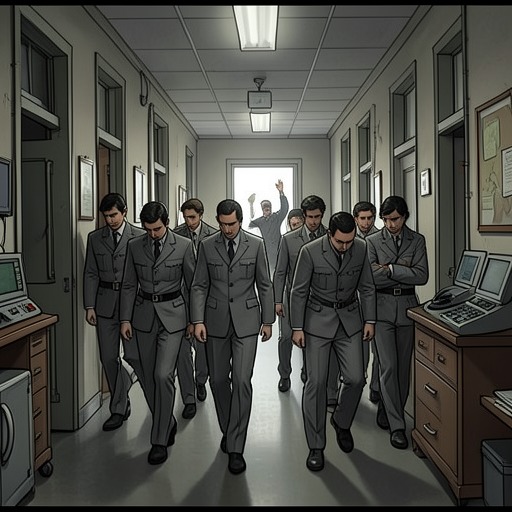
Stacy Pierce
StrikeStacy Pierce is Tucker’s mother and, in a confrontation with Feit, the captive whose presence makes an already dangerous standoff immediate and personal. The narration first places her among Tucker’s companions in a military helicopter under attack, then reveals her alive beside Feit in the clearing: a discovery that brings Tucker relief, fear, and the urge to act before he has considered the danger to anyone else.
Identity and Presence
Stacy is identified through Tucker’s intimate, familial perspective: she is his mother, and seeing her alive eclipses the crowded clearing around them. The narration describes her as more exhausted than he has ever seen her. She squints against the bright sun and raises a hand to shield her eyes, as though emerging from prolonged darkness. Her long blonde hair is tied back in a ponytail; despite her exhaustion, the narrator thinks the style makes her look younger than her forty-something years.
Her appearance does not define her response. Standing beside Feit, she holds her head up defiantly and fixes her eyes on him. The contrast between physical depletion and visible courage establishes her as more than a vulnerable figure in the scene: even while under an enemy’s control, she refuses to meet the moment with submission.
Captivity and Defiance
Stacy’s survival is the first fact that reaches Tucker when he sees her. That relief is so powerful that he briefly feels light-headed; in his perception, the thousands of people in the clearing vanish, leaving only his mother and Feit. The scene’s sudden narrowing makes the personal stakes of the confrontation plain. Tucker’s enemies are no longer an abstraction: Feit has his mother.
Stacy tries to stop Tucker from exposing himself. Her urgent whisper warns him that revealing himself is exactly what Feit wants. Tucker understands, at least vaguely, that coming forward could also endanger Tori Sleeper and Kent Berringer, but in that moment he cannot make himself care more about concealment than about his mother being handled by his enemy. He calls out to Feit, and the sound turns every person in the clearing toward him. Kent’s weary response recognizes that the concealment is over.
Feit then makes Stacy’s captivity an explicit means of controlling Tucker. He tells Tucker that he has no issue with her unless Tucker continues to cause trouble, while the prisoners are surrounded by Retro soldiers. The threat is conditional, but its leverage is unmistakable: Stacy’s safety is tied to Tucker’s conduct. Tucker’s next exchange with a lead soldier focuses on preventing another demonstration against the prisoners, underscoring how the standoff places his concern for his mother alongside the immediate danger to the crowd.
Family and Narrative Role
The earlier helicopter scene also places Stacy within Tucker’s small group of endangered companions. Six people are trapped in a military helicopter under attack, spinning out of control toward the ground. Tucker sits beside Tori, whose leg has been hit by a bullet, while Kent and Stacy sit on the other side of the craft. The darkness outside leaves them unable to judge their altitude or when impact will come; they can only huddle together and brace themselves. In that shared peril, Stacy is present not as a distant objective but as part of the family and company Tucker fears losing.
Her later appearance beside Feit reverses the emotional meaning of reunion. Stacy is alive, but the discovery does not resolve the danger: it gives Feit a way to pressure Tucker and forces Tucker to choose between remaining hidden and responding to his mother’s captivity. Stacy’s warning shows that she recognizes this trap and tries to protect him from it. Her role in the scene is therefore both emotional and practical: she brings Tucker’s private hope of finding his mother into direct conflict with the tactical demands of keeping their group concealed.