Cutter
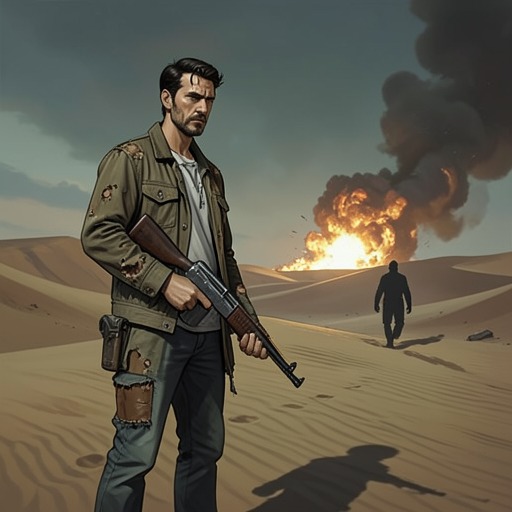
StrikeCutter is a marine commando and helicopter pilot whose concealed allegiance to SYLO complicates his earlier role as a leader of the rebels in Las Vegas. During the flight carrying Tucker Pierce and his companions, he keeps the damaged helicopter aloft until enemy fire disables it. He dies in the crash, leaving the group without its pilot and making the loss of their aircraft the point at which their hopes of stopping the Retros’ plans collapse.
Identity and Background
Cutter first appears in the cockpit, at the controls while Captain Granger sits strapped into the copilot’s seat. The division of responsibility makes Cutter the person directly tasked with keeping the helicopter in the air, while Granger is present as a commander. The narration identifies Cutter as a marine commando, placing him among the trained military personnel on whom the passengers’ survival depends.
His connection to the earlier events in Las Vegas is disclosed only after his death. Tucker remembers him as someone who had helped lead the rebels there, while secretly belonging to SYLO. The two affiliations give Cutter a concealed dimension: he was not simply a rebel leader whose loyalties were visible to the people around him. Tucker’s account links the fighter they knew in Las Vegas to a covert organizational commitment that had not been apparent to them.
The Flight Under Fire
As the helicopter lifts back into the sky, the people aboard face the possibility that the Retros on the ground will shoot them down. Cutter announces, “Help is incoming,” in a casual manner that contrasts with the danger around them. The confidence of the delivery briefly makes rescue seem possible, even as the aircraft remains exposed to fire.
That assurance does not mean the danger has passed. After Granger warns that they are not out of trouble, the helicopter lurches again. Cutter reports, “I’ve lost lateral stability,” and identifies the likely cause: the tail rotor has taken a hit. The aircraft begins to spin more violently, converting the threat of being shot down into an immediate loss of control. These details establish the circumstances of Cutter’s death as part of a worsening mechanical emergency rather than a deliberate choice to abandon the passengers.
The windshield then shatters under further fire. Glass strikes Cutter, and he goes limp in his seat. Tucker cannot tell at first whether he is unconscious or dead, but the immediate practical consequence is clear: Cutter is no longer flying. Granger tries to take the controls, only to find Cutter’s fallen body obstructing them. The helicopter spins faster and drops. Cutter’s injury thus removes the pilot at the precise moment when another crew member needs access to the controls.
Death and Remembrance
Tucker survives the crash and crawls toward the wreck despite a badly injured leg, a spinning head, and severe nausea. He keeps going because he needs to know who is inside; the people aboard are all he has left. At the helicopter, the first person he sees through the shattered windshield is Cutter. This time there is no uncertainty: Tucker recognizes that the pilot is dead.
Tucker’s recollection makes the death more than the loss of a useful crew member. He remembers Cutter as having seemed like an arrogant jock, but also as someone with compassion. Cutter had told the group that he was honored to know them; Tucker’s own response is that he was honored to have known Cutter. The paired expressions of regard reverse the impression created by Cutter’s swagger. Tucker does not erase that first impression, but places it beside the kindness that made Cutter matter to the group.
Tori later confirms that she saw Tucker get sucked out of the helicopter before the aircraft went down and that she awoke in the infirmary. Tucker tells her flatly that Cutter is dead and believes he died before the crash itself. Her lack of surprise and her comment that matters keep getting worse register the death as one more loss amid the group’s escalating misfortunes. The confirmation also closes the uncertainty that began when Cutter went limp in the cockpit.
Narrative Role and Significance
Cutter’s brief arc is structured around the contrast between competent action and sudden helplessness. He is introduced doing his best to fly the group out, and his calm announcement of incoming help offers a moment of reassurance. Damage to the tail rotor, a shattered windshield, and the obstruction of the controls then dismantle that fragile security in rapid succession. His body, first the means by which the helicopter is controlled and then an obstacle to Granger’s attempt to take over, becomes part of the crash’s physical chain of consequences.
His death also marks the boundary between the group’s earlier success and its new despair. Tucker concludes that the crash ended their hope of stopping the Retros from resetting society: destroying the enemy’s fleet had not put the Retros out of action, and their moment of victory had been short-lived. Cutter’s death is not presented as the sole cause of that strategic failure, but it is inseparable from the crash that makes the failure immediate. The man who had quietly promised help becomes the first person Tucker finds dead in the wreck, while Tucker’s final judgment preserves the compassion behind the fighter’s rough exterior.