Kenny Sokol
StrikeKenny Sokol is a Sounder captain whose defining appearance in the story comes during a dangerous escape through the underground railway. He enters the scene as an unfamiliar ally, quickly establishes his name and rank, and then takes control of the group’s next move. His plan turns the pursuing train into a threat directed back at the pursuers: the collision leaves the fugitives clear of the blast while sending an explosion through the tunnel and up into the city above.
Identity and Introduction
Sokol is introduced while the group is aboard a train and another car is visible behind them. Tori Sleeper asks the Sounder for his name; he gives both his surname and his rank, then adds his first name, Kenny. The exchange supplies the forms by which he is addressed: Captain Sokol, Captain Kenny Sokol, and Kenny. His introduction is practical rather than ceremonial, occurring in the middle of an escape when the group needs to know who is guiding them.
The scene also gives a brief physical description: Sokol is a big man with jet-black hair and dark eyes. No family history or earlier personal background is supplied here. Instead, the account establishes him through his membership in the Sounders, his captain’s authority, and the decisions he makes under immediate pressure. The compact introduction shifts attention from appearance to capability almost at once, as Tori asks how well he knows the tunnels.
Taking the Lead in the Escape
With a second train following behind, the group faces the danger of being pursued along the underground route. Sokol proposes taking a tunnel the pursuers do not expect, and his confidence in the route becomes the basis for the group’s next action. His authority is not imposed through a long explanation: although Tori and the narrator are confused by his apparent certainty, they do not challenge him because he seems to know what he is doing.
Sokol then explains the immediate plan. He intends to stop at the next station, warns that the stop will be abrupt, and orders the others to get out quickly once the train has stopped. The train approaches without slowing, because he wants to buy every possible second. That detail gives the maneuver its urgency: the stop is not an ordinary arrival but a tightly timed decision made while the pursuing train remains behind them. Sokol’s directions turn uncertainty into a sequence the group can follow—hold on, reach the station, get out fast.
The Collision and Its Consequences
Sokol’s plan culminates in a collision between the two nuclear-powered trains. When asked what happens when such trains collide, he admits he is not certain, but says they are about to find out. The answer makes the risk plain without interrupting the escape: the group has already reached the point at which the plan must be carried through, and its result cannot be precisely predicted.
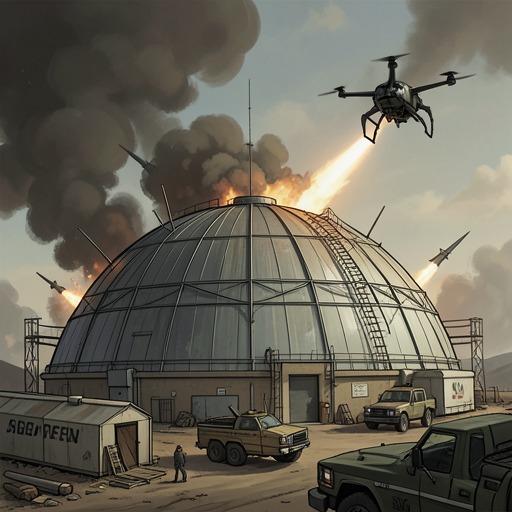
The impact occurs two hundred yards behind the fugitives. The ground erupts, and the explosion tears through the tunnel before breaching the surface beneath an ancient warehouse. It rips through the building and blows out its roof, sending debris into the sky. A brilliant spray of light rises through the opening, briefly illuminating the decrepit neighborhood and forming a beacon visible as far back as the dome. The scale of the blast contrasts with Sokol’s concise instructions at the station: the escape depends on swift, controlled movement, while the consequence behind the group is vast and destructive.
The others respond to the outcome with relief and exhilaration. Kent Berringer cheers and hopes that Major Bova was aboard the other train, a hope rather than a confirmed fact. Tori Sleeper praises Sokol’s maneuver. Their reactions register both the success of getting clear and the violence of the method; the collision has created a spectacular opening in the city, but the account does not confirm who, if anyone, survived aboard the pursuing train.
Character and Narrative Role
Sokol’s role in this episode rests on a contrast between uncertainty and decisiveness. He does not claim to know exactly what a nuclear-train collision will do. Yet he acts with confidence about the route, the timing of the stop, and the need for the others to get out quickly. The narrative therefore presents his competence not as omniscience but as command under pressure: he makes a hazardous choice, communicates the next steps, and gives the group a chance to escape its pursuers.
His brief appearance also changes the group’s immediate prospects. Before his instructions, they are being followed through the tunnels; after the abrupt stop and collision, the pursuing train is behind them in a scene dominated by the blast’s light and debris. The account offers no extended personal arc for Sokol beyond this episode, but it gives him a clear function within the Sounders’ resistance: he is the captain who can convert knowledge of the tunnels and decisive timing into an escape, while accepting that the destructive consequences of the plan cannot be fully known in advance.