People's Republic of Rock and Roll
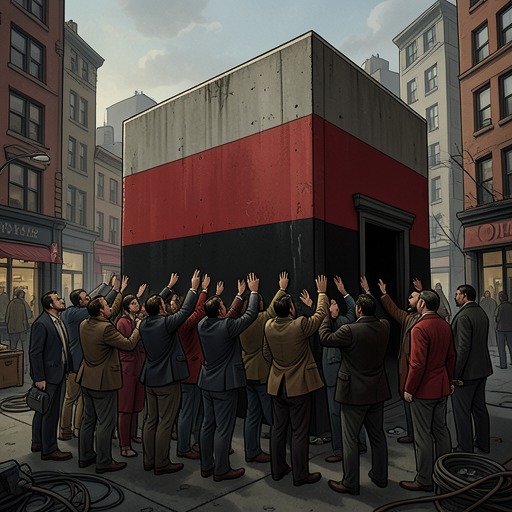
VinelandThe People's Republic of Rock and Roll, or PR3, was a self-proclaimed independent state formed by students at the College of the Surf. It arose from the discovery that their campus was a property scheme disguised as a public gift, and flourished for weeks as a vulnerable but unexpectedly durable community. Its story turns on a sharp contrast: students claimed the land in the name of the people, while state authorities used concealed routes and transfers to make the community's members disappear from public view.
Setting and Origins
The republic occupied a small crescent-shaped region around the College of the Surf, close to San Clemente and other politically sensitive places. At first, its apparent fragility seemed to invite suppression: the novel observes that military forces could have crushed the protest within hours. Instead, the community survived and grew over the following weeks. Its cheerfulness is presented neither as despair nor as arrogance, but as relief after earlier events, even as the students remained unsure how their experiment could be stopped.
That experiment began with a reversal in how the campus was understood. Students, newly conscious of how little they had been taught, began researching around the clock and learned that the College of the Surf had never been intended as a true center of learning. It had been designed as a real-estate investment, with vacation developments planned for the rocky coast after five years of financing. The institution's educational promise thus concealed a future in which public land and public purpose would be converted into private development.
Declaration and Political Life
Concluding that the state had participated in the scheme at every level and that the courts would not treat them fairly, the students decided to reclaim the campus and separate from California. After a tumultuous all-night assembly, they named their new state the People's Republic of Rock and Roll, choosing a name tied to what they regarded as a lasting common bond. Their declaration was followed by visible acts of public assertion: young people put up posters and painted political slogans on walls, while cafes, breweries, and pizzerias became places where plans and arguments circulated.
PR3's existence was not simply a proclamation. The community's weeks of survival gave it time to develop an emerging leadership and an urgent appetite for learning. Weed Atman, initially quiet at a political gathering, was brought into what appeared to be the new leadership group. Later, Brock Vond described Atman as a crucial support for the whole structure: in his assessment, removing him would leave the others to fight over Vond's money and cause PR3 to fall apart. The republic's political coherence was therefore both a source of possibility and a point of vulnerability.
Filmmaking, Surveillance, and Exposure
The arrival of the 24fps convoy the day after independence connected the republic to a radical film collective's effort to treat the camera as a political instrument. The equipment included cameras, lights, an editing table, a hydraulic camera mount, and a refrigerator full of film. The collective's inheritance included an uncompromising manifesto about filming political power, though some members objected to its language. Within PR3, cameras could record the movement's crowded, disorderly political life; at the same time, images of the campus could also be seen and used by people outside it.
Frenesi Gates filmed at the campus and supplied Brock Vond with copies of her footage, telling herself that the films were public and that he had as much right to see them as anyone. Vond first watched what she had recorded, then began suggesting what she should film. As she followed those suggestions, he gained a deeper place in her life. Her colleagues suspected that she was involved with Weed Atman, while Prairie noticed the way Frenesi filmed him. PR3's public visibility thus had two sides: the camera preserved images of the community, but the circulation of those images also opened a channel through which Vond could observe and influence it.
Removal and Narrative Significance
When the authorities' operation reached the campus, media attention fixed on the public-facing spectacle, including students and armed personnel at the main entrance. A separate convoy of unmarked, sealed gray trucks left through the rear, passed a checkpoint without stopping, and joined the little-known Federal Emergency Evacuation Route. The route ran for hundreds of miles along the coastal range beneath camouflage netting and weatherproof coverings; conceived in the 1960s as a disposable emergency highway, it led toward a remote northern valley prepared as an evacuation site. The concealed transfer made the state's reach legible precisely through what most reporters failed to see.
Brock Vond publicly characterized the missing students as having gone underground, while a radical reporter's questions about their legal status led to his removal from the press gathering. The discrepancy between that account and the trucks' departure exposes how PR3's defeat could be narrated as voluntary disappearance. The republic is significant not only as a protest against a fraudulent educational promise, but as a place where spatial control—who may occupy the campus, leave it, or learn where its members have gone—becomes a political weapon. Its rise and suppression bring the novel's contrast between collective self-determination and state-managed invisibility into concrete form.