Battle of Katan
WatchmenThe Battle of Katan is the central urban engagement in the conflict between the Komani invaders, Shinarian resistance, and the Terran forces attempting to direct Shinarian self-defense. Its decisive significance lies in the reversal at its center: Katan cannot be saved from destruction, but its defenders prevent the destruction from becoming a Komani victory by holding the Lesser City until Imperial reinforcements and Merdon’s fighters close the escape routes.
Causes and Strategic Stakes
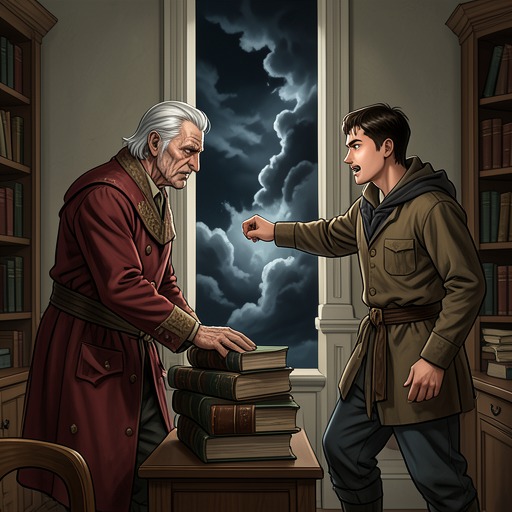
The immediate crisis began when Okatar Kang sent a column of Komani troops to sack Katan, where Clanthas’s father lived. Merdon reacted by gathering men for a direct assault on Okatar’s main camp, intending to kill the Komani leader. Vorgens recognized that this was a suicidal mission: Okatar’s camp was too strongly guarded, and Merdon could not reach Katan quickly enough to protect his father. The attack therefore created two linked dangers—Katan faced imminent invasion, while Merdon risked destroying himself in a gesture that would not save the city.
Aikens’s assessment made the strategic problem still sharper. Reports from observation planes indicated that the Komani column would reach Katan by midmorning, whereas the earliest Terran troops could arrive was midafternoon. The defenders could not prevent the initial attack. Aikens instead proposed allowing the Komani to enter and wreck the city, then striking when the attackers were disorganized and unprepared. The plan accepted immediate damage in exchange for the possibility of destroying the invading force.
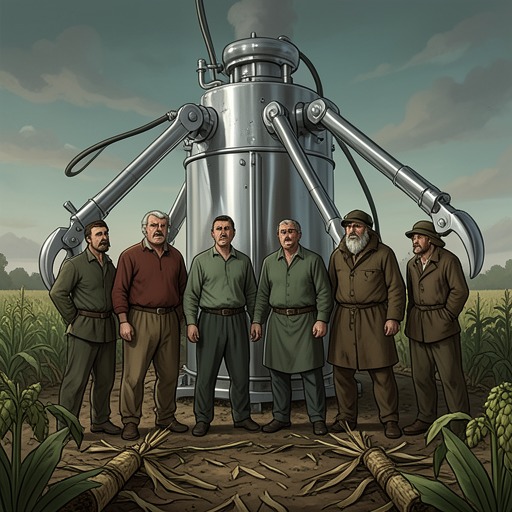
The battle also grew out of the political history of Shinar. Clanthas had organized farmers and demonstrations against Terran rule after recalling Geoffrey Knowland’s argument that freedom required the intelligence and courage to resist enslavement. The demonstrations had escalated into riots, civilian deaths, the murder of the Terran governor, the arrival of Imperial Marines, and the landing of Komani warriors. By the time of Katan, military action was no longer a simple contest between an empire and a colony. It was a struggle involving Shinarian self-defense, Terran imperial power, and Okatar’s larger ambition to use Komani victory to break the Terran Empire.
Preparation and Opening Attack
Through the night, Katan prepared for the assault. The arsenal was opened, and every male or female citizen who was old and strong enough to handle a weapon received one. People planned positions building by building and block by block, selecting windows and rooftops from which to fire, while others prayed. At dawn, ordinary commerce had disappeared. Shops and offices were closed, doors and windows were bolted, and the streets were nearly empty except for patrolling policemen. The city’s crescent-shaped harbor and river became the geography of a defense organized around enclosed buildings, rooftops, warehouses, and the waterfront.
Vorgens, Aikens, McIntyre, and Aikens’s staff arrived by aircar after flying over the Komani column. Vorgens reported that the attackers were approximately two hours away, perhaps less. Aikens warned the mayor that the Terran troops were advancing in land cruisers but would not arrive before noon at the earliest, leaving Katan to defend itself. Clanthas’s veranda became a battle headquarters where the town council, mayor, police chief, and other community leaders received the Terrans and coordinated the city’s response.
The Komani appeared over the hills as a dense swarm of flyers. They divided their assault into two columns. One drove toward the Lesser City and the warehouses beside the waterfront; the other crossed the open suburban area toward the Greater City and the arsenal. The division gave the attack two objectives but also separated its forces, creating the conditions for the later counterattack.
Urban Fighting and Destruction
The Greater City was overrun more easily. The Komani reached the arsenal, discovered that it was nearly empty, and turned their frustration against the building. They burned it and spread through the surrounding district, looting, burning, and destroying. By noon, smoke from dozens of fires had blotted out the sunshine, and much of the Greater City had become a shambles. The ruined arsenal could not provide the invaders with the weapons they expected, but its destruction demonstrated the scale of the city’s loss.
The crucial fight occurred in the Lesser City. Komani forces moving toward the warehouses met resistance from Katan’s citizens and a hastily assembled brigade of Imperial Marines. Aikens established a defensive perimeter a few blocks from the warehouses, extending it around the riverside flank. The perimeter temporarily stopped the advance, but the battle then deteriorated into house-to-house and man-to-man fighting. Most Komani warriors dismounted and fought on foot, while others remained in the air to fire into rooftops and windows. The attack reached close enough to threaten Clanthas’s headquarters, whose veranda was buzzed repeatedly by Komani flyers; Vorgens stood there with a beam pistol while watching the battle through the communications center.
The defenders paid heavily for the delay. The three companies of air-dropped Marines were reduced to a stubborn handful holding the warehouse steps. Shinarian civilians fought beside them, including old men, boys, and women. Along the river, Komani flyers tried to evade fire from both banks, while some broke through toward the warehouses and others bombarded the buildings from which Shinarians fired. The defense was therefore not merely an Imperial operation conducted on behalf of passive inhabitants. Katan’s civilians became combatants in the immediate defense of their homes, fighting and dying beside the Marines.
Encirclement and Victory
The turning point came almost two hours after the battle had begun in earnest, when the Terran forces finally arrived. Vorgens saw Terran troop carriers racing over the last line of hills and battle cruisers skimming across the harbor toward the warehouses. He initially expected Marines, but then realized that the vehicles from the hills carried Merdon’s men. The force assembled around Katan had unexpectedly become a combined operation: Aikens’s Marines pressed from within and along the city streets, while Merdon’s fighters approached from outside.
The Komani were caught in a vise. Aikens’s Marines advanced in battle cruisers and armored cars between the warehouses, using concentrated firepower to crush the attack. The Komani fell back slowly, but their attempts to regroup failed because Terran armored vehicles continued to drive against them. When the invaders fled toward the outskirts, they encountered Merdon’s vengeful fighters. The tactical plan had converted the devastation of Katan into a trap: the Komani could penetrate the city, but they could not consolidate their gains or withdraw intact.
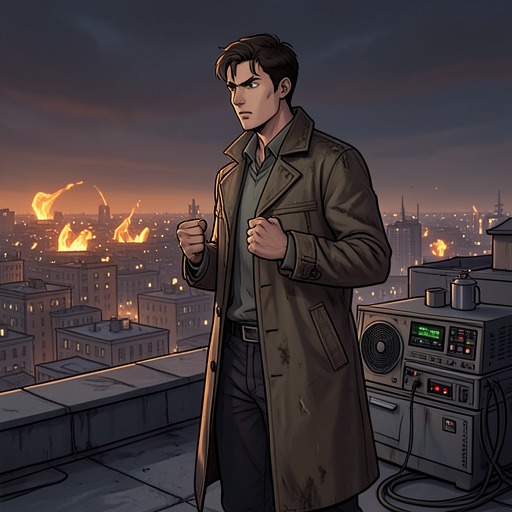
By nightfall, the battle was over. Only a very small number of attackers escaped. Merdon and the exhausted citizens of Katan celebrated by torchlight through streets filled with rubble and blackened ruins. The city’s electrical generators had been badly damaged, so the celebration took place in darkness and flickering light rather than in a restored civic space. Vorgens remained at the veranda railing, watching the celebration, while McIntyre returned grimy and tired but alive after the day’s fighting.
Consequences and Wider Significance
The Battle of Katan produced a military victory, but not an untouched one. Katan survived as a defended community while much of the Greater City was destroyed, the arsenal was burned, warehouses were endangered, civilians were killed, and the defenders suffered severe losses. Its success therefore embodies a value shift rather than a simple triumph: the city moves from helpless exposure to collective agency, but freedom and survival are purchased through ruin and death.
The battle also strengthened the practical alliance among Vorgens, Aikens, Merdon, and the people of Katan. Earlier, Vorgens had offered rebels a truce and demanded that they lay down their arms, while Merdon rejected the offer and treated him as a prisoner. At Katan, however, Terran planning and Shinarian resistance became interdependent. The victory depended on the very people whom imperial policy had been tempted to treat as subjects requiring pacification, and on Merdon’s fighters, whose political aims were opposed to unqualified Terran control.
Katan was followed by six weeks of almost uninterrupted fighting across Shinar. Okatar Kang responded by attempting to sack the planet systematically, raiding districts and towns for food, weapons, equipment, and ammunition. Against that policy, Vorgens developed a concept of Shinarian self-defense directed and supported by Terran forces. The war thereafter favored skirmishes, feints, ambushes, sudden attacks, and maneuvering over massive head-on battles. Katan thus serves as the model and emotional proof for a broader strategy: a population armed to defend itself, supported rather than simply subdued by imperial troops, could deny Okatar the easy conquest he expected and make the political future of Shinar a matter of organized local resistance rather than imperial decree.