Kerak Coup against Kanus
WatchmenThe Kerak Coup against Kanus is the decisive overthrow of Chancellor Kanus, carried out through a coordinated seizure of the Kerak Ministry of Intelligence, the release of prisoners, the mobilization of loyal army units, and the tactical use of the Dueling machine by Major Par Odal and Hector H. Hector. Its significance lies not only in removing Kerak’s dictator but also in converting an uncertain revolt into a transfer of authority that may avert civil war.
Causes and Immediate Opportunity
The coup begins when Hector H. Hector reaches the Ministry of Intelligence after escaping from a Kerak starship and being captured by Kor while trying to reach the Dueling machine. Major Par Odal has jumped back from Acquatainia, and Kor is temporarily locked in one of his own facilities. Hector tells Romis that the opportunity is narrow: only a few minutes remain to act against Kanus. The change in circumstance is crucial because the conspirators are no longer merely resisting from outside the regime; they possess access to the Ministry, have Kor in custody, and can strike at the political center before the intelligence chief’s private army responds.
Major Par Odal explains that the Ministry must be held while as many of Kor’s prisoners as possible are released. He also asks Romis to bring in dependable troops, arguing that most of the army may defect once the conspirators reach Kanus. The proposed objective is therefore broader than an assassination or a palace raid. It is an attempt to expose the regime’s isolation, enlist the army against its own leader, and end the dictatorship without a general slaughter.
Romis recognizes that the message could be a trap, perhaps one of Kor’s maneuvers, and even questions whether the Star Watchman on the screen might be an impersonator. Yet he concludes that a genuine opportunity of this scale will not recur. Within three minutes he places three calls, commits himself to the operation, orders an air car, dresses quickly, and takes a palm-sized pistol from his bedside table. His decision places both the success of the coup and the lives of several hundred men, including his own, at stake.
Seizure of the Ministry and Palace Advance
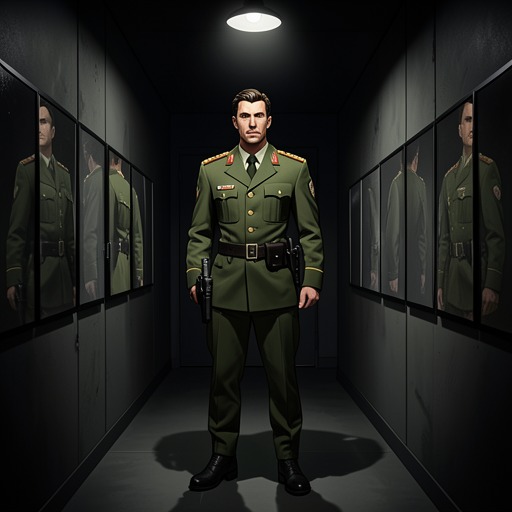
The action turns on speed and deception. Hector H. Hector and Major Par Odal reach the Dueling machine ahead of Kanus’s guards, overpower the guards at the entrance, and take their uniforms. They then arrive at Kanus’s palace only a few steps before the pursuing security force. The disguise is simple, but it exploits the regime’s dependence on uniforms, access, and instant obedience: the dictator’s own guards become the means by which his opponents approach him.
At the Ministry, the conspirators hold Kor’s prisoners and prepare to defend the building against Kor’s private army. Romis sends every unit he can trust to reinforce them. The coup consequently joins two kinds of action: a physical occupation of the intelligence apparatus and a political effort to detach the regular army from Kanus. The Ministry is the operational stronghold, while the palace is the site where the dictatorship must be made to surrender its personal command.
Kanus learns of the revolt from Kor, who communicates from a cell using a pocket communicator. Kor reports that the traitors have locked him in one of his own cells, but he remains confident because he has monitored their calls and believes Romis is heading toward the palace to kill Kanus. The exchange reveals both the danger and the irony of the operation: Kor’s surveillance network still functions, yet his knowledge cannot restore control once the conspirators have seized the institution that made that network effective.
The Overthrow of Kanus
When Romis arrives at the palace, Kanus calls him a traitor and an assassin and orders the guards to shoot him. Romis reaches for the gun at his waist, but the apparent guards remove their helmets and reveal the blond faces of Major Par Odal and Hector H. Hector. Their arrival at the Dueling machine has allowed them to pass through the palace defenses and confront Kanus at close range before he can organize a counterattack.
Romis then announces the political reality: he has seized the Ministry of Intelligence, most of the army has turned against Kanus, and Kanus is deposed. He urges the Chancellor to surrender and order his remaining guards not to fight their countrymen. This appeal makes the coup a controlled transfer rather than a punitive execution. Romis explicitly values Kanus alive because his surrender can prevent a civil war, even though fighting continues elsewhere.
Kanus tries to escape through the doorway, but the immediate confrontation gives way to a more extraordinary struggle inside the Dueling machine. He imagines himself before kneeling multitudes as an all-powerful Leader whose word is the law of nature, while Romis stands as the lone figure who refuses to kneel and walks toward him. Romis tells him that his guards have surrendered, that he has spent two hours in the Dueling machine, that most of the army has refused to obey him, that the Kerak Worlds have repudiated him, and that Kor has committed suicide. The regime’s military, territorial, and intelligence supports have collapsed together.
Collapse, Surrender, and Aftermath
Kanus insists that he is the master of the universe and that no one can stand before him. Romis answers that he is sick and needs help. The exchange reframes the fallen ruler: the man who formerly appeared omnipotent is now isolated, frightened, and incapable of understanding the loss of authority. Kanus finally admits that he is alone and afraid. Romis responds with a mixture of distaste and pity, extends his hand, and asks him to come along.
The ending rejects both triumphal vengeance and simple restoration. Kanus is not celebrated, and Romis does not pretend that the former Chancellor deserves affection; nevertheless, he offers assistance rather than immediate execution. The gesture contains the coup’s practical objective in miniature: authority must be removed from Kanus without allowing the removal itself to produce a wider massacre. The dictatorship ends when obedience shifts away from the individual ruler, and the first act of the new order is an attempt to keep the defeated tyrant alive.
Narrative Significance
The coup develops a recurring political contrast in the novel between coercive command and organized self-defense. Earlier resistance on Shinar grows from protests and demonstrations into armed struggle after Terran force kills civilians and the governor is murdered. Later, Emil Vorgens argues that Shinarian survival depends on cooperation against the Komani, while the local leaders gradually decide to work with him and distribute weapons through a broader defensive alliance. The Kerak coup echoes that pattern on another world: victory depends on persuading institutions and communities to withdraw obedience from a ruler, not merely on defeating one guard unit.
Its scene-level reversal is especially sharp. Romis begins uncertain whether the communication is genuine and accepts the possibility that his decision may kill hundreds. He ends at the center of a successful operation, facing a deposed Chancellor whose army has abandoned him and whose chief enforcer, Kor, is dead. The value at stake shifts from uncertainty and imminent bloodshed to the possibility of a controlled surrender. Through that reversal, the event presents political power as something sustained by collective compliance—and therefore something that can disappear with startling speed when the army, the intelligence apparatus, and the population cease to recognize one man’s command.