Battle of Carmeer Valley
WatchmenThe Battle of Carmeer Valley is the decisive confrontation that transforms Shinar’s rebellion from a confused colonial emergency into a crisis with galactic consequences. The Komani surround the Terran Mobile Force in the Carmeer district, while local rebels and civilian leaders make the battle inseparable from the question of Shinar’s political future. The immediate struggle is for survival in a valley; the larger contest is whether a Komani victory will become the signal for a general uprising against the Terran Empire.
Causes and Background
The battle grows out of a breakdown in imperial control. The Terrans hold Shinar’s four major cities and its spaceport, but Komani raiders are attacking the countryside and native rebels are operating alongside them. Brigadier Aikens sends the Mobile Force to hunt the raiders, expecting a conventional operation against what he regards as a barbarian threat. Instead, the force becomes isolated in Carmeer, where the Komani use their superior reconnaissance and surrounding positions to turn the imperial expedition into a defensive siege.
The crisis has been prepared by a Shinarian political movement that begins with organized demonstrations. Clanthas, a merchant whose livelihood depends on farmers’ produce, responds to imperial restrictions by organizing farmers in Katan and then arranging similar demonstrations in the major cities. The demonstrations escalate into riots; troops fire on unarmed civilians, the Terran governor is murdered, Imperial Marines arrive, and Komani warriors land on Shinar. The resulting conflict is therefore not simply an external invasion. It combines economic grievance, anti-imperial resistance, violent repression, and Komani expansionism.
The political language surrounding the battle reaches back into Shinar’s history. Clanthas recalls the Terran Geoffrey Knowland, who defeated the Masters and established Terran rule over Shinar, arguing that the principle of freedom can be turned against the rulers who originally proclaimed it. Emil Vorgens likewise remembers that his grandfather judged the Terrans unbeatable and sent his oldest son into the Star Watch as an example of accommodation rather than hopeless resistance. These competing memories give the battle two opposing meanings: it can be seen as the renewal of Shinarian independence, or as the first step toward another age of conquest and chaos.
Encirclement and Military Stakes
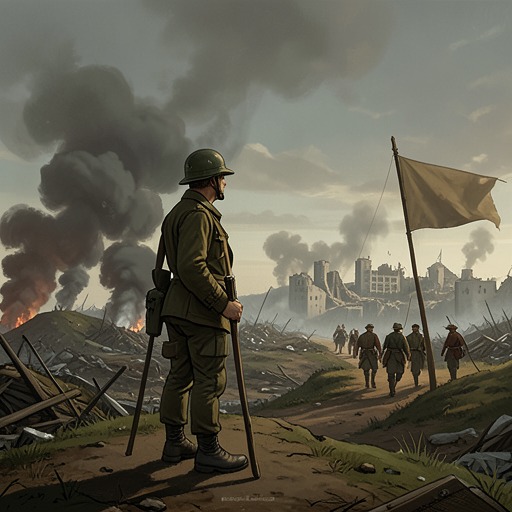
By the time the danger is understood, the Mobile Force of the 305th Imperial Marines is threatened with annihilation. The ordinary routines of military administration disappear as the troops dig in across the valley and concentrate on self-preservation. Reports from patrols are uniformly bad, equipment and personnel are scattered, and the force is completely cut off. The Komani have trapped the Terrans, and Clanthas fears that the battle’s outcome will leave the entire planet at the mercy of the invaders.
Brigadier Aikens initially treats the situation as a problem that additional strength can solve. He proposes reinforcements from the city garrisons, together with air cover and support, so that the Komani can be pinned between the existing force and an outside column. His aim is not merely to survive the engagement but to crush the raiders once and for all. This confidence conflicts with the strategic reality: the Komani are better informed, possess substantial forces, and are capable of withdrawing into the hills if they suffer a setback without being decisively contained.
The Komani leadership assigns the battle a much larger purpose. Okatar Kang argues that the Terrans are already weakened and that the small Mobile Force sent to Shinar will be extinguished. He expects other Komani clans to join him once they see that the Empire can be humbled in battle. His objective is consequently not limited to Shinar. A victory at Carmeer Valley would provide the political demonstration needed to unite the Komani and make the Terran Empire appear ripe for conquest.
The Assault at Dawn
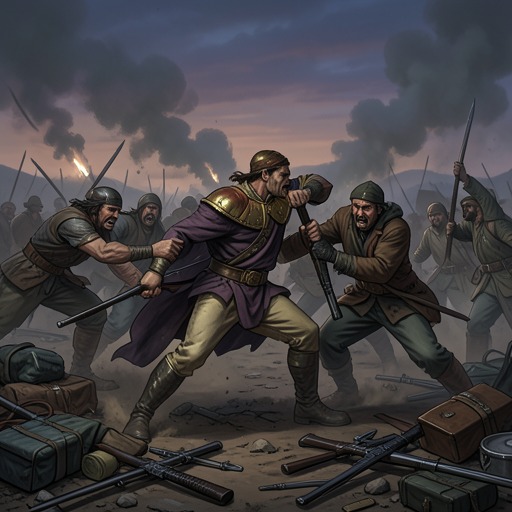
Okatar plans to attack at dawn from the side of the valley where the rising sun will be behind his forces. The arrangement gives the Komani an immediate tactical advantage and turns the valley’s light and shadow into part of the battle plan. When the signal is given, a hundred beams of light lance from the hills toward the shadowed valley floor and strike the Terran energy shield in blinding bursts. Missiles roar through the morning mist, explosions break against the defenses, and Komani warriors charge from the hilltops on one-man flyers.
The first assault produces both danger and uncertainty. Missiles penetrate the Mobile Force’s energy shield and one strikes a cruiser, prompting Okatar to laugh in triumph, while the force beams are stopped completely by the shield. From his screens, Okatar watches the Terran armored vehicles shift position and begins to wonder what they are attempting. The battle therefore does not unfold as a simple rout: the Komani can inflict damage and dictate the opening, but the Terran defenses remain capable of absorbing the attack and concealing their response.
Emil Vorgens understands that a tactical defense cannot be separated from the political consequences of defeat. He warns Aikens that the local military situation is overshadowed by the possibility that the destruction of the Mobile Force will trigger a general uprising among the Komani clans. If the force fights and is wiped out, the result will be more than the loss of a unit; it will touch off a war of terrible proportions. Vorgens therefore argues for withdrawal and the refusal of combat at the chosen time and place, even though Aikens insists that his men can defeat any undisciplined horde.
From Imperial Defense to Shinarian Alliance
Vorgens’s strategy is to deny Okatar the quick, decisive victory on which his authority depends. He explains that the Mobile Force can defend itself but cannot defeat the Komani alone before reinforcements arrive, and that Okatar’s weakness is the need to win rapidly on Shinar. If he can be held at bay and frustrated, the other clans may refuse to ally with him, and even his own people may tire of a fruitless war.
That strategy requires the Terrans to ask the Shinarians for help rather than treating them solely as rebels to be subdued. Vorgens presents them with a stark choice: fight for their world alongside the Terrans against the Komani, or allow the Komani to seize Shinar as the springboard for a galactic war. When a Shinarian asks whether cooperation will earn imperial support for self-government, Vorgens can offer only the possibility, not a guarantee. The alliance is thus founded on necessity and conditional trust rather than on a settled political agreement.
The appeal succeeds because the battle changes the calculation of participation. Clanthas and other leaders have previously resisted imperial rule, while Merdon urges the recruitment of Komani and others to free Shinar and ultimately destroy the Empire. Vorgens refuses to betray his oath as a Star Watch officer, but he also recognizes that imperial power alone cannot protect the planet. Later, Clanthas tells him that the other leaders have accepted his argument and will work against the Komani in whatever way possible. The threatened public good—Shinar’s survival—begins to overcome the risks of cooperation.
The alliance becomes operational rather than merely rhetorical when Merdon lacks enough groundcars to reach Katan quickly. Vorgens offers a squadron of vans and troop carriers within the hour, converting imperial logistics into the means of supporting Shinarian resistance against the Komani. Merdon admits that he has been wrong about Vorgens and agrees to follow his orders, while also asking to fight beside him. Their handshake and joint descent toward the waiting people mark a personal and political reversal: the former antagonists become partners in the defense of the same world.
Consequences and Narrative Significance
The Battle of Carmeer Valley matters because its value cannot be measured only by territory gained or lost. It is the point at which a local encirclement becomes a test of whether military action will stabilize Shinar or ignite a conflict across the galaxy. The Komani seek the spectacle of imperial humiliation; Vorgens seeks time, survival, and the prevention of escalation. The same battlefield therefore carries incompatible temporal horizons: immediate triumph for Okatar, delayed political and military resistance for the Terrans and Shinarians.
The battle also exposes the limits of both imperial paternalism and nationalist romanticism. The Terran Empire has brought order and prosperity to worlds such as Plione IX, yet its rule over Shinar has produced resentment and violence. The Komani present themselves as liberators from imperial domination, but their proposed victory would replace one external power with another and use Shinar as a platform for galactic war. Vorgens’s position occupies the unstable middle ground between those claims: he defends the Empire against the Komani while recognizing that Shinar’s desire for self-government must be taken seriously.
In that sense, Carmeer Valley is a battle of coordination as much as weapons. Reconnaissance, energy shields, armored vehicles, flyers, transport carriers, city garrisons, local leaders, and rival political memories all shape its outcome. The decisive resource is not simply firepower but the ability to prevent the Komani from converting tactical success into collective action by other clans. The battle’s deepest reversal is that imperial survival increasingly depends on empowering the people whom imperial policy had treated as subjects, making Carmeer Valley the military and political hinge of Shinar’s movement toward a different future.