Hector–Odal Mind Fusion
WatchmenThe Hector–Odal Mind Fusion is the decisive psychonic accident of the dueling machine’s development: Hector and Major Par Odal are drawn into a complete, amplified exchange of consciousness that briefly makes them one person. The fusion exposes the memories and moral injuries beneath both men’s military identities, then leaves them separate but irrevocably linked. Its significance is therefore double. It demonstrates that the machine projects personality as well as thought, and it makes inner knowledge—not physical victory—the event’s lasting weapon.
Causes and Technological Background
The fusion occurs within a machine originally designed to make aggression safe. Emile Dulaq had chosen a stubby cylindrical stat-wand, his own invention, for a duel in his familiar crowded city, trusting the machine to settle a score without mental or physical injury. Its defining promise was that hostile impulses could be acted out in an artificial environment while the participants remained unharmed. That promise depended on a strict separation between the projected dream and the external world.
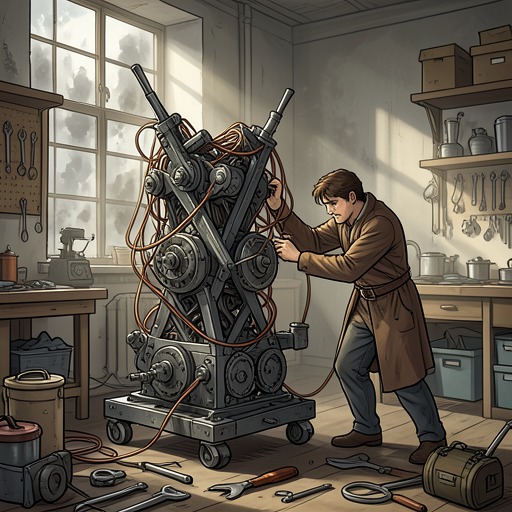
Dr. Leoh’s later experiments with Hector exposed the machine’s deeper capacities. The two men first used it to play hide-and-seek across jungles, cities, glaciers, and interplanetary voids without leaving their booths. Leoh then tested whether it reproduced and amplified thought patterns with fidelity. Light duels, pistols, sonic beams, and grenades showed that the machine did not improve knowledge or physical ability; it projected each participant’s existing capacities into a shared dream. Yet Leoh repeatedly defeated Hector when they faced one another, despite Hector’s superior training and reflexes. The result led Leoh to recognize that the machine projected personality as well as thought.
By the time Hector entered the Kerak installation, the machine’s safety had been revised. Leoh had added a circuit that psychonically isolated duelists from the outside world, making contact beyond the machine impossible while it operated, and another that monitored the entire duel so the chief meditech could review the recording if either participant claimed that rules had been broken. These safeguards were intended to prevent a recurrence of the lethal misuse associated with Major Par Odal. Instead, the isolation and amplification of the machine created the conditions for a different kind of danger: not bodily death, but the collapse of the boundary between two minds.
The Fusion Event
Hector reaches the dueling-machine chamber and runs to its main control desk, beginning to set the power before the room’s lights blaze on and white-helmeted guards rush in with guns. The threat surrounding him is intensified by the warning that the Watchman is a natural telepath: if he regained consciousness inside the machine, he could disappear at will, with fatal consequences for those holding him. Hector is drugged and only partly conscious, but he understands that the machine is active and that others are trying to examine his mind.
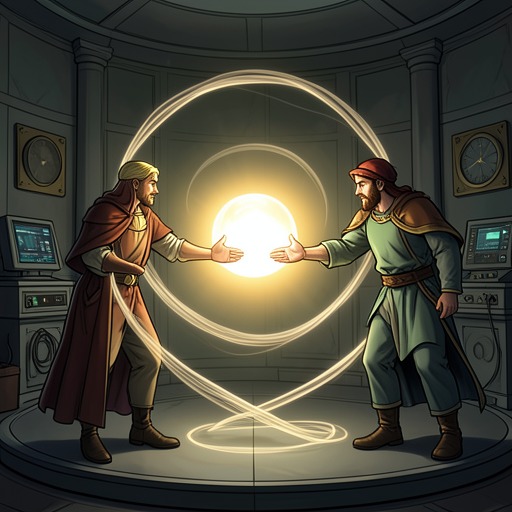
The decisive contact arrives as a violent mental shock. Hector’s body is seized by a flood of alien thought, while Odal—sitting in the Acquatainian dueling machine and thinking about Geri Dulaq—suddenly knows that he is in Kerak and that Hector is sharing the machine with him. The machine’s circuits expose and cross-link the two minds with the force of a supernova-like flash. Their nerves and muscles arch under the impact as though an enormous electrical current were passing through them.
The exchange is not limited to observation. Hector can see into Odal’s mind as though it were his own, experiencing a double vision in which he is simultaneously himself and Odal. Odal, sharing Hector’s mind, becomes Hector in the same reciprocal process. The machine turns telepathic access into mutual embodiment: each man is not merely reading the other’s memories but temporarily inhabiting the other’s identity.
Memories, Violence, and Recognition
The fusion makes military experience tangible as shared memory. Hector encounters files of exhausted cadets in heavy gray uniforms, the weight of field packs, and the heat of training beneath a scorching sun. Odal encounters the exhilaration of a boy seeing a starship for the first time as it hangs magnificently in orbit. Their histories therefore meet through radically different emotional registers: discipline and fatigue on one side, wonder and aspiration on the other.
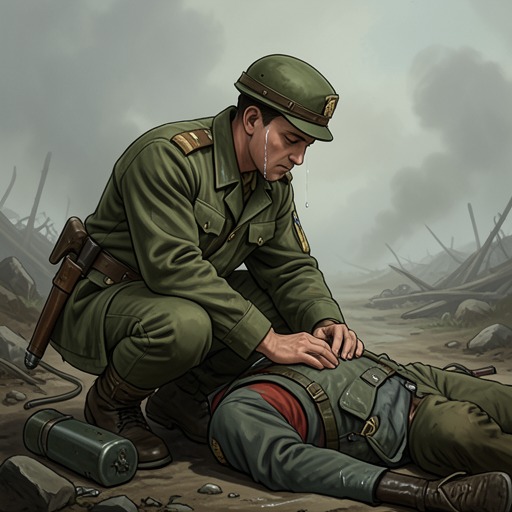
The shared consciousness also carries memories of violence that neither man can keep private. It contains the shame and terror of standing with a gun, wanting to kill and wanting to satisfy another person’s demand for death, then looking at the fallen man and recognizing that nothing warrants taking a human life. It contains the memory of beating Emile Dulaq with others until his face was bloody, while repeating that he was an enemy and that killing was necessary to survive and obey the Leader. The fusion places moral hesitation and institutionalized brutality in the same mental field, where neither can be dismissed as an abstract principle.
Other fragments reach beyond combat: a mother’s face, the familiar smell of a private room, laughter, a fireplace after a day in snow, a father’s pipe, and the contented purring of a kitten. The remembered domestic warmth contrasts with the process by which a young man leaves home, struggles through training, and learns the Star Watch’s mission to protect the peace alongside the habits of hatred, killing, and revenge against Acquatainia. The fusion thus reveals that the two soldiers are composed not only of official loyalties and battlefield reflexes but also of abandoned homes, childhood attachments, fear, tenderness, and choices made under pressure.
Interruption and Irreversible Consequences
The fusion is stopped only when a Kerak meditech notices the abnormal surge of power and switches off the machine. The interruption restores the men as separate individuals, but it does not restore their former separateness. Their memories, personalities, neural patterns, and chemical balances have intertwined so completely that each has been altered by the other. The event is therefore neither a successful duel nor a temporary vision. It is a permanent psychological consequence produced by a machine intended to keep aggression harmless.
The immediate aftermath gives the transformation a visible form. The doors of both booths open at the same time. Hector emerges clear-eyed, straight-backed, tall, lean, and blond, with a calm expression that is almost a smile. Odal stands in the other booth with the same height, build, coloring, and nearly identical knowing satisfaction on his face. Their physical resemblance may be longstanding, but after the fusion it becomes theatrically charged: the two men appear as counterparts who have acquired a private certainty no outside observer can penetrate.
Kor expects the Watchman either to remain contained or to have escaped, but instead sees Hector and Odal standing at opposite ends of the machine. The guards, meditechs, and Kor are frozen around them while Kerak’s bluish morning light enters the stone-ribbed chamber. The image turns the machine into a threshold between institutional control and a new, uncontrollable relation. The operators can shut down the power, but they cannot undo what the machine has made.
Narrative and Thematic Significance
The incident changes the story’s central opposition from a contest between Hector and Odal into a relationship of involuntary mutual knowledge. Before the fusion, the dueling machine promises controlled conflict: it projects weapons and environments while preventing genuine injury. After the fusion, the machine reveals that the most consequential battlefield is personality itself. A technology built to contain violence instead exposes the histories that generate it and joins two antagonists at the level where loyalty, fear, guilt, memory, and desire are formed.
The event also reverses the expected structure of victory. Neither man defeats the other through superior speed, accuracy, or weapon skill. The decisive result is a brief loss of individuality followed by altered individuality. Their apparent separation after shutdown conceals a deeper connection, and the matching calm on their faces makes that connection visible without explaining it to the surrounding authorities. The fusion is consequently both a revelation and a transformation: it discloses what each man has carried within him, and it ensures that each must henceforth carry part of the other.