Breakout from Carmeer Valley
WatchmenThe Breakout from Carmeer Valley is the Mobile Force’s escape from a Komani trap on Shinar, achieved after Emil Vorgens assumes command and replaces Brigadier Aikens’s aggressive plan with a carefully coordinated withdrawal. Its decisive significance lies in the way a tactical retreat becomes a strategic victory: the force survives, the Komani are denied the annihilating triumph they need, and Vorgens gains the credibility required to unite Terran troops with Shinarian resistance.
Crisis and Change of Command
The operation begins in a situation made dangerous by both geography and command judgment. Aikens had wanted reinforcements, air cover, and an encircling attack that would pin the Komani between two forces and crush them. Emil Vorgens recognized that the Mobile Force could not safely fight on those terms. A defeat would not merely destroy one formation; it could trigger a general uprising among the Komani clans and ignite a war of much larger proportions. He therefore argued that the force had to withdraw and decline combat rather than allow local confidence to override strategic reality.
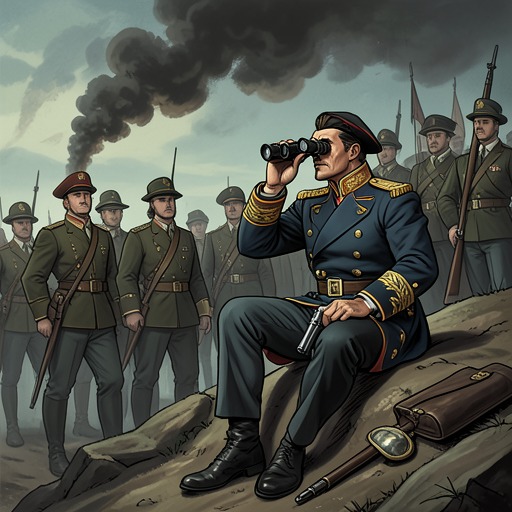
Aikens refused to accept that assessment. He insisted that his troops could defeat any supposedly undisciplined horde, but Vorgens countered that the Komani were as well trained as troops anywhere in the galaxy and that the odds were overwhelmingly unfavorable. When Aikens prepared to act in full-dress uniform, with ornate pistols buckled around him, Vorgens formally relieved him of duty and assumed command of the Mobile Force. The moment is a sharp reversal of military authority: the commander who had treated retreat as weakness is displaced by the Watchman who understands survival as the condition of future victory.
The Escape Plan
Vorgens’s plan divided the breakout into mutually supporting stages rather than relying on a single rush through the Komani lines. Scoutcars and troopcarriers were ordered toward Sectors W5 and W6, where the Komani presence had thinned. Troopers were to seize and hold those slopes, while scoutcars neutralized isolated pockets of resistance. Light cruisers, less maneuverable than the smaller vehicles, would follow the first assault and add firepower once the initial positions had been secured.
The terrain itself had to be remade before the main body could escape. Engineers’ vans were sent forward to grade the slopes with force beams and explosives, gouging out a broad route without the major obstructions that had previously slowed movement. Vorgens remembered how his battle cruiser had been forced up a twisting, narrow trail and understood that a whole Mobile Force attempting to file through the same passage would be destroyed. Engineering was therefore not a supporting detail but the material center of the operation: the escape route had to be constructed while the battle was still in progress.
At the same time, the rest of the Mobile Force was to fall back gradually toward the prepared slopes. A special rear guard of ten dreadnaughts, including Vorgens’s flagship, would keep the Komani attack stalled and off balance until the final movement. The plan depended on timing, controlled pressure, and the separation of tasks. Forward units opened the route, engineers made it usable, the main force withdrew, and the dreadnaughts absorbed the enemy’s attention long enough for the entire formation to pass.
The Breakout in Action
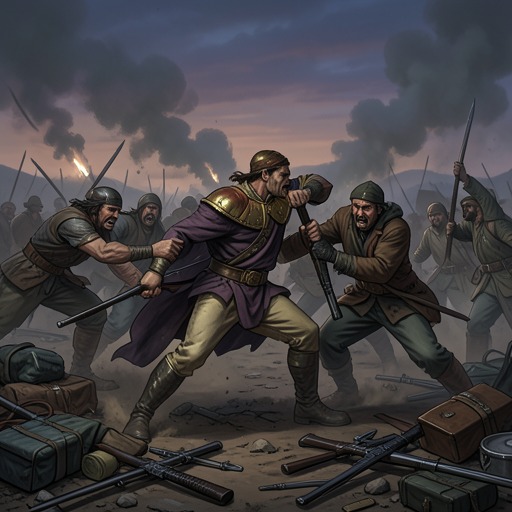
The success of the plan became visible from the trenches. Roughly twenty Terran vehicles lay scattered across the valley, smoking and inert, evidence that the escape had not been bloodless or effortless. Yet the remainder of the Mobile Force was streaming up the hillsides along paths of raw earth carved by the engineers and intensified by Komani bombardment. The same valley that had served as a trap was becoming a corridor toward the crest of the hills and freedom.
A battle-scarred cruiser reached the trench as the troopers climbed aboard. Sergeant McIntyre understood the significance of what he was seeing and credited the Star Watchman with pulling the force out alive. The engineer who had helped create the route, grimy and hollow-eyed, refused any pause for celebration; the Komani might attack again, and every moment had to be used to complete the withdrawal. The scene joins exhaustion to momentum. Survival is confirmed, but it remains fragile until the vehicles clear the valley.
The operation’s value is therefore measured not by the absence of losses but by the preservation of the force as a fighting formation. Vorgens does not defeat the Komani by destroying them in the valley. He defeats the immediate strategic danger by refusing to let the Komani choose the terms of the engagement, using terrain, mobility, and disciplined sequencing to deny them the decisive victory they sought.
Consequences and Political Meaning
The breakout gives Vorgens the authority to argue that Shinar’s survival cannot be secured by Terran troops alone. He explains that the Mobile Force can defend itself but cannot defeat the Komani in isolation, especially before reinforcements arrive. The Komani leader Okatar Kang needs a quick and decisive victory; if he is held at bay and kept off balance, his dream of glory may fade, other clans may refuse to join him, and even his own people may tire of a fruitless war.
This reasoning turns the retreat into the opening move of a broader alliance. Vorgens presents the Shinarians with a choice: fight for their world alongside the Terrans, or allow the Komani to take it as the springboard for a galactic war. He cannot guarantee that the Empire will reward their assistance with self-government, but the military situation has created a political opportunity. The Mobile Force’s escape buys the time in which that opportunity can be taken.
The first response comes from Clanthas, whose commercial interests and earlier appeal against Terran disruption had placed him among those most affected by imperial policy. After hearing Vorgens’s argument, he and the other leaders decide to help and to work against the Komani in whatever way possible. Later, when Katan is threatened and there are too few groundcars to move forces quickly, Vorgens promises a squadron of vans and troop carriers within the hour. Merdon, acknowledging that he had been wrong about Vorgens, tells his people to follow the Watchman’s orders and asks to fight beside him. Their handshake and joint descent toward the waiting people convert personal mistrust into operational cooperation.
Strategic Significance
The Breakout from Carmeer Valley establishes the principle that governs Vorgens’s campaign on Shinar: military success is inseparable from political restraint. Aikens seeks a conclusive battle because he believes superior courage and firepower can overcome the Komani. Vorgens instead sees the valley as a strategic hinge. If the Mobile Force dies there, the Komani gain momentum, the clans may unite behind them, and imperial conflict may widen into galactic war. If the force escapes, the Komani’s required victory is postponed, reinforcements can arrive, and Shinarian participation becomes possible.
The event also gives concrete form to the freedom that Clanthas had associated with strength and resistance. Freedom is not treated as a declaration detached from force; it depends on people being strong enough to resist enslavement, and on commanders understanding when survival requires withdrawal rather than spectacle. The smoking vehicles, the raw engineered slopes, the ten-dreadnaught rear guard, and the exhausted engineer all embody that tension. The breakout is a retreat in physical direction but an advance in strategic and political possibility.