Shinar Peace Settlement
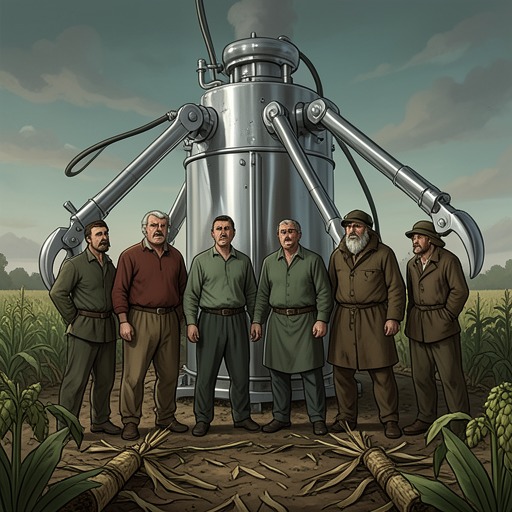
WatchmenThe Shinar Peace Settlement marks the decisive turn from open warfare to an uncertain peace on Shinar. Its immediate result is the departure of the Komani and the cessation of fighting, but the settlement is also a political compromise shaped by battlefield losses, the assassination of Okatar Kang, local resistance, and the threat of further Terran intervention. Peace arrives as a change in the balance of fear and honor rather than as a fully secured constitutional solution.
Causes and Background
The settlement grows out of the failure of military force to produce a stable victory. Emil Vorgens, an officer of the Star Watch, had come to Shinar to arrange a truce and end the bloodshed. He offered both sides the same terms: lay down their arms and return home, with the warning that the Terran Empire would otherwise be compelled to crush the resistance. The proposal expressed the Empire’s claim to be a carrier of law, stability, commerce, and order, but it also revealed the coercive foundation beneath that claim. Merdon rejected Vorgens’s terms and treated the truce-bearer as a prisoner who would soon be killed by the Komani.
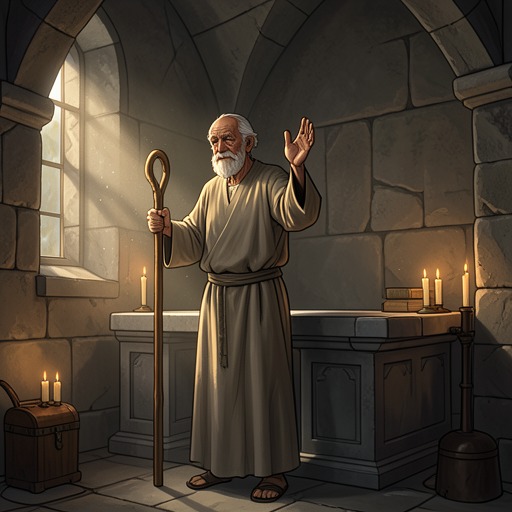
The moral limits of the war are made visible in the sanctuary defended by Sittas. When a Komani officer attempted to claim Terrans sheltered among the wounded in the name of Okatar Kang, Sittas refused with unusual vehemence. He insisted that the place was sanctuary for wounded men, that the patients were no longer warriors until they recovered, and that neither Okatar Kang nor the Terran commander had the right to seize prisoners there. This assertion temporarily removes the wounded from the logic of the war: in that town, Sittas declared, the war did not exist. The settlement’s later promise of peace therefore follows an earlier insistence that not every human being could remain an object of military possession.
What Happens
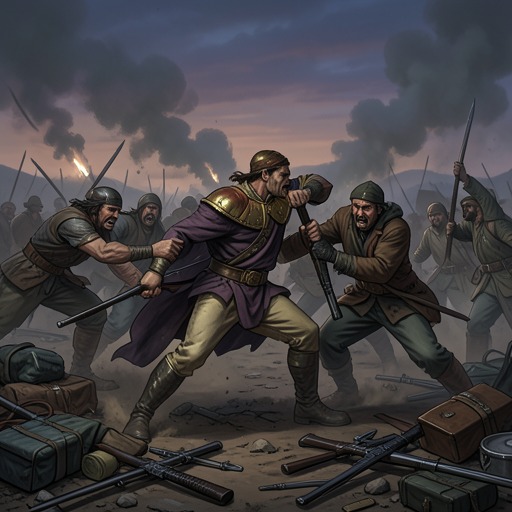
The immediate political opening comes after Okatar Kang is killed. The death is reported alongside the loss of Sergeant McIntyre and other troopers: four men are killed, one is wounded, and the victory is presented bitterly as a triumph purchased by terrible cost. Okatar’s death does not by itself create peace, but it removes the figure around whom much of the Komani fighting has been organized. The result is a sudden weakening of Komani resolve rather than a ceremonial surrender imposed by an overwhelming conqueror.
Vorgens later explains that Okatar’s death took most of the fight out of the Komani. Shinarian forces had also fought hard enough to make the Komani understand that they could gain no glory by continuing. A small group of reinforcements became the final pressure. The Komani nobles consequently blamed everything on Okatar and returned home. Their retreat preserves a measure of dignity: they can represent the war as the consequence of one disgraced leader rather than acknowledge an outright defeat before Shinar and the Terran Empire.
Vorgens’s diplomacy completes the military reversal. He deliberately allowed the Komani to believe that more Terran reinforcements might arrive at any moment, thereby demonstrating that the Empire was ready and able to defend itself. The threat worked because it offered the Komani a choice between continued danger and a settlement that did not shame them. Vorgens describes this as making them take the bait, but the maneuver is more than a trick: it constructs an exit in which withdrawal can be accepted as prudence rather than humiliation.
Consequences and Aftermath
When the Komani have gone, Sittas states the immediate consequence plainly: Shinar is at peace. Vorgens responds more cautiously, attributing the outcome to luck as much as skill. His account distributes causation among several forces—the death of Okatar Kang, Shinarian resistance, the arrival of reinforcements, and the implied possibility of further Terran intervention. The settlement is therefore presented as a compound result, not the achievement of one commander or one army.
The peace also opens the possibility of direct discussion between former enemies. Vorgens agrees to remain and accept Shinarian hospitality after a ceremony, hoping that the occasion will allow them to talk about ways to stop the killing. The exchange turns from immediate truce to the broader prospect of peace, suggesting that ending combat is only the first stage of repairing a society damaged by war.
Yet the settlement does not resolve Shinar’s constitutional status. Sittas believes the circumstances require a court-martial to acquit Vorgens, arguing that none of what has come to pass would have happened if Brigadier Aikens had remained in command. Vorgens still warns that nothing is definitely settled: if the Senate refuses to grant Shinar any measure of self-government, the court-martial may add treason and sedition to its charges. Peace thus coexists with political danger. The guns fall silent, but the question of whether Shinar will govern itself remains capable of reopening the conflict in another form.
Narrative and Thematic Significance
The Shinar Peace Settlement reverses the expectation that war ends through total victory. Its structure is closer to a negotiated return than to a heroic conquest: the Komani withdraw after their leader’s death, the Shinarian fighters make occupation costly, and Terran power supplies the threat that makes compromise credible. The decisive value shift is from killing to political possibility, but the shift remains fragile because the Empire’s willingness to defend Shinar has not yet guaranteed Shinarian self-government.
The settlement also exposes the tension within the Terran imperial order. Vorgens speaks as an officer charged with restoring order and ending bloodshed, yet his peace depends on the credible threat that the Empire will crush those who refuse its terms. Humanitarian sanctuary, military coercion, local resistance, and political self-determination occupy the same chain of events. Peace is achieved when these forces temporarily converge, not because their contradictions disappear.
Finally, the event transforms death into a political instrument while refusing to make that transformation triumphant. Okatar Kang’s assassination breaks Komani resistance, but Sergeant McIntyre’s death and the other casualties prevent the result from becoming a simple victory scene. The settlement’s emotional and ethical weight lies in that contrast: the war ends, yet its price remains visible, and the future is left open to the Senate’s decision about Shinar’s autonomy.