Dueling-Machine Teleportation Breakthrough
WatchmenThe Dueling-Machine Teleportation Breakthrough is the decisive technological reversal in the later history of the dueling machine: a system created to project thought and personality into harmless simulated combat becomes a mechanism that can move a living person across space. What begins as an anomalous disappearance inside the machine develops into Hector’s controlled psychonic teleportation, an interstellar transport possibility, and a strategic threat that places the discovery under the shadow of Chancellor Kanus and the Kerak regime.
From Harmless Combat to Physical Possibility
The dueling machine was originally valued because it could settle scores and release aggressive feelings without causing mental or physical injury. Its projections reproduced the participants’ thoughts, knowledge, reflexes, and personalities inside a shared environment rather than altering their bodies or abilities. In experiments between Dr. Leoh and Hector, the machine supported hide-and-seek across jungles, cities, glaciers, and interplanetary voids, followed by weapon simulations with foils, pistols, sonic beams, and grenades. Those trials established that the apparatus could reproduce thought patterns with strict fidelity, but they also exposed a deeper capacity: the machine projected personality as well as thought.
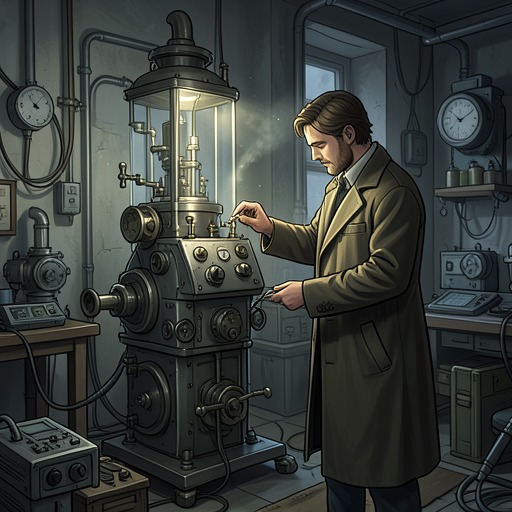
The breakthrough emerged when Hector was reunited with Dr. Leoh and Geri Dulaq at the machine chamber. Before the new experiments, Dr. Leoh had modified the apparatus to psychonically isolate duelists from the outside world and to monitor the entire contest. The isolation circuit was intended to prevent a participant from contacting the external world while the machine operated, while the monitoring circuit allowed the chief meditech to review a recorded duel and determine whether rules had been violated. These safeguards were designed to prevent the machine from becoming lethal again, yet the strengthened enclosure also provided the conditions in which an entirely different kind of contact could occur.
The First Teleportation
When Dr. Leoh activated the machine for Hector and Geri Dulaq, nothing happened at first. The screen then filled with a soft green and blue glow, and Hector found himself floating beside Geri in a shared green world. The apparent failure and delayed response became part of the mystery: the machine was not merely producing an imagined setting but was undergoing a process whose physical consequences were not immediately visible.
Dr. Leoh eventually found only one explanation for the machine’s unusual behavior: teleportation. The machine amplified the powers of natural telepaths, and reports suggested that some telepaths could move small objects without apparent physical force. Dr. Leoh therefore considered whether the same amplification could extend to transport, at the cost of an immense electrical drain. The question remained speculative because the booths lacked tape cameras, leaving him unable to determine exactly when Hector arrived or whether the transit occurred in four picoseconds, four-trillionths of a second.
Once the possibility was recognized, Hector and Dr. Leoh shifted from accidental discovery to measurement. Hector repeatedly transported himself from one booth to the other, making the jump twelve times on the first day. Dr. Leoh timed each transit and measured the energy consumed. The average journey took four picoseconds, while the power drain was approximately equivalent to that of a starship’s drive engines pushing a mass equal to Hector’s weight. The machine thus converted an invisible psychonic capacity into a measurable event with a precise duration and a substantial material cost.
Expansion of the Experiment
The initial demonstration did not establish unrestricted movement. For several days, Hector moved inanimate objects while remaining in one booth. He lifted weights without touching them and then transported Geri Dulaq from one booth to the other. At this stage, however, the ability remained confined to the interior of the dueling machine. The apparatus was still both instrument and boundary: it enabled transport, but only within the controlled environment that had produced it.
After a week of testing, Dr. Leoh concluded that the researchers might have discovered an interstellar transport mechanism. The possibility carried an important limitation: a dueling machine, or something equivalent to it, would be required at the destination. Teleportation therefore did not simply abolish distance; it reorganized distance around a network of compatible machines, telepaths, controls, and power sources. The device became an active participant in the event, determining where transport could occur, how much energy it demanded, and what infrastructure would be necessary to extend the experiment beyond the laboratory.
The later confirmation was vastly larger than the booth-to-booth tests. Sir Harold Spencer learned that Hector had apparently jumped from Kerak to Acquatainia in less than a second, crossing four hundred and fifty light-years. Dr. Leoh’s report transformed the earlier hypothesis into a fact of interstellar scale. What had begun as a strange glow and an unexplained power drain now implied that a person could cross distances that ordinary starships would require immense time and resources to traverse.
Military Stakes and Political Danger
The discovery immediately exceeded the boundaries of laboratory science. Sir Harold Spencer recognized its military potential and warned that Chancellor Kanus must know about it. Kor’s report to Kanus describes the possibility of using a telepath such as Major Par Odal together with the dueling machine to transport objects from one place to another over almost any distance, nearly instantaneously. Kanus’s immediate question was whether whole armies could be transported. The question reveals the strategic meaning of the breakthrough more clearly than any technical explanation: the same system that had promised harmless resolution of personal aggression could become a means of sudden invasion, reinforcement, or logistical domination.
The political danger is intensified by the fact that Hector is being held somewhere in Kerak. Dr. Leoh understands that the breakthrough is inseparable from the question of Hector’s survival and custody. Knowledge of the mechanism gives its possessor leverage, while control of the telepath gives a regime practical access to the mechanism. The event therefore links scientific achievement to coercion: the machine is not merely a discovery but a contested instrument whose operation can redistribute power between scientists, governments, military authorities, and the people capable of psychonic transport.
Consequences and Significance
The breakthrough changes the meaning of the dueling machine. At first, its value lay in substituting simulated danger for actual injury; after Hector’s experiments, its projections can produce an actual displacement of matter. The distinction between imagined environment and physical action collapses. A booth that once represented a jungle, city, glacier, or void can become the launching point for a real journey, while thought and personality become forces capable of acting on bodies and objects.
The event also establishes a recurring contrast between control and escalation. Dr. Leoh’s safety circuits attempt to isolate the duelists and preserve accountability, but the machine’s new capacity exceeds the purpose for which those safeguards were designed. Measurement, recording, and medical review can identify foul play, yet they cannot by themselves neutralize a technology capable of crossing four hundred and fifty light-years. The apparatus has become safer as a dueling system while becoming more dangerous as a transport system.
Its final significance lies in the double future it opens. In Dr. Leoh’s hands, the discovery suggests an interstellar transport network requiring a machine at each end. In Chancellor Kanus’s political orbit, it suggests a secret weapon powerful enough to move objects, and potentially armies, almost instantaneously. The Dueling-Machine Teleportation Breakthrough is therefore both scientific liberation from distance and the technological foundation of a new form of military threat.