Dulaq–Odal Duel
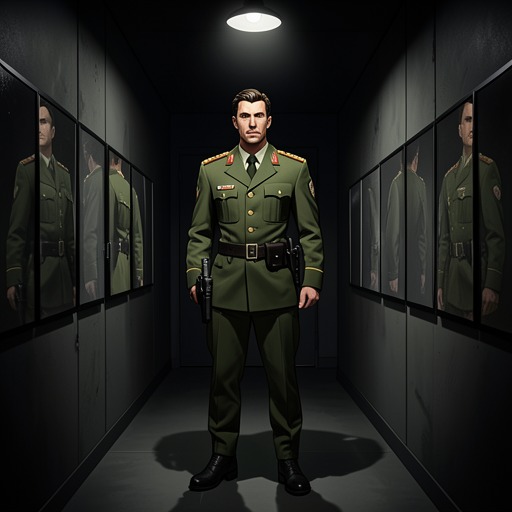
WatchmenDulaq–Odal Duel is the decisive confrontation between Emile Dulaq, Prime Minister of the Acquataine Cluster and leader of the coalition opposing Chancellor Kanus of the Kerak Worlds, and Major Par Odal of Kerak. Fought through the Dueling machine rather than on an ordinary battlefield, it turns a political contest into an ordeal of consciousness: Dulaq must hunt an enemy inside an illusion that feels physically real, while the machine exposes how completely the mind can be captured by its own perceptions.
Political Background and Stakes
The duel occurs within the wider struggle against Chancellor Kanus of the Kerak Worlds. A newsman describes Dulaq as the acknowledged leader of the coalition against Kanus and identifies Odal as his Kerak opponent, making the match both a personal contest and a public political spectacle. Its outcome carries the prestige of rival governments and movements, while the machine’s unusual method gives the confrontation a symbolic form: authority and resistance are tested through the minds of their representatives.
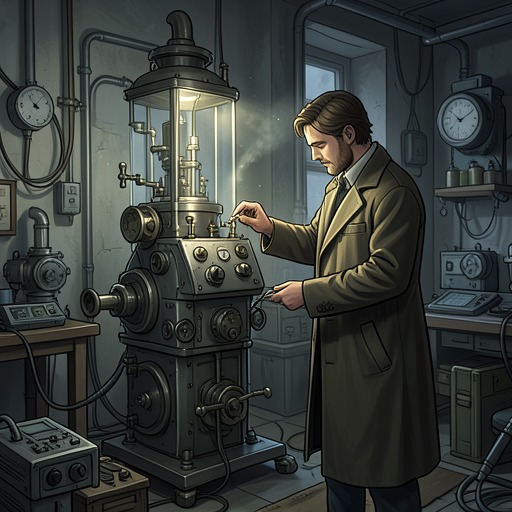
The Dueling machine was invented by Dr. Leoh and stands at the oldest university in the capital city of Acquatainia, in the Acquataine Cluster. The setting gives the duel an institutional and technological character. It is not a spontaneous assassination attempt but a regulated encounter conducted under recognized terms, watched by newsmen and followed by observers who wait for each man’s condition to reveal what has happened.
The First Stage: A Hunt Through Illusion
Dulaq enters the machine with a precise obligation: he must find Odal before sunset and kill him. The terms restrict both men to the pedestrian walks of the commercial quarter of an imagined city, an area Dulaq knows intimately. The familiarity is part of the machine’s danger. The city is populated by crowds, avenues, vehicle thoroughfares, air cars, perfumed trees, and the warmth of a reddish sun; every feature appears convincing enough to compete with Dulaq’s intellectual knowledge that the scene is artificial.
Dulaq searches methodically for the tall, fair-haired, blue-eyed Odal. After only a few minutes he spots him on a lower crosswalk and follows without disturbance, closing the distance from fifty meters to five as they move through the crowd. When Dulaq reaches arm’s length, he draws a stat-wand and touches it to the base of Odal’s skull, beginning to activate the killing bolt. The apparent success is interrupted before the attack can be completed. Later, Dulaq again sees Odal among the homeward-bound crowds, approaches the motionless figure at the railing, and prepares to use the wand, only for the machine to announce, "TIME, GENTLEMEN. TIME IS UP. THE DUEL IS ENDED."
The interruption changes the meaning of the first stage. Dulaq has found his opponent, but finding him is not equivalent to defeating him. The rules, the allotted time, and the machine’s control over the scene prevent physical proximity from becoming victory. The duel therefore shifts from a straightforward search-and-kill exercise into a contest over endurance, timing, and the reliability of perception.
Renewal and the Primitive Arena
Dulaq refuses to withdraw after the first part of the duel. Although he has the option of retiring for the day if Odal agrees, he insists on continuing immediately. His advisers fall silent before his hardened resolve, and the chief meditech returns him to his booth. Odal enters his own booth after glancing toward the Acquataine observers and grinning humorlessly.
Inside the booth, Dulaq sits while meditechs attach neurocontacts to his head and torso. Once they leave, the bare dead-white walls and the viewscreen isolate him from ordinary human support. Shifting colors fill the screen, merge into swirling patterns, and draw him into the machine’s psychonic environment. The transition is presented as gradual and compelling, but its result is total immersion: Dulaq is no longer merely observing a simulation but inhabiting it.
The new landscape is stripped of the city’s distractions. Dulaq stands on an immense barren plain of rocky ground beneath a harsh yellow sky, with no tree, grass, hill, bush, or hiding place anywhere to be seen. At his feet lies the weapon Odal has chosen, a primitive club. Dulaq picks it up with dread and sees a tall, lithe figure approaching across the horizon with an identical club. The technological apparatus has produced an archaic arena in which political rank, urban knowledge, and sophisticated weapons are reduced to bodily courage and survival.
Breakdown of the Duel and Its Aftermath
Observers in the gallery see Odal looking happy, then react with alarm at Dulaq’s appearance. The external witnesses can recognize that something has gone wrong, but they cannot directly share the experience that has caused it. The machine thus creates a split between public spectacle and private consciousness: the audience sees effects, while Dulaq experiences an enclosed reality whose emotional force exceeds its artificial origin.
The consequences become clear when Dulaq is removed from the machine. Dr. Leoh is told that the prime minister remains in a state of catatonic shock, completely withdrawn from the real world and unable to speak, hear, or see. He is described as a living vegetable. The condition is unprecedented in the history of the Dueling machine, and its novelty immediately places responsibility on Dr. Leoh as the inventor. The duel has not ended with a cleanly observable death, but with the destruction of one participant’s ordinary access to reality.
The experience later becomes accessible to Dr. Leoh when he enters the machine and encounters the same commercial-city environment. As the mists clear, he senses Dulaq’s thoughts and recognizes Dulaq’s astonishment at the reality of the illusion. This establishes that the machine can reach beyond Dulaq’s uncommunicating mind and that the duel’s effects are not limited to a physical injury. The machine has sealed Dulaq inside an experience that remains psychologically active even after the external procedure is over.
The Duel as Psychological Violence
When Dr. Leoh advances toward Odal within the machine, the single opponent appears to divide into two, four, and finally six figures. Six identical Odals approach with massive clubs, each a tall, lean, blond assassin bearing a cold smile. The multiplication converts Dulaq’s opponent into an overwhelming image of threat. Whether the figures are an effect of Odal’s power, Dulaq’s terror, or the machine’s interaction with both minds, the scene makes fear itself operative: Dulaq does not merely face a stronger fighter but an enemy that has become impossible to contain within one body.
Dulaq panics and scrambles away, but the figures easily overtake him. A blow sends him sprawling, one of them kicks away his club, and the six attackers stand over him before striking repeatedly. The assault is rendered as sustained pain, blood, screaming agony, and the heavy impact of clubs against flesh and bone until everything goes blank. The violence explains the catatonic aftermath without reducing it to a simple physical defeat. Dulaq’s mind has been forced through an experience of helplessness so complete that ordinary perception cannot resume.
The duel’s decisive reversal is therefore not simply that Dulaq fails to kill Odal. He begins as the pursuer, armed with a stat-wand and confident in his knowledge of the city, but ends as a defenseless figure confronted by multiplied enemies in a landscape without refuge. Its deepest conflict is between the conviction that an illusion can be recognized as an illusion and the fact that recognition does not cancel its power. Dulaq knows the city is man-made and hallucinatory, yet its sounds, odors, warmth, crowds, and dangers command him as reality. The Dueling machine makes that contradiction the battlefield, and Dulaq’s catatonia is the final proof of its force.