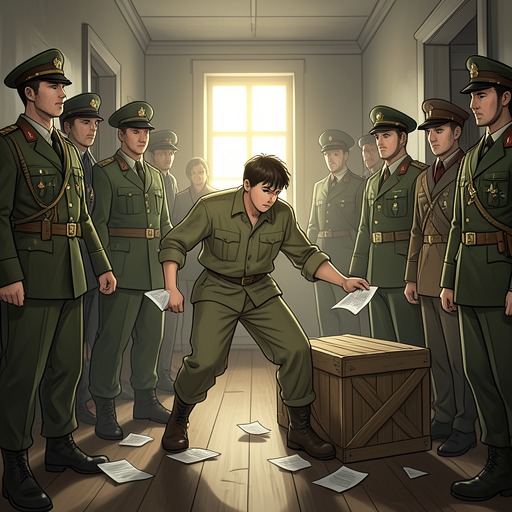
Hector–Odal Duel
WatchmenThe Hector–Odal Duel is the central experimental and strategic trial of the dueling machine’s new possibilities. Staged between Hector and Major Odal under formal rules, it begins as a contest in which Odal appears to possess every conventional advantage: he chooses the first weapon and environment, commands the knowledge of an experienced warrior, and expects a Star Watchman to be more technician than fighter. The duel’s reversals instead demonstrate that the machine projects personality as well as thought, permits distant allies to enter a shared combat environment, and can turn a supposedly harmless simulation into a test of survival, pride, and political control.
Causes and Participants
The duel takes place after Leoh and Hector have spent days testing the machine’s fidelity. Their earlier experiments ranged from hide-and-seek through jungles, cities, glaciers, and interplanetary voids to light duels with foils, pistols, sonic beams, and grenades. The machine did not improve either participant’s knowledge or physical abilities; it projected what each already possessed into a shared dream. Hector was trained with the weapons they tried, while Leoh knew little about fencing and had slower reflexes, yet Leoh won most of their bouts when they confronted one another. That unexpected pattern led Leoh to recognize that the machine projected personality, not merely isolated thoughts or motor skills.
The formal encounter begins when Odal enters the dueling-machine chamber with a small retinue of Kerak seconds. Hector and Leoh are already waiting, accompanied by a broad-faced, iron-gray-haired Star Watch veteran. The chief meditech announces that, because Odal is the challenged party, he has the first choice of weapon and environment and may give any necessary instructions before the contest. Odal treats the ceremony as an opportunity to question Star Watch martial competence, choosing a setting associated with the glory of many warriors. The exchange establishes the duel as both a personal challenge and a public test of the institution Hector represents.
First Environment: The Mounted Battle
Odal chooses a medieval-style meadow in which the opponents appear as mounted warriors armed with great spears. He salutes Hector across the field, then charges. Hector returns the salute but nearly drops his spear, and his mount carries him forward in a jolting gallop while Odal advances with far greater control. The initial arrangement makes the outcome seem predetermined: Odal is at home in the role of the armored warrior, whereas Hector is barely managing the equipment and animal beneath him.
The apparent one-to-one contest changes abruptly when six black figures roar toward Hector. Six Kerak warriors charge abreast with spears aimed at him, while Hector initially struggles even to turn his mount aside. Then additional hoofbeats sound beside him. Through the machine’s transceiver, five Star Watch officers physically sitting aboard a starship orbiting high above the planet enter the imagined battle. Leoh’s gamble has worked: the duel is no longer a simple contest between two bodies, but a networked confrontation in which technology redistributes the advantage. The odds become even, and the Star Watch selects its roughest and most aggressive hand-to-hand fighters on only one day’s notice.
The twelve chargers meet head-on. Spears shatter, men and animals fall, and Hector becomes entangled in the confusion. A sword blow knocks his helmet away after flipping him into a somersault, and he rises with his head spinning just as the fighting stops. The dust reveals that every Kerak fighter except one is down. The surviving black-armored warrior removes his helmet and appears to be Odal, although the indistinguishability of the armored figures makes physical identity uncertain. Hector understands that the decisive identity in the scene is mental: Odal’s mind is the dominant one, regardless of which identical body the machine places before him.
Odal, confronted by equal numbers and the collapse of his numerical advantage, appears uncertain. Hector remains prostrate while a Star Watch fighter attacks the major with a wild swing. Odal pulls back, but the broadsword strikes just above his wrist with enough force to shatter bone. His ax falls, blood passes through his fingers, and he turns away from Hector in bitter resignation. The environment then fades, returning Hector to the booth and converting the apparent battlefield defeat into a machine-mediated result rather than a physical injury in the outside world.
Second Environment: The Airless Planetoid
After the rest period, the contest continues with Hector choosing the environment and weapons. Odal finds himself in darkness wearing a spacesuit, standing on a small, airless planetoid roughly a mile in diameter. The surface has almost no gravity, the boots are magnetized, and jagged rocks stand against a background of stars. The setting strips away the conventions that had favored Odal in the mounted battle. There is no horse to master, no formation to command, and no familiar warrior’s ritual; the combatants must improvise with the terrain and their limited movement.
The duel becomes a contest with stones. Odal retreats toward a boulder while throwing small rocks to occupy Hector, who answers with his own barrage. Odal is struck more than once, including a blow that nearly unbalances him, but he patiently reaches the oblong boulder, about the size of a small chair, and tests whether he can move it. Hector stands on a rise and calmly fires stones at him. Odal’s patience and physical strength briefly restore his advantage: he crouches, grips the boulder, and hurls it with a violent uncoiling motion toward Hector.
The low gravity gives Hector time to leap aside as the boulder drifts past. Odal’s failed attack leaves him exposed. Hector’s stones knock him down, and several strike his helmet and oxygen tank. When Odal rises to throw again, the boulder he launched earlier has completed its slow trajectory and returns from behind him. It smashes into him, lifts him from his feet, and drives him against the projecting rocks. The reversal is especially severe because Odal’s own weapon becomes the instrument of his defeat: the environment preserves the force and direction of his action until it comes back upon him.
Hector finally turns a valve and ignites a rocket, blasting Odal free of the boulder and completely off the planetoid. The explosion also knocks Hector over and sends him rolling across the tiny world. Odal tries to reach the rocket throttle and return to the planetoid, still intent on killing his opponent, but pain and unconsciousness overpower him. The simulated scene ends abruptly, and Odal finds himself back in the booth. He has not killed Hector and has not even defeated him; at the door stands Kor with a grim, angry expression.
Consequences and Development of the Machine
The duel confirms that the machine can reproduce thought patterns with extraordinary fidelity while also exposing a deeper danger. Its environments do not merely decorate combat. They determine which traits become useful, force participants to confront unfamiliar conditions, and reveal that success depends on a combination of learned skill, instinct, temperament, and the ability to improvise. Odal’s mastery of the mounted battlefield cannot prevent defeat once the machine turns the contest into an equal-number engagement, while Hector’s relative awkwardness gives way to survival through adaptation in low gravity.
The duel also demonstrates the machine’s capacity to connect people separated by distance. The five Star Watch officers enter the mounted battle while remaining physically aboard an orbiting starship, making the simulated confrontation a distributed action rather than an encounter limited to those inside the chamber. This development follows the machine’s earlier use with Dulaq, whose stat-wand invention and chosen city environment belong to the same system of projected conflict. In the machine, a weapon can be an invention, a city can be a battlefield, and a remote mind can become an armed participant.
Later safeguards respond directly to the risks made visible by the contest and by Odal’s earlier violence. Leoh adds a circuit that psychonically isolates duelists while the machine operates, preventing Odal or anyone else from contacting the outside world. A second circuit monitors the entire duel so that the chief meditech can review the recording if either side requests an examination of possible rule-breaking. The technology therefore develops from an instrument for settling aggressive feelings without mental or physical harm into a regulated system requiring isolation, surveillance, and adjudication.
Narrative Significance
The Hector–Odal Duel is a reversal of the assumption that warrior prestige alone determines victory. Odal enters with ceremony, trained confidence, and a chosen heroic environment, but the machine repeatedly separates appearance from decisive power. The first battle makes identity unstable among identical black-armored figures and locates dominance in the mind; the second turns Odal’s own boulder against him and leaves him unable to complete the objective he had been ordered to accomplish.
The encounter also prepares the machine’s later transformation from a protected simulation into a technology capable of physical transportation. Leoh and Hector subsequently begin experimenting with teleportation, with Hector moving from one booth to another twelve times on the first day. The average transit takes four picoseconds, and the energy consumed is approximately equivalent to a starship’s drive engines pushing a mass equal to Hector’s weight. The duel is therefore not an isolated sporting episode. It is the proof-of-concept through which projected combat, remote participation, personality transfer, and eventually bodily transit become connected stages in the machine’s development.