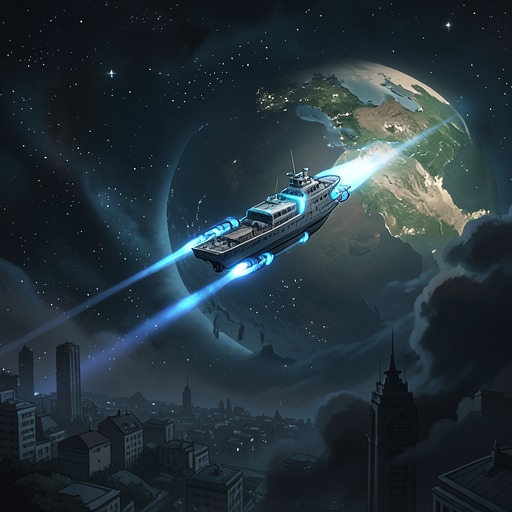
Galactic War
WatchmenThe Galactic War is the decisive historical conflict from which the Terran Empire’s power and political self-conception emerge. The Star Watch fought the successful war against the Masters, and that victory transformed the Terran Confederation—almost against its own will—into the new master of most of the galaxy. The war therefore functions not merely as background history but as the origin myth of an interstellar order whose institutions claim to preserve civilization while inheriting the logic of permanent mobilization.
Origins and Historical Consequences
The Star Watch existed before the Empire, dating back to the era of the Confederation more than a century before the events on Shinar. Its victory over the Masters expanded Terran power across most of the galaxy, creating a territory too vast for the old political arrangement to govern effectively. The difficulties of ruling that expansion led to the creation of the Terran Empire. In this sequence, military success produces imperial administration: the force that won the war becomes the guardian of the routes connecting the new dominion, while the Imperial Marines take responsibility for fighting on planetary surfaces.
The institutional division reveals the war’s lasting material consequence. The Star Watch is not simply a historical army remembered in ceremonies; it remains an interstellar military arm, controlling the space routes through which imperial authority, commerce, and communication move. The Imperial Marines are its subsidiary branch for planet-based fighting. The Galactic War thus survives in the machinery of government, turning a past emergency into a permanent structure of rule.
Memory, Fear, and Imperial Doctrine
The war is also preserved as a warning about the vulnerability of Terran civilization. In a confidential explanation to Sittas, Emil Vorgens recounts the Terrans’ gradual discovery that a race of Terrans had reached into space a million years earlier, encountered a powerful alien civilization, and been devastated in a catastrophic war. The ruins on Mars, the machinery on Titan that produced the Ice Ages, and the remains of the First Empire all become evidence of an older cycle of expansion and destruction. The remote antiquity of that catastrophe makes it more, rather than less, politically useful: it is presented as a civilizational memory whose lesson governs present policy.
Vorgens explains that the Terrans are building their new Empire as solidly as possible because they believe the Others may still exist somewhere among the stars, perhaps even in another galaxy. The earlier near-extermination of the Terrans gives imperial expansion an explicitly defensive rationale: the Empire must be strong enough to exterminate the Others if they return. This reasoning converts fear into doctrine and makes the incorporation of local societies appear necessary to survival. Shinar is consequently described as being required to become a cog in the imperial machine, not because of anything intrinsic to its people, but because the Galactic War has made security an argument for universal political control.
The War’s Echo on Shinar
The war’s memory also complicates the relationship between Terrans and the Komani. Vorgens acknowledges that the entire Komani nation fought alongside the Terrans in the Galactic War, even though a century later the Komani are treated as enemies and their armed movement threatens Shinar. The remembered alliance exposes the instability of imperial categories: a people once accepted as military partners can become “barbarians” in the language of a later campaign. The past therefore gives Vorgens and the Shinarian priest Sittas a basis for imagining reconciliation, even while present violence makes that possibility appear remote.
Vorgens’s role on Shinar is shaped by this contradiction. As an officer of the Star Watch, he has been sent to arrange a truce and end the bloodshed, offering both the Komani and the Shinarian rebels terms that require them to lay down their arms and return home. Yet the same imperial institution that sends him as a truce-bearer threatens to crush resistance if negotiations fail. The Galactic War’s legacy is visible in this double posture: the Star Watch presents itself as the carrier of law, stability, commerce, and order across more than half the galaxy, but its authority ultimately rests on the capacity for overwhelming force.
The danger of renewed escalation is repeatedly framed in relation to the larger galactic order created by the war. Vorgens warns that a defeat of the Mobile Force could trigger a general uprising among the Komani clans and develop into a war of terrible proportions. He argues that a tactical engagement must be judged by its strategic consequences: if the Mobile Force is defeated at the wrong time and place, the result will not remain a local setback. Later, he tells Clanthas that Okatar Kang must win quickly on Shinar; if his advance can be frustrated until reinforcements arrive, the other Komani clans may refuse to join him. The local struggle is therefore treated as a possible ignition point for a conflict extending far beyond the planet.
Violence, Restraint, and the Imperial Order
The Galactic War’s legacy is contrasted with moments in which characters attempt to limit violence rather than reproduce it. When a Komani officer claims Terran prisoners sheltered in a sanctuary for the wounded, Sittas refuses with exceptional vehemence. He insists that the wounded are no longer warriors until they recover and that, within the town, the war does not exist. His religious sanctuary establishes a boundary that neither Okatar Kang nor the Terran commander is allowed to cross. The episode offers a local moral authority distinct from imperial command and Komani military custom, suggesting that order can arise from protection and restraint as well as from conquest.
The later death of Sergeant McIntyre during the operation that kills Okatar Kang shows the continuing human cost of the war system. A trooper reports that Okatar is dead, but that the sergeant has also been killed, with four soldiers dead and one wounded. The victory is immediately presented as both a military success and a personal bereavement. That conjunction resists any clean separation between strategic triumph and suffering: the old war created the institutions that promise galactic security, while every new application of those institutions produces fresh casualties.
Significance in the Novel’s Structure
The Galactic War operates as a historical shadow over every argument about empire, rebellion, and peace. Its victory explains why the Star Watch possesses authority beyond any single planet; its memory of earlier catastrophe explains why the Terran Empire treats expansion as preparation for survival; and its remembered alliance with the Komani exposes the political contingency of friend and enemy. The conflict is over in chronological terms, but it remains active as an institutional inheritance, a justification, and a warning.
Its deepest significance lies in the tension between protection and domination. The Empire claims that only a strong, unified order can prevent another civilizational catastrophe, yet that claim requires Shinar and other worlds to surrender political independence. Vorgens recognizes the necessity of stability but also sees the moral and strategic danger of treating every local conflict as a problem to be crushed. The Galactic War is therefore the novel’s foundational paradox: a victory that saved Terran civilization becomes the precedent for an empire whose attempt to prevent future destruction risks generating new wars of its own.