Shinar Rebellion
WatchmenThe Shinar Rebellion is the central political and military crisis on Shinar: a movement that starts with displaced farmers and demonstrations in Katan, expands through riots, assassination, foreign intervention, and armed resistance, and ultimately exposes the unstable relationship between imperial modernization and the freedom it claims to provide. The rebellion is not a single contest between two uniform sides. Shinarian self-determination, Terran imperial control, and Komani expansion all pursue different futures for the planet, while the conflict’s violence repeatedly transforms the aims of the people who began it.
Causes and Background
The immediate grievance appears when farmers begin arriving in Katan, reporting that Terran authorities have driven them from their land to make room for factories producing synthetic foodstuffs. The displacement strikes at both livelihood and identity. Clanthas, a merchant whose business depends on buying and selling farm produce, appeals to the Terran governor and is told that the nutrient processors are necessary, even vital. The official justification therefore presents the factories as a solution to material scarcity, while the farmers experience them first as confiscation and expulsion.
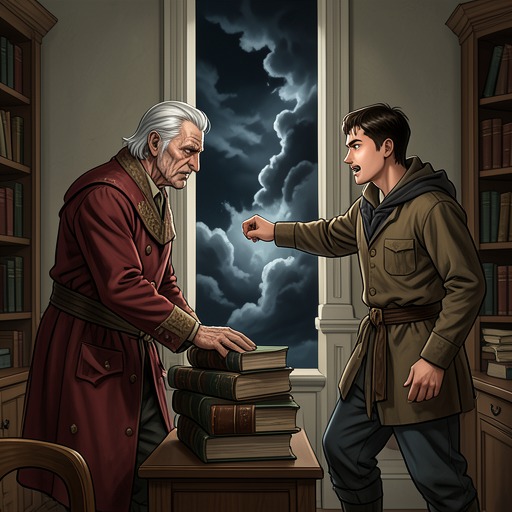
Clanthas refuses to accept the policy quietly. Remembering words attributed to the Terran Geoffrey Knowland, the conqueror who defeated the Masters and established Terran rule over Shinar, he accepts the argument that freedom requires the intelligence and courage to resist enslavement—even when that argument turns against the Terrans themselves. This historical irony gives the rebellion one of its earliest ideological foundations: the imperial tradition supplies language that the colonized can use to challenge the Empire.
The deeper cause is demographic and economic rather than merely procedural. Clanthas explains that the Masters once kept Shinar’s population fixed at roughly 500 million, but after their domination ended the population grew explosively. When Clanthas was Merdon’s age, Shinar had two billion people; it now has three billion. The planet is not yet unable to feed itself, but it must devote nearly all its food production to domestic consumption, leaving little for export. Trade with neighboring worlds is dying, and Shinar is becoming bankrupt. The nutrient processors are therefore only the trigger. Resentment has already accumulated because the population is becoming overcrowded and impoverished under Terran rule.
The rebellion is intensified by a failure of communication and consent. A proclamation claims that the processing plants will greatly increase food production and restore interplanetary trade, but little effort is made to explain the policy to the farmers. They know only that they are being removed from their farms for Terran factories. A reform that might have been presented as economic rescue is thus experienced as an imperial command, and the gap between intended benefit and lived dispossession becomes politically explosive.
From Demonstration to Armed Revolt
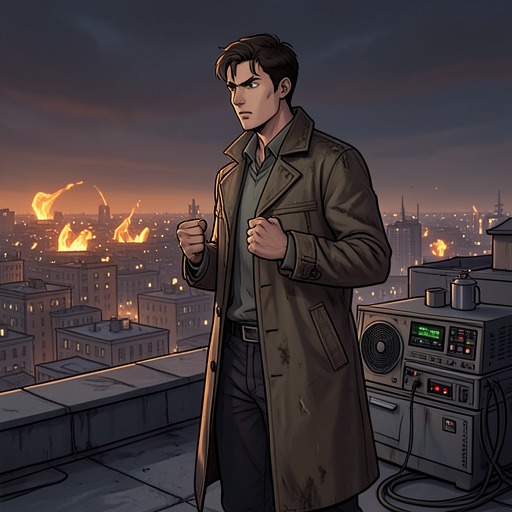
Clanthas organizes the farmers and holds a demonstration in Katan, then arranges similar demonstrations in Shinar’s major cities. The movement rapidly exceeds the control of its organizers. Some of the larger demonstrations become riots; troops are summoned; shots are fired; unarmed civilians are killed. Anger escalates into further violence, the Terran governor is murdered, and the Imperial Marines arrive. Komani warriors then land on Shinar, turning a domestic rebellion into an international and interstellar crisis.
Clanthas becomes the acting leader of his people before he has time to understand how completely the political situation has changed. He faces the Empire, determined to pacify Shinar and restore it as a compliant colony; the Komani, whose warriors have their own plans; and Shinarian hotheads and opportunists whom no civilian leader can fully command. The rebellion’s original demand for protection of farmers therefore becomes entangled with competing military projects. Its leadership is forced to negotiate among forces that share opposition to Terran authority but not a common political destination.
Merdon states the insurgent position plainly: the Komani are in Shinar because Shinarians invited them, and they are considered guests and allies rather than conquerors. The rebels reject the Terran commanders’ belief that Shinarians are merely unwitting pawns in a Komani plan. Their stated strategy is to meet force with force, continuing to fight until the Terrans are no longer willing to pay the price of holding Shinar and leave the planet free. The language of resistance converts an initially civic protest into a war of attrition, with sacrifice treated as the cost of independence.
The rebellion’s armed phase also reveals a conflict within the anti-imperial camp. Okatar Kang presents the struggle as the beginning of a wider Komani reversal of galactic power. He argues that the Terran Empire is already crumbling, that a small Mobile Force will be destroyed, and that other Komani clans will join his once the Terrans have been humbled. His objective is not simply Shinarian freedom but the opportunity to replace Terran supremacy with Komani dominance. Clanthas’s account of invited allies and Okatar’s vision of a galaxy-wide conquest consequently occupy the same battlefield while pointing toward incompatible futures.
Alliances, Technology, and the Wider War
The rebellion is shaped by networks that extend beyond streets and farms. Shinarian rebels recruit the Komani as military allies, while Terran officers attempt to reorganize resistance as a form of Shinarian self-defense directed and supported by the Empire. Vorgens orders supplies from the arsenals of the four cities held by Terran forces to be given to native fighters, despite Brigadier Aikens’s protest. The decision treats local participation as necessary to the war effort and suggests a shift from direct imperial control toward arming and training Shinarian forces.
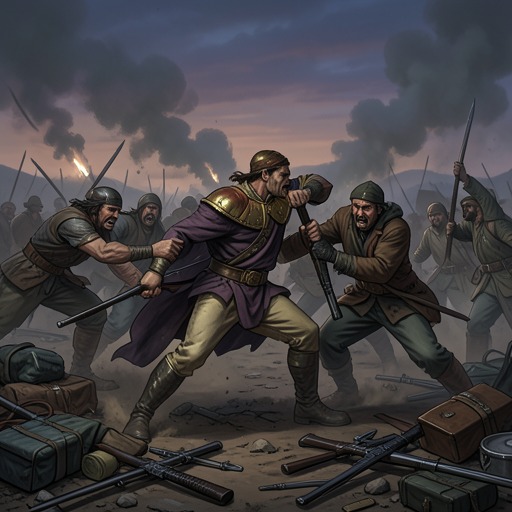
The conflict’s military form is correspondingly dispersed. After a celebration at Katan, six weeks of almost uninterrupted fighting spread across Shinar. Okatar orders systematic raids through districts and towns, taking whatever food, weapons, equipment, and ammunition he wants. Opposing him is Vorgens’s concept of Shinarian self-defense, organized around Terran direction. Rather than massive armies meeting in a single decisive clash, the campaign consists of skirmishes, feints, maneuvers, sudden attacks, and ambushes; few individual actions involve more than a battalion. The rebellion therefore becomes a struggle over mobility, supplies, local allegiance, and endurance as much as over territory.
The broader narrative connects the rebellion to technologies that redistribute power between individuals and institutions. The dueling machine can project thought patterns and personality into a shared environment, allowing conflicts to be fought without physical injury; later safeguards isolate duelists from the outside world and monitor the entire encounter for rule violations. Hector’s teleportation experiments demonstrate that the machine can move a person between booths in an average of four picoseconds, at a power cost roughly equal to a starship’s engines driving a mass equal to his weight. These technological developments belong to the same political world as the rebellion: machines do not merely decorate imperial society but alter who can act, who can be protected, and where responsibility for violence is assigned.
The rebellion also remains haunted by inherited historical memory. Geoffrey Knowland’s conquest of the Masters becomes a source of both imperial legitimacy and anti-imperial rhetoric. Vorgens, by contrast, recounts a family history in which his grandfather recognized that the Terrans were unbeatable and sent his oldest son into the Terran Star Watch to demonstrate that life within the Empire could be better than a hopeless resistance. That son died before the war ended, but the family remained tied to the Star Watch, and Vorgens became a Watchman as well. The opposing memories—resistance as freedom and accommodation as survival—give the conflict a generational depth that exceeds the factory dispute.
Consequences and Political Meaning
The rebellion destroys the possibility of treating Shinar as a passive colony with a manageable administrative problem. Farmers become demonstrators, demonstrators become combatants, and local leaders become negotiators between an empire and an invading ally. The murder of the governor and arrival of the Imperial Marines show how quickly a dispute over land use can collapse the ordinary machinery of colonial government. The landing of the Komani makes the danger still greater, because a movement seeking self-government can become the opening through which another power attempts to seize the galaxy.
Clanthas later insists that the real issue is not simply whether nutrient processors work. The issue is whether a population of three billion, pressed by overcrowding, declining trade, and poverty, can trust an outside authority that makes decisions over its land without giving its people a meaningful explanation or political role. The rebellion thus exposes a paradox of imperial development: the Terrans may possess a technical answer to Shinar’s food problem, but their methods deepen the resentment that makes cooperation possible. Economic modernization under coercion becomes evidence of domination rather than proof of benevolent rule.
The conflict also produces competing versions of legitimate force. Shinarian rebels claim that imperial violence leaves them no alternative but armed resistance. The Terran response seeks to restore order and preserve the Empire, yet Vorgens’s later strategy recognizes that local self-defense and local trust are indispensable. The Komani claim to aid liberation while pursuing a broader conquest. These positions prevent the rebellion from settling into a simple moral division between freedom fighters and tyrants: the same weapon can be described as defense, pacification, alliance, or preparation for conquest according to the political future attached to it.
In narrative terms, the Shinar Rebellion is the event through which private grievances become a planetary test of sovereignty. Its decisive movement is from misrecognized suffering to organized action, then from organized action to consequences no original faction can fully control. The farmers’ removal, the unheeded appeal to the governor, the demonstrations, the killings, the assassination, and the arrival of foreign troops form a chain in which each attempted solution sharpens the next crisis. Shinar’s rebellion therefore matters not only because it produces battles, but because it reveals how an empire can create the resistance that eventually makes its rule untenable.