Brandon Scott
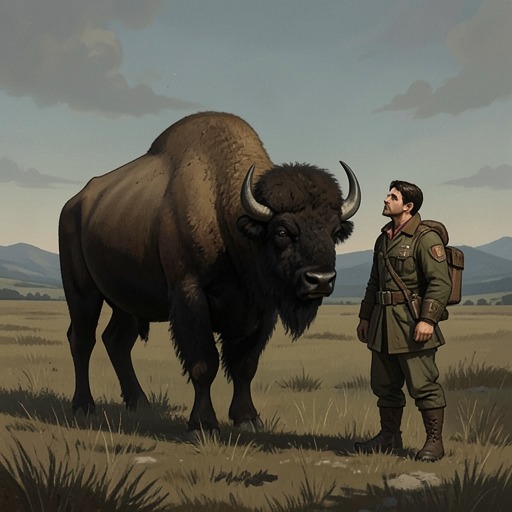
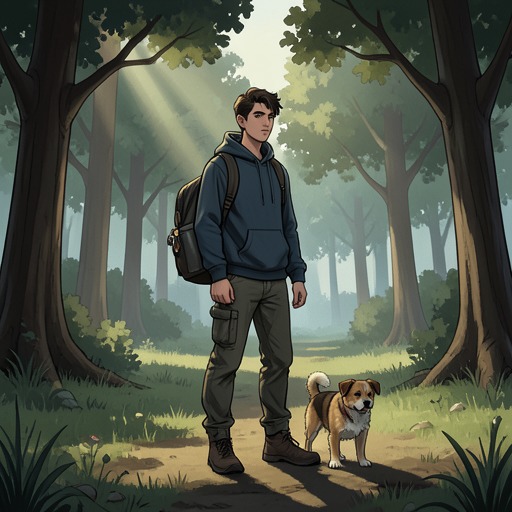
WoodwalkersBrandon Scott is a bison woodwalker whose central conflict is not a lack of power but hesitation about what that power might do. At Clearwater High, he is urged to use his strength, yet repeatedly worries that acting forcefully could break something or injure someone. His progression from standing still to charging in training and in the examination ring makes that conflict visible: confidence grows through action, but control remains essential.
Identity and School Life
Brandon’s second form is a bison, a fact made explicit when the school director calls on him by his full name during the midyear examination and asks him to assume that form. The transformation gives him formidable physical force, but the story defines him as much by his caution about using it as by his size. When Bill Brighteye asks him to attack during a lesson, Brandon remains in place, all four hooves planted, because he fears that he could break something or hurt someone.
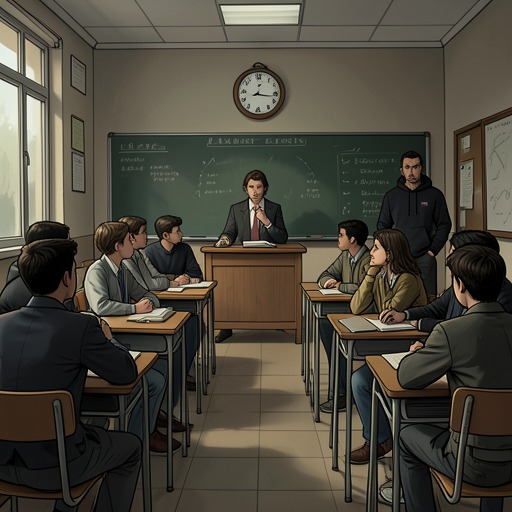
His school life also shows a generous, companionable side. After a demanding lesson, Brandon tosses two kernels of corn into his mouth at a time and welcomes Carag’s request to copy his mathematics and physics homework. Brandon is good at those subjects, while Carag says he struggles with the calculations and does better in history and geography. Brandon’s readiness to help makes their difference in academic strengths an everyday exchange rather than a source of competition.
Strength, Restraint, and Training
Bill Brighteye presses Brandon to act rather than treating his reluctance as a reason to leave him passive. In one exercise, Brighteye shifts naturally into wolf form, positions himself in front of Brandon, and assures him that he can defend himself. He even invites Brandon to knock him down. Brandon still cannot bring himself to do it. The scene distinguishes physical capacity from the willingness to use it: reassurance alone does not immediately overcome his fear of causing harm.
The lesson broadens beyond animal forms. Bill Brighteye has the students practise human fighting techniques so that they can defend themselves in any form, including a mix of karate, taekwondo, and other self-defence methods. The class leaves them gasping and sweaty. Brandon, relieved that the lesson is over, jokes about the next subjects, mathematics and physics; the contrast joins his physical training to the more familiar routine of classes and homework. His strength is not presented as a substitute for learning control or technique.
The Chrysler Incident
A later encounter with a car brings Brandon’s hesitation into a less controlled setting. Holly speaks soothingly, telling him that the car will soon leave and he can return to playing among the fallen trunks. Brandon lowers his head and charges. The driver panics, shifts into reverse, and accelerates, sending the Chrysler zigzagging backward while Brandon watches with blazing eyes. Carag calls out in alarm that Brandon will get into serious trouble.
The episode is a significant reversal from the exercise in which Brandon could not attack even when Bill Brighteye offered himself as a safe target. Here Brandon does act, but the object in front of him is a car and its occupants, not a teacher who has explicitly invited a controlled bout. The charge shows that his force can become dangerous when it escapes the limits of a lesson; Carag’s warning makes the possible consequences plain, though the evidence does not establish what punishment or damage followed. During the later examination, Carag wonders whether the incident and their exercises have helped Brandon, linking the reckless episode to his growing ability to initiate an attack without treating that connection as a simple triumph.
The Midyear Examination
At the midyear examination, the director draws the order of participation from slips of paper in a glass bowl and announces Brandon Scott first. Brandon’s face is visibly pale, and Carag quietly wishes him luck. Being drawn first may spare him the added strain of waiting, but the moment still places his fear in public view: he must take his second form and fight under examination conditions.
When the bout begins, Brandon lowers his head and gallops forward with determination. Carag is so encouraged that he has to stop himself from cheering. Bill Brighteye, in wolf form, is quick and unafraid; he goes for Brandon’s hind legs, attempts an attack on his nose, and circles while growling to force him to turn rapidly. Brandon defends himself well against these approaches. Carag then notices that Bill Brighteye is deliberately putting himself at a disadvantage by moving aside too late. Brandon takes the opening, charges again, and comes close to goring his teacher before the gong ends the bout. His performance demonstrates real progress, but its near-dangerous finish keeps the question of restraint alive.
Character Arc and Narrative Role
Brandon’s scenes form a progression through three different tests of force: he cannot attack a willing teacher in practice, he charges a real car in an uncontrolled burst, and he finally attacks decisively in a supervised examination. The sequence resists a simple story of strength being unlocked. His reluctance has a protective basis—he does not want to hurt anyone—and his later actions show both the value and the risk of overcoming it. The examination provides the clearest evidence of improvement because Brandon responds to a challenge, defends himself against repeated attacks, and makes use of an opening; the near-goring also shows that confidence does not by itself guarantee control.
His quieter traits keep this physical arc grounded in school life. He is academically capable in mathematics and physics, shares that competence with Carag, eats corn after an exhausting class, and takes part in lessons designed to prepare students to defend themselves in different forms. Together, these details make Brandon more than a measure of brute force: he is a considerate classmate learning when action is necessary and how carefully it must be directed.