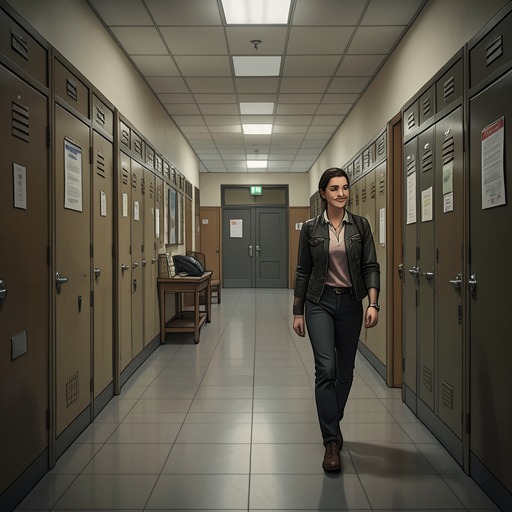
Sherri Rivergirl
WoodwalkersSherri Rivergirl, the cook and nurse at Clearwater High, is one of the school’s most quietly dependable adults. A beaver shapeshifter, she moves between the everyday work of feeding students and the urgent work of treating injuries. Her care is practical rather than ceremonious: she applies foul-smelling disinfectant, gives injections and painkillers, and makes sure an injured student is covered and carried to safety. The same competence is accompanied by small gestures of kindness and a wry sense of humor, making her a sustaining presence in the school community.
Identity and Work
Sherri’s two jobs place her at the center of ordinary student life and its disruptions. As cook, she is present at meals; as nurse, she tends students when physical danger or injury sends them to the infirmary. The story does not give her a separate biography, but repeatedly defines her through this combination of practical responsibilities and close contact with students.
Her beaver form gives a specific, memorable detail to her medical work. When Carag is sent to the infirmary with an injured arm, Sherri pours disinfectant over the wound. The treatment seems to him almost unbearable in its smell, but she assures him it will help while holding her breath. A beaver shapeshifter, she can remain underwater without breathing for as long as a quarter of an hour. The moment turns her animal nature into a matter-of-fact workplace advantage, while her willingness to use the unpleasant disinfectant shows a nurse focused on treatment rather than comfort alone.
Care in School Life
Sherri’s attention to students is not limited to the infirmary. After Holly and Brandon tell the school about Carag’s nighttime exploit, many students want to sit with him at lunch. Sherri greets him with a friendly look and gives him a double portion of chocolate pudding without waiting for him to ask. The extra serving is modest, but it makes her care concrete: she recognizes that Carag has become the focus of the school’s attention and responds with an uncomplicated act of generosity.
Her role also extends into the school’s organized activities. During the midyear examination, she draws the slips for the first test, combat, from a glass bowl and passes them to Lissa Clearwater, who announces the selected student. This small procedural task places Sherri among the adults who keep the examination moving, alongside her more visible work in the kitchen and infirmary. Her presence links the school’s routines to the possibility of physical risk: students are tested in combat, and Sherri is among those available when such risks have consequences.
That connection is evident in a combat lesson involving Dorian and Nell. Carag worries that the encounter might become serious and thinks that Sherri has already had plenty to do in the infirmary lately. She is not the focus of the lesson, but his concern places her care work in the background of student training: the school’s physical challenges are not abstract, because injuries may require her attention afterward.
Treatment and Rescue
Sherri’s care becomes especially urgent after Carag returns injured from the forest. Bridger reaches him beside the road, and Sherri helps wrap him in a blanket and lift him into the back seat of the school van. Someone gives Carag an injection in the arm, while another person identifies the wound as a graze. Sherri’s part is immediate and physical: she helps secure him for the journey to Clearwater High’s infirmary, where he can receive further care.
At his bedside afterward, she continues that work in a manner that is both reassuring and brisk. She approaches with a smile, puts a needle into his arm, strokes his head, and leaves another painkiller on the bedside table. Carag expects an affectionate congratulation for surviving, but Sherri instead tells him to wash his hair as soon as possible. The contrast is characteristic: tenderness is present in her smile and touch, yet it does not prevent her from giving practical instructions or noticing ordinary personal care.
These scenes show her care as a sequence of actions rather than a general expression of concern. She treats the wound, helps move Carag, administers medication, and leaves pain relief within reach. The story gives no account of her formal training or medical decisions; what it does show is the dependable presence of someone who responds to need with specific, useful work.
Alertness and Narrative Role
Sherri is also among the first adults Carag summons when he suspects that a fly near his room is spying on the school. After he calls for Bridger and Sherri, both hurry into the room. When the fly’s voice speaks inside Carag’s head, Sherri responds with a mischievous suggestion: a flyswatter. The director raises an eyebrow but does not contradict her. The moment gives Sherri a dryly comic edge without making light of the danger; her quip arrives as the suspected spy is trapped and the adults move to deal with it.
Across these episodes, Sherri’s significance lies in the way the school’s ordinary care system meets moments of danger. Food, disinfectant, a blanket, an injection, and a painkiller are all small, concrete forms of support, while her humor keeps that support from becoming solemn or distant. She is neither a combat instructor nor the person directing the investigation, but students encounter her at the points where the consequences of school life must be tended. Her warmth is expressed through a second helping of pudding and a hand on an injured student’s head; her reliability appears in the quick assistance that carries Carag back to the infirmary.