Carag
WoodwalkersCarag’s story turns on a choice that cannot be reduced to becoming human or remaining an animal: he must decide how to live as both. Known to the public as the mysterious “Mystery Boy” and to his human schoolmates as Jay, he is a puma Woodwalker who remembers his past clearly. His move from the forest to human society brings danger, friendship, tests of self-control, and finally a refusal to let Andrew Milling define what his identity means.
Identity and Departure
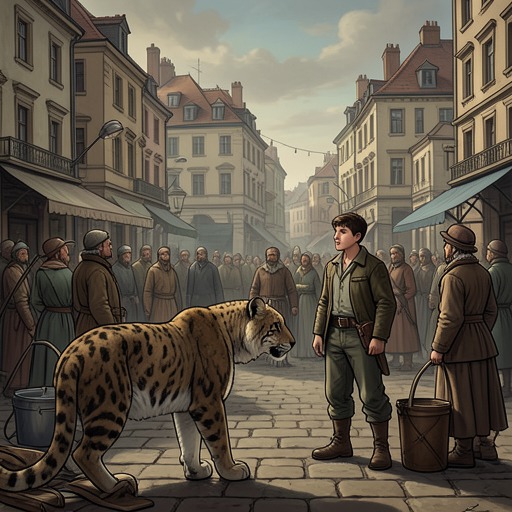
Carag is a puma, also called a mountain lion or cougar, and his animal identity is not a disguise that he can simply set aside. At the beginning of the account, newspaper and television coverage has turned him into the “Mystery Boy,” a boy said to have appeared from the forest with no idea who he is. The public story is wrong: his memory works perfectly, and he remembers the day he was first allowed to approach humans. The gap between what people think they know about him and what he remembers establishes a recurring tension between his public identity and his actual life.
Leaving his birth family is a painful decision rather than a clean escape. Before going, Carag embraces his sister Mia, his father, and his mother. His mother sends him a silent warning to stay careful; his father neither moves nor meets his eyes. Carag tries to read his father’s rejection as temporary anger, but cannot know whether that hope is justified. He takes the clothes he had hidden, descends toward the valley in human form, and walks barefoot through woods and clearings until he reaches the first buildings.
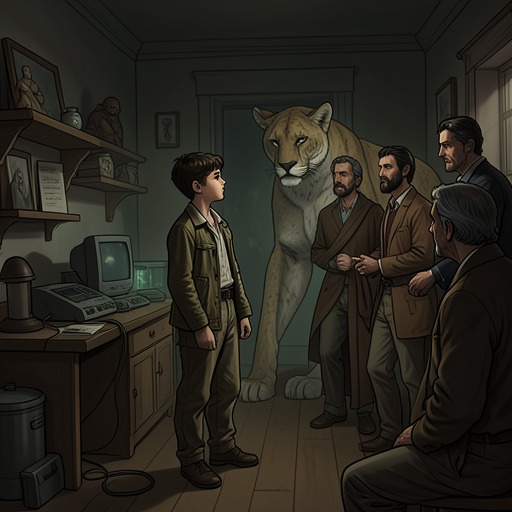
At the police station in Jackson Hole, Carag tells the officers that he does not know who he is or where he came from. The deception works: they take him for a human and provide the documents he needs. He is thirteen, uses the name Jay, and has begun seventh grade at the Junior High School in Jackson Hole only after private lessons at his adoptive family’s home prepared him for the human world. His short, sand-colored hair and green-gold eyes, along with jeans, sneakers, and a backpack, help him pass as an ordinary student; most people have grown accustomed to him, though not everyone has.
Finding a Place at School
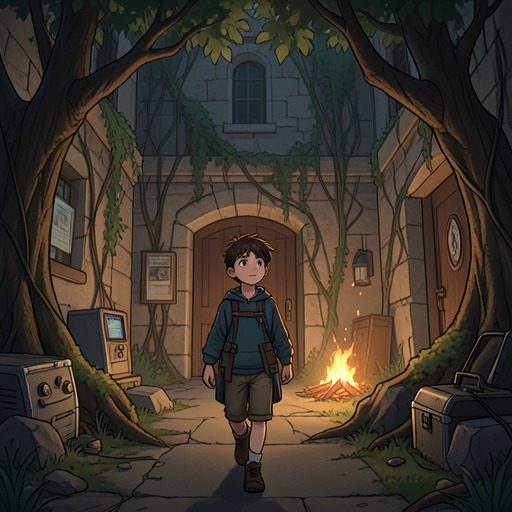
Carag’s arrival at Clearwater High offers a different kind of passage into human society: the school is a community of Woodwalkers, but belonging there requires learning rules that regulate the meeting of animal instincts and shared life. A scholarship makes attendance possible without cost to his adoptive family. Anna Ralston and Donald Ralston initially expect to take him themselves, but Lissa Clearwater arranges for a school driver to collect him on Monday morning. Before leaving, Carag packs a carved horn necklace made by his mother. She had gone into town twice a year, despite her fear of humans, to sell such objects and replenish the family’s hidden money. The necklace lets him carry a physical reminder of a family he does not know whether he will see again.
The school’s rules become concrete on Carag’s first day. When Nimble invokes Clearwater High Rule 3: Predators must not mistreat prey, Jeffrey answers with contempt and bares his fangs after partially transforming. Carag recognizes the wolves from encounters in which a wolf pack drove his family from food and chased them for amusement. The sight rekindles the anger he associates with Marlon’s bullying, and he is close to responding physically. Bridger stops the confrontation and reminds him that students may transform only with a teacher’s permission and that student fights are permitted only in class. Carag has not yet read the regulations Lissa Clearwater gave him; his first collision with the rules shows how school discipline can restrain predator-prey intimidation, while also requiring him to control his own reflexes.
Human and Woodwalker worlds also collide around the Ralstons. When Donald encounters a bison in the school, he questions whether Jay can be safe there. Carag tries to reassure him, while Lissa Clearwater calmly explains that the school sometimes uses live animals for biology lessons. Leroy, a skunk hiding nearby to do homework, is terrified by the humans and has to be reassured as the Ralstons are ushered away. The scene exposes how easily a Woodwalker’s ordinary school life can look alarming to a human visitor—and how fragile the secrecy surrounding that life can be.
Learning Control and Facing Danger
Carag’s education is practical as well as institutional. During a lesson with Bill Brighteye, he changes into his puma form despite an injured forepaw that has not fully healed and cannot take part in the physical exercise. Brighteye instead teaches him how to hunt a porcupine without ending up with a muzzle full of quills. Carag handles the task easily, but notices Lou watching him with her large, dark wapiti eyes and feels guilty that his predator form may make him seem threatening. When he sees Nell in her tiny mouse form, he licks her affectionately rather than treating her as prey; she promptly returns to human form and punches him on the nose. The comic reversal makes his restraint visible as an action, not merely a rule he has memorized.
The midyear exam tests whether Carag can call on his animal form under pressure. The new students assemble in a large hall with a pointed timber-beam ceiling, glass panels that admit light while preventing views from outside, and a floor covered in dry earth. Older students watch from cushions around the perimeter, while Lissa Clearwater and the teachers occupy the front row. When Carag is called, he uses the transformation word Timbuctù and imagines his puma body until the change takes hold. He is among the few students required to face Bill Brighteye himself, a large black wolf with yellow eyes. The stakes are personal: failure would mean leaving his class and starting again, while disappointing the people who have given him opportunities. The examination thus measures more than technique; it places his hard-won membership in the school under pressure.
A later danger strips away the importance of school standing. Carag remembers from a lesson that puma hunting season lasts from October through March and that killing a puma requires only an easily obtained license. Far from the school’s safe territory and possibly beyond Grand Teton National Park, he hears a pack of hunting dogs closing in. With no clothes to change into human form, he must survive as a puma. He doubles back so that his hind paws follow the prints of his forepaws, then breaks the trail by leaping onto a tree and across to a rock. Reaching a river, he enters the freezing water because it can carry his scent away and make the dogs’ trail harder to follow. The sequence turns lessons in tracking and survival into immediate, bodily knowledge: what he has learned at school can mean the difference between being found and escaping.
Milling’s Offer and Carag’s Choice
Andrew Milling’s interest in Carag begins with a mistaken reading. After an article reports a mountain lion appearing at a campground, Milling suspects that the animal is a Woodwalker who might share his view of humans. He identifies Carag and contacts him on that assumption. Carag understands that Milling’s hostility is rooted in harm associated with humans, but the proposed bond rests on a belief that Carag himself does not share. Being a puma does not make him an enemy of humanity.
When Milling presses for an answer, Carag refuses to become his ally. The silence after his decision and Milling’s cold warning make the consequences plain: Carag has turned down a powerful and dangerous figure, not merely declined a friendship. Yet the refusal is also an assertion of independent judgment. The public has misrepresented him as a boy without a past; Milling has mistaken his animal identity for proof of a shared political purpose. Carag rejects both imposed accounts.
Change and Narrative Role
At the close, Carag acknowledges that life is imperfect and that he now has a genuinely dangerous enemy, but he is happy because he believes he has done the right thing and has learned a great deal in recent weeks. His certainty is no longer dependent on making himself human. He accepts that he is not, and will never be, human, while finding pleasure rather than regret in being a Woodwalker. That ending does not erase his separation from Mia and his parents or settle what will happen with Milling. Instead, it gives Carag a clearer basis from which to face those unresolved dangers: he can belong to human and Woodwalker worlds without pretending that either one cancels the other.