Mia
WoodwalkersMia is Carag’s older sister and a puma whose attachment to her animal life stands in striking contrast to his desire to enter the human world. In their brief shared scenes, she is stubborn, physically assured in her puma form, and drawn to the familiar rhythms of the mountains; after the siblings are separated, Carag’s memories of her become one of his clearest measures of what he has lost.
Identity and Early Life
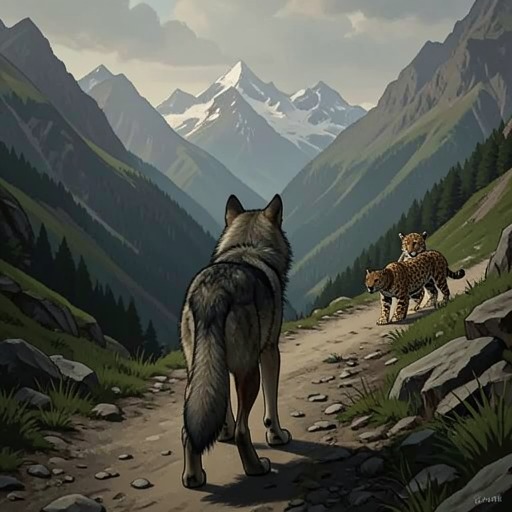
Mia belongs to Carag’s puma family, and the two siblings begin the story close enough to travel together through a spruce forest with their mother. The outing is a rare excursion toward the human city. Carag is so excited that he repeatedly asks, mind to mind, whether the journey is really happening; his mother finally warns that another question will mean turning back. Mia’s place in the family is conveyed less through explanation than through this shared movement: she is the older sister accompanying him and their mother on an adventure beyond their usual surroundings.
The siblings’ different responses to transformation emerge as their mother demonstrates her human form and instructs them to follow. Mia shakes her head stubbornly, an incongruous gesture from a puma that makes her reluctance visible without requiring words. Carag changes quickly and delights in standing barefoot among the pine needles, testing his human footsteps and the use of his hands. He urges Mia to try, warning that otherwise she cannot come with them. His impatience reflects the excitement of the expedition, but the moment also establishes a difference between them: he wants to cross into human experience, while she does not readily leave her puma form behind.
The City Excursion
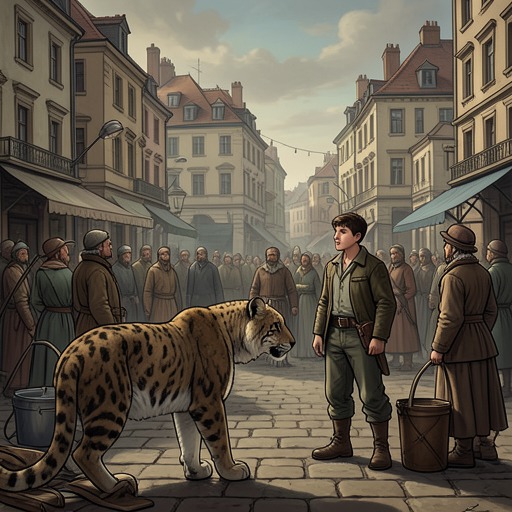
Mia does eventually make the effort to appear human, but the change is unstable. Her canines begin to shrink, then the smell of meat draws her attention down the corridor. At the butcher’s counter, she abruptly returns to puma form and bounds toward the meat, catching a steak on each claw. Her response turns the family’s attempted passage through human space into a public disturbance: customers flee, shout, and raise the flat objects in their hands toward her, while Carag struggles to remain human and takes the objects away from them.
The episode gives Mia an independent physical presence rather than treating her simply as the object of Carag’s concern. Her attention fixes on immediate prey, and she pursues it with the speed and balance of a puma. She even tries to carry her catch to a cereal display, but the smooth shelving offers no grip. It rocks under her weight; she slides down and disappears beneath falling cardboard boxes, with only her lashing tail visible. The comedy of the mishap does not erase the danger around her. The fleeing customers and her mother’s attempt to catch up make clear how poorly her animal instincts and the crowded human setting fit together. Mia’s return to puma form is not presented as a considered choice so much as an abrupt pull back toward the body and appetites she knows.
Separation from Carag
The more consequential division between the siblings comes when Carag considers choosing a human second form and going to live among people. Their mother warns that humans do not tolerate predators and that, if Carag makes that choice, the family will no longer be able to remain close to him; they may not see him for a long time. Carag anxiously suggests that his family could transform from time to time too, but neither Mia nor their mother answers with agreement. Their silence, and their mother’s reluctance to trust humans or transform, expose the practical and emotional distance his decision would create.
Mia responds by pressing her soft head against Carag’s bare leg. She looks confused and unhappy and appeals to the life they already share in the mountains. The gesture makes the disagreement intimate: she does not argue about the abstract advantages of either form but reaches for her brother through familiar contact and asks, in effect, whether he can truly want to leave. Carag knows that he likes the mountains, yet feels that being only a puma is not enough for him. His distress and tears accompany the recognition that his desire cannot be explained away, while his mother’s warning makes the cost of pursuing it plain. Mia’s attachment to him is therefore part of the scene’s stakes, even though she cannot resolve the conflict between his longing for another life and the family’s inability to follow.
Memory and Continuing Significance
After leaving his family, Carag repeatedly thinks of Mia as safe somewhere in the Rocky Mountains. His reassurance does not remove his questions about why she and their parents have not contacted him, or his fear that they may have left the region to forget the son they rejected. When the memory returns, it brings not only anxiety but an acute sense of absence: his family, and Mia in particular, are part of the life he misses while trying to build another one.
That bond surfaces even during Carag’s transformation exercises with James Bridger. Asked to choose a personal magic word to help control his changes, Carag first thinks of Mia and recognizes how much she would laugh at the idea. He briefly chooses her name, then realizes that saying it could trigger a transformation when he sees her again and leave her unable to recognize him. Bridger’s practical warning turns Carag’s longing into a small, concrete problem of recognition: the name that could summon his sister in memory might interfere with their reunion. Carag instead settles on “Timbuctù,” and begins to use it in practice. Mia is thus present in the method by which he works to master his changing body, even when he chooses not to use her name.
Later, the possibility of learning where his family is intensifies Carag’s homesickness. He yearns for Mia alongside his parents and the mountains, remembering shared games in the undergrowth, resting together in a sheltered nest of dry grass, and the excitement of a hunt pursued as a family. These memories give Mia a life beyond the city mishap and the moment of separation: she belongs to a reciprocal world of play, shelter, and shared activity. The narrative does not establish what becomes of her after Carag leaves, but it shows that she remains central to his idea of home and to the family connection he hopes, fears, and longs to recover.