Lissa Clearwater
WoodwalkersLissa Clearwater is a biologist, the founder and director of Clearwater High, and one of the adults responsible for preparing young woodwalkers to live in both human and animal worlds. She recognizes Carag as a fellow shapeshifter and opens a path from his isolation into a community with its own teaching, rules, and tests. Her leadership is not untroubled: her reliance on Andrew Milling’s support makes her initially dismiss Carag’s warning about him, but her later handling of Carag’s crisis shows a readiness to weigh evidence and revise a consequential decision.
Identity and Founding Clearwater High
Lissa first enters Carag’s story as a visiting lecturer at his old school. A week earlier, she had come to speak about eagles, the subject of her biological research, and had noticed him there. When they meet again, her white hair, proud face, curved nose, and slender but imposing figure give Carag enough clues to identify her animal form as a bald eagle. She confirms the recognition by introducing herself. The encounter is strikingly unlike an ordinary human introduction: Lissa does not offer her hand, an etiquette Carag dislikes, and her attention quickly turns from formalities to the possibility that he may need help.
Three years before their meeting, Lissa had founded Clearwater High as a special boarding school for young people who wanted to learn to live more easily in both worlds. She explains that the school brings together woodwalkers of different kinds, although it has not previously enrolled a mountain lion. She also describes a second school in Florida, run by her elder son Jack, for shapeshifters who need an aquatic environment. Her account makes clear that Clearwater High belongs to a wider, deliberately organized response to the needs of a rare population, rather than being simply a conventional school with unusual students.
Lissa’s work as a biologist also shapes the school’s teaching. When Carag’s foster family discovers a bison inside the school, Donald worries that Carag cannot be safe there. Lissa remains composed and explains the animal’s presence as part of biology lessons that sometimes use live animals. The explanation serves as a cover for the family’s encounter with the woodwalker community, while also reflecting her stated interest in giving students contact with nature. Her handling of the moment is practical: she redirects the visitors toward the refectory and ice cream before the discovery can expose more than it should.
Recognizing and Enrolling Carag
Lissa’s recognition gives Carag a way out of the human life he has been struggling to inhabit. He has been hiding his origin and cannot explain his distress to her at first, but she does not press him when he withholds the truth. Instead, she tells him about Clearwater High and asks whether it might interest him. Her invitation makes the school a concrete possibility for a boy who has been feeling that he is only a mountain lion and has no easy way back to the mountains.
The decision to enroll him moves quickly. Carag’s foster father, Donald, calls the school after learning that Andrew Milling recommended it; Clearwater High offers Carag a scholarship, so his attendance will cost the family nothing. The next morning, the family has agreed that he can attend, and Lissa arranges for a school driver to collect him on Monday. Her intervention thus has consequences beyond the first meeting: it connects Carag to a new home and education without requiring his foster family to pay tuition. As he packs, he includes a carved-horn necklace made by his mother, a reminder that entering Lissa’s school does not erase the family he is leaving behind.
At Clearwater High, Lissa remains a visible point of welcome and authority. She is waiting outside an unclaimed dormitory room when Carag is shown to the place that will become his, alongside a possible roommate. She also meets his foster family when they visit. Her warm but firm manner lets her manage the school’s first impressions while protecting the separation between its hidden population and ordinary humans. The need to preserve that boundary is not abstract: during the visit, Carag is anxious that evidence of shapeshifters may be discovered, and Lissa steps in before the situation can escalate.
Rules, Teaching, and Authority
Lissa’s leadership is exercised through a school with explicit limits on how students may treat one another and use their animal forms. The rules prohibit predators from looking down on or harming prey, restrict transformations during school hours unless a teacher gives permission, and allow student fights only during the designated combat-and-survival lesson. When Carag nearly fights Jeffrey’s group after seeing Jeffrey intimidate Nimble, teacher James Bridger intervenes and reminds Carag of the transformation and fighting rules. The episode gives the school’s regulations practical force: recognizing injustice does not exempt a student from the rules governing how to respond to it.
Lissa also teaches biology herself. After a lesson, Carag considers telling her that Andrew Milling is dangerous and plans to harm humans. He believes her intelligence could help her understand the threat. But when he attempts to raise the matter, Lissa asks whether he has concrete proof. Carag admits that he does not. She warns him against spreading the allegation, describing Milling as powerful and as someone who uses that power for good. She points to his funding of the school, including the donations that made its western wing possible. Her response is not simply a refusal to listen: it is grounded in the evidence Carag lacks and in her direct knowledge of what Milling’s money has enabled. Yet the scene also reveals the cost of that dependence. The benefactor whose support has helped build the school is precisely the person Carag fears, and Lissa’s confidence in his public generosity leaves her unable, at this point, to act on the warning.
The school’s authority also appears in its examination system. Lissa presides over the drawing of lots for the fighting test in the midyear exams, calling students in turn to assume their second forms. The exam is part of a larger standard of progress: students who pass can join the later learning trips, while those who fail must repeat their first three months. Through these procedures, Lissa’s school makes transformation and combat skills matters of demonstrated competence, not merely identity.
Judgment, Crisis, and Reconsideration
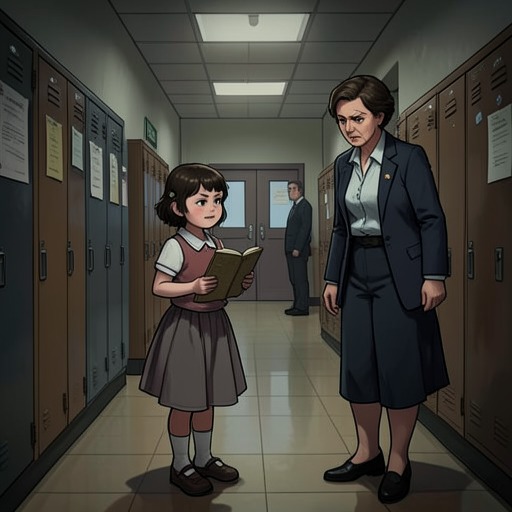
Lissa’s disciplinary role becomes especially visible when she summons Carag, Holly, and Brandon from class. Jeffrey and the other wolves appear pleased as the three leave, and Carag realizes that he and his friends have fallen into a trap connected to a threatened act of revenge. In her office, Lissa hears Brandon acknowledge that anger sometimes gets the better of him. She knows that his loss of control has already cost the school replacement furniture, but she frames the more serious danger in terms of the wider community: provoking human hostility could make woodwalkers pay with their lives. She gives Carag and Brandon a reprimand and tells Carag to consider whether his actions will actually achieve their purpose before acting.
Her warning connects school discipline to the secrecy on which the community’s safety depends. Lissa does not treat the students’ conduct as a private matter of manners; she presents its possible consequences as collective and severe. At the same time, she sets academic expectations, reminding the students that the December midyear exams will determine who can take part in learning trips. Her leadership combines protection, correction, and the demand that students learn to govern themselves.
Carag’s later flight from hunters puts that judgment to a more difficult test. During the chase, he remembers that puma hunting season runs from October through March and that a hunter needs only a readily obtained license to kill one. Far from the school’s safe territory and perhaps beyond Grand Teton National Park, he evades the dogs by doubling back over his own tracks, then leaving the trail through a tree and onto a rock before entering the freezing river to lose his scent. These choices save him, though he is injured. Once he returns, Lissa tells him that a dozen students and teachers had gone out searching for him. After hearing how he survived, she recognizes that his actions in the emergency were largely right, while noting that he should have climbed down from the tree sooner.
The incident also threatens Carag’s place in the school: he initially expects that he has failed the midyear exam. When Lissa asks whether that is why he ran away, he makes clear that it was not. She agrees to cancel the examination and asks him to explain what happened, then consults the other teachers. Their eventual decision is to reconsider his result. Although he was already injured, Carag had managed to transform again at a moment of extreme danger, and Lissa tells him that the faculty considers this a notable achievement. He is promoted to the midyear exam. Her decision does not erase the danger or turn the failed test into an ordinary pass; it recognizes a capacity the examination was meant to assess, revealed under conditions far more severe than the formal test.
Narrative Role and Significance
Lissa stands at the crossing point between the school’s educational ideals and its material vulnerabilities. She founded an institution where shapeshifters can learn to inhabit both forms, protects its students through rules and secrecy, and personally helps Carag enter and remain in that community. But the school’s dependence on Milling’s donations complicates her ability to recognize the danger he poses. The contrast between her dismissal of an unsubstantiated accusation and her later willingness to review Carag’s exam result makes her neither simply unquestioning nor all-knowing: she asks for evidence, acts on the information available to her, and can change course when new evidence becomes concrete.
For Carag, Lissa is consequently both a gateway and an authority to be challenged. She offers him a place when he has few ways to reconcile his identities, but her faith in Milling initially blocks the warning he most wants her to hear. Later, when Carag survives a real threat through skills acquired in and around the school, she helps ensure that a rigid examination outcome does not outweigh demonstrated growth. Through Lissa, Clearwater High’s rules become more than regulations: they are attempts to preserve a community whose students must learn not only what they are, but how their decisions affect the safety and future of others.