Viola
WoodwalkersViola is a goat Woodwalker at Clearwater High, where her appearances show how the school’s ideals of respect take shape in ordinary, sometimes awkward interactions. Carag first recoils from her animal scent, but later sees her helping a struggling classmate, competing in an examination, and joining in the school’s winter play. She is not defined by a single dramatic conflict: her character emerges through repeated moments in which difference is noticed, accommodated, and put to the test.
Identity and First Encounters
Viola is introduced to Carag through his senses before he knows her name. In class, one of the two available seats is beside a girl in a brightly colored sundress. She smiles at him, but he catches the unmistakable smell of a goat beneath a heavy layer of sweet deodorant and perfume. Rather than sit beside her, he moves to the other open seat, next to Leroy. Carag realizes almost immediately that his retreat was rude, but feels unable to spend the lesson with a clothespin on his nose. The encounter exposes the distance between the school’s principle of respecting differences and the instinctive discomfort Carag has not yet learned to manage.
James Bridger makes that principle explicit by asking Viola to recite Clearwater High Rule 1. She answers that everyone should respect other people’s particularities. The lesson is pointed: Viola is asked to voice a standard that Carag has just failed to uphold toward her. His regret does not erase his reaction, but it makes the rule more than a formula; it gives him a specific incident to recognize in himself.
Kindness and Social Connections
During a strenuous group run, Viola is struggling near the end of the course. Lou could run faster and appears not to be tired, yet she stays beside Viola and repeatedly encourages her to keep going. Carag notices this choice while he is exhausted himself, and it changes what he sees in Lou: her kindness matters more to him than her attractiveness. Viola’s role in the moment is quiet but consequential. Her difficulty gives Lou an opportunity to show care through action, and Carag’s attention to that care helps shape his developing feelings for her.
The scene also places Viola among classmates with different physical capacities. Jeffrey and his wolf pack have reached the finish well ahead, while Holly is red-faced and close to collapsing. Viola’s slower progress is not treated as a reason to leave her behind by Lou. The encouragement is practical and repeated, making the group’s shared effort visible rather than reducing the run to a contest of speed.
Lessons, Questions, and the School’s Rules
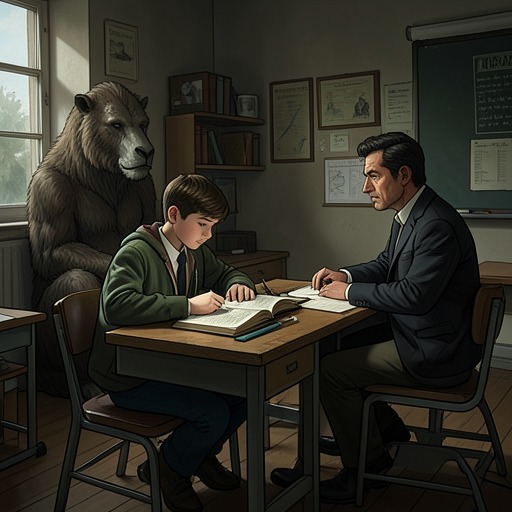
Viola appears again as a participant in classroom discussion. When James Bridger recounts being caught in a trap with a foreleg pinned and asks what the class would have done, Viola responds by questioning why help could not simply be called. She wonders whether he had hidden his phone nearby. Bridger explains that he had left his belongings in a cache a couple of kilometers away. Viola’s questions approach the predicament through an ordinary, human solution, while the episode makes clear that the circumstances of Woodwalker life can put such solutions out of reach.
Her presence in these lessons complements her recitation of the school’s respect rule. At Clearwater High, coexistence is not left to goodwill alone: students are taught regulations for conduct, and teachers direct discussion of the dangers Woodwalkers face. Viola contributes by articulating a fairness principle in one class and pressing for a practical means of assistance in another. The evidence does not show her as a rule enforcer; instead, it presents her as a student who can voice the school’s expectations and question a situation that seems needlessly perilous.
Competition and Play
At the midyear examination, Viola faces Lou in a human-form wrestling match. Lou loses, but her defense earns her a passing grade of six. The result establishes Viola as a capable competitor without turning the encounter into a personal feud: the account records the outcome and Lou’s credit for defending herself, but gives no indication that Viola’s victory damages their relationship.
Viola’s school life also includes exuberant play. During a snowball fight outside Clearwater High, she remains in human form and tries to rub snow onto Tikaani’s muzzle. Shadow and Wing swoop above her, throwing snowballs with their claws, and she becomes a target in the same lively exchange as the other students. Lou rolls the tiny Nell into a snowball and gently tosses her toward Leroy, while Berta shields Dorian from Holly’s throws. The scene places Viola inside a communal game whose participants use their different bodies and abilities for fun rather than intimidation.
Later, when Cliff is struck in the face by Leroy’s defensive spray, Viola exclaims and dodges him, telling him to stay away. The reaction is immediate and physical: Cliff is blinded and disoriented, while the students around him keep their distance. Her response belongs to the messy aftermath of the incident, not to a broader confrontation with Cliff, and the student representative ends the party by ordering him to leave and take a shower.
Narrative Significance
Viola’s characterization is built from contrasts between discomfort and inclusion, effort and competition, and danger and play. Carag’s first response to her scent makes respect an embodied challenge rather than an abstract maxim; her recital of Rule 1 turns that embarrassment into a lesson he must confront. Elsewhere, her struggle on the run reveals Lou’s generosity, her questions in class expose the practical risks behind a teacher’s trap story, and her examination match places her among students whose abilities are formally tested. These glimpses make Viola a part of Clearwater High’s social fabric: present not as the center of its conflicts, but as a distinct classmate whose ordinary encounters help show how its community works.