Cookie
WoodwalkersCookie is an opossum woodwalker at Clearwater High, where her animal instincts repeatedly surface in the middle of human-shaped routines. Her most distinctive trait is also a practical defense: when frightened, she can go limp and play dead. The response first appears as a lesson in animal behavior, then becomes a comic misunderstanding during an exam and the decisive beat in a short fight with Holly. Across these scenes, Cookie is not simply a joke about nervousness; the same species behavior can look like knowledge, panic, or defeat depending on the situation.
Identity and Species
Cookie comes from a swamp, and she left many brothers and sisters there because they preferred to live as opossums. The detail places her among woodwalkers whose relationship to their animal form is not identical to that of their relatives: her siblings chose the opossum life, while Cookie attends school among human-presenting classmates. The account does not explain her family’s circumstances further, but it establishes a background in which animal identity is part of family life rather than a classroom curiosity alone.
At school, Cookie is identified as an opossum and participates in lessons in human form. Her species remains relevant even when she is taking notes, checking email, or sitting for exams. The contrast is especially clear when a familiar opossum response appears in the middle of a human academic setting: a frightened student’s collapse is initially mistaken for a medical emergency, until another student recognizes it as behavior associated with her species.
Lessons and Everyday School Life
In Sarah Calloway’s Humanology lesson on signs that a human is in a bad mood, Cookie guesses that a person might move their ears backward. Calloway says that is almost never the case and invites other answers. The exchange places Cookie among classmates learning to read human behavior, but her guess also carries the lesson’s central difficulty: signals familiar in one animal context do not necessarily translate to humans. When the teacher adds that people displaying certain behaviors are dangerous, Cookie opens her eyes wide and asks whether they are dangerous. Calloway answers with a joke about drinking and shopping. Cookie’s alarm makes the human-focused lesson feel less like abstract study than practical preparation for interpreting unfamiliar conduct.
Cookie’s ordinary routines are more understated. When the Ralstons visit Clearwater High, she is checking email in the refectory while classmates occupy themselves with books, conversation, games, and writing on the board. That quiet, recognizably student activity contrasts with the species-specific episodes elsewhere in her school day. Cookie belongs to the school’s shared social world, even as her animal nature can abruptly make her behavior legible in a different way.
A less polished moment occurs during a family visit to the school. Melody steps on something opossums leave behind when no bathroom is available, and the narration identifies it as Cookie’s. Anna cleans Melody’s shoe with a tissue. The incident gives Cookie’s animal life a mundane, bodily consequence rather than a dramatic transformation: her species is present not only in lessons or defensive reflexes, but in an awkward disruption of the school tour.
Fear, Reflex, and the Exam Room
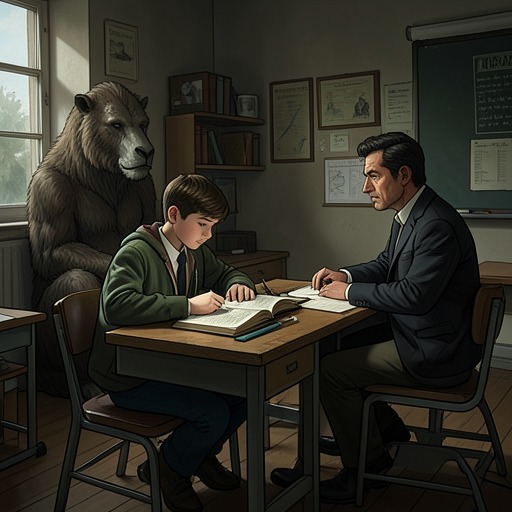
Cookie’s fear becomes unmistakable during a theoretical test. When the teacher announces the exam, she squeals, falls backward from her chair, and lies motionless with her eyes wide and her paws raised. Carag smells her and thinks she is dying, then believes Sherri Rivergirl must be called. Leroy corrects him: Cookie is only pretending to be dead, an opossum reflex she uses whenever she is afraid. The moment turns a classroom assessment into a collision between two interpretations of the same body. To Carag, the stillness signals imminent danger; to Leroy, it is an expected defensive response. The test has not even begun, yet Cookie’s animal adaptation has already taken over the scene.
Her performance is not evidence that she fails the examination. In the later results, Cookie earns a six in Humanology, just enough to pass. Asked what Christmas is, she explains it as a celebration in which humans worship a conifer. Sarah Calloway considers the answer not entirely wrong. The result offers a small counterpoint to Cookie’s earlier panic: she may be unsettled by an exam, but she can still supply an answer that reflects her outsider’s observation of human customs and earn a passing mark.
Combat and Narrative Role
Cookie’s defensive reflex also shapes her brief encounter with Holly in a practical combat examination. Holly, in squirrel form, faces Cookie, an opossum, and the fight is over almost immediately: Cookie is lying on the ground pretending to be dead. Holly asks cheerfully whether that means she has won, then balances on Cookie’s back. Lissa Clearwater sighs and gives Cookie another attempt in human form, while Holly is reassigned to fight Nimble. Cookie’s reflex has a different consequence here than in the exam room: it is no longer misread as a medical crisis, but it brings the animal-form bout to an abrupt end and changes the examination’s course.
Taken together, these scenes give Cookie a compact but recurring role in the school’s portrayal of woodwalker life. Her species-specific behavior is not kept outside the classroom: it interrupts a test, determines the outcome of a fight, and becomes part of what other students must learn to recognize. At the same time, Cookie is shown in the ordinary rhythms of school—attending lessons, using email, and passing an exam. The contrast makes her opossum identity concrete without reducing her to a single reflex: the same characteristic that can provoke alarm or laughter is also a learned, embodied way of responding to fear.