Bridger
WoodwalkersBridger is a coyote woodwalker, teacher, and practical mentor at Clearwater High. He first makes a decisive impression by stopping Carag from retaliating against Jeffrey and the other wolves: the hand on Carag’s shoulder is strong enough to hold him in place, and the intervention prevents an angry confrontation from becoming a prohibited fight. His authority is not merely disciplinary. Through classroom anecdotes and direct counsel, Bridger teaches Carag how school rules, human danger, and the demands of living between two forms converge in a woodwalker’s life.
Identity and Teaching Role
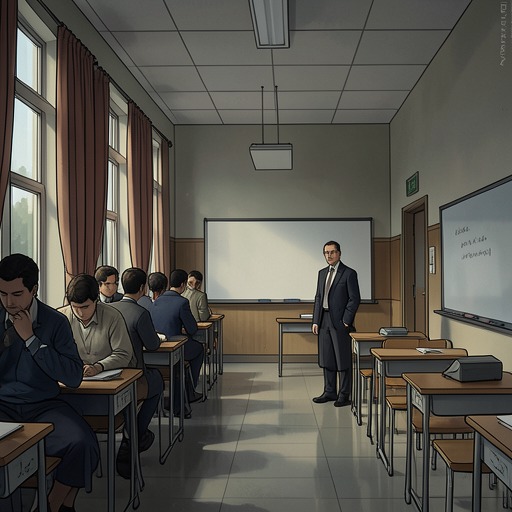
Bridger is introduced as an athletic adult with an alert gaze, a beaver-colored mustache, rough stubble, and cowboy clothes in red, white, and brown checks. His appearance reminds Carag of Andrew Milling, though Bridger’s checked shirt contrasts with the white shirt Milling wore when Carag met him. The resemblance is only visual: Bridger’s first important act is to restrain Carag from acting on his anger and to send the students to class.
His teaching responsibilities span several subjects. He tells Carag that he teaches Special Situations as well as Physics, Chemistry, and Mathematics. The range places him in both the practical and academic life of Clearwater High, while his attention to student conduct makes him an active guardian of its rules. Carag initially does not know what animal Bridger is, but later recognizes him in coyote form. That recognition clarifies the ease with which Bridger moves between the school’s human-facing routines and its woodwalker reality.
Authority and School Rules
Bridger’s authority is first shown in a tense encounter with Jeffrey, Tikaani, Cliff, and Bo. After Jeffrey mocks Nimble, a rabbit woodwalker, Nimble invokes the school rule forbidding predators from belittling or harming prey. Jeffrey responds by partially transforming to display his fangs, while Carag, remembering wolves chasing his family from food, prepares to transform in anger. Bridger grips Carag’s shoulder, orders everyone to class, and explicitly includes the wolf students in the command. The pack leaves, and the crowd disperses; Carag remains held until Bridger has addressed the danger of his own intended response.
Bridger then reminds Carag that students may transform during school hours only with a teacher’s permission, and that student fights are allowed only in Fighting and Survival class. Carag has arrived that day and has not yet read the regulations Lissa Clearwater gave him. Bridger directs him to read the entire rulebook by the end of the day before releasing him to class. His intervention thus links two kinds of school order: permission governs when a woodwalker may reveal an animal form, while the fight rule confines physical conflict to a supervised lesson. In the earlier confrontation, the prey-protection rule is voiced by Nimble and tested by Jeffrey; Bridger’s response is to stop the escalation before anyone is injured.
His enforcement does not make him simply punitive. After Carag later appears injured, he worries that Bridger will report the fight to Clearwater. Bridger gives no definite answer, briefly places a hand on Carag’s uninjured shoulder, and leaves. Carag understands from that gesture that Bridger will not betray him. The moment complicates the image of the strict teacher: he recognizes rule-breaking, but also responds to the student in front of him rather than acting as an automatic channel of punishment.
Anecdotes and Personal History
Bridger often teaches through stories drawn from his own life. In one classroom anecdote, he recalls visiting the Grand Canyon at about twenty-five. Daytime crowds and heat—with road asphalt melting—made him return at night in coyote form. As a student with little money earned at rodeos, he also appreciated not having to pay the thirty-dollar park entrance fee. The episode makes transformation part of his ordinary experience, not an abstract lesson, and shows how his animal form changed his access to a human-managed place.
A more dangerous story concerns a trapper’s foothold trap. Bridger had been caught by the foreleg and feared that the approaching trapper intended to kill him before freeing him. With one paw trapped, he transformed, struck the man in the face with his free hand, and knocked him unconscious. He used the trapper’s tools to open the trap and treated his wound with alcohol. Rather than kill the man, Bridger made him drink the remaining liquor so he could attribute the sight of a coyote turning into a naked man to drunkenness. Carag listens anxiously, hoping the story will not end in a human death; when Bridger survives the tale without killing the trapper, Carag recognizes that not all woodwalkers kill humans in anger. The anecdote teaches both survival and restraint, while showing how secrecy can be preserved without making murder the outcome.
Bridger’s openness about the costs of living between worlds becomes more personal when he talks with Carag outside the classroom. He was once married to a human Navajo woman who knew what he was and did not reject that knowledge. They had a son, Joseph, who was also a woodwalker. Bridger says he does not know where Joseph lives or what became of him: unable to withstand the strain of the two worlds, Joseph began using drugs and eventually disappeared. The marriage did not survive the crisis. This history gives Bridger’s later warning to Carag a personal basis; he has seen how unstable life between identities can become, not merely taught it as a principle.
Bridger also explains that he himself came to teaching after a human driver deliberately accelerated toward him as he crossed a road. The near collision made him realize that he still had his life and should do something useful with it. A few weeks later, someone told him about Clearwater High, and he applied, despite never having taught anyone before. His account presents the school as a chosen response to danger and disconnection, rather than a career for which he had long prepared.
Relationship with Carag
Bridger’s relationship with Carag develops through a pattern of restraint, trust, and increasingly direct instruction. At their first encounter, he prevents Carag from attacking Jeffrey’s group and makes clear that Carag is responsible for learning the school’s rules. Yet Bridger does not reduce him to his mistake. When Carag later fears a report, Bridger’s restrained response gives him reason to believe the teacher will protect their confidence.
The trust deepens when Carag asks what Bridger thinks of Andrew Milling. Bridger calls Milling unsettling; Carag agrees and tells him everything. Bridger listens silently, with a grim expression. The scene gives Carag a listener within the school’s adult community at a point when he is unsure whom to trust. Earlier, after Holly comforts him, Carag hopes Bridger will believe his concerns. Bridger’s recurring habit of telling stories that happen to fit what Carag is facing provides an indirect form of guidance, though the evidence does not show that each anecdote is deliberately chosen for Carag.
Bridger’s most explicit counsel concerns transformation. In a private exchange while walking with Carag, he warns that living as a woodwalker who follows the rules is difficult, but Carag must try. He tells Carag that a predator like him may not receive a second chance and insists that he must master his transformations if he is to grow old in a hard world. The warning connects school discipline to survival: control is not simply obedience for its own sake, but a condition of enduring life as a woodwalker.
Teaching Through Practice and Example
Bridger’s stories are not his only teaching method. After learning of Carag’s nighttime incursion, he addresses it at their next morning lesson. He takes Carag toward the river with a bucket, fills it with icy water, and raises it as if to pour it over Carag in human form. Carag jumps back instinctively. The encounter turns instruction into a physical test, although the available scene does not establish its full outcome. It reflects Bridger’s willingness to teach through immediate experience rather than explanation alone.
His survival teaching also includes the school’s protection beyond its buildings. Bridger explains that Lissa Clearwater has bought as much surrounding land as she could afford, leaving a five-kilometer radius around the school protected from hunters and trappers even when students are in animal form. That assurance has practical limits: Carag later wanders far from the school’s safe territory and may also have left Grand Teton National Park. During cougar hunting season, which runs from October through March, a hunter needs only a license to kill one. Bridger’s classes have taught Carag enough to recognize the danger, but the lesson is tested when hunting dogs begin following a trail.
Carag tries a tracking countermeasure learned at school: he doubles back over his own pawprints, then leaves the trail by jumping to a tree and a rock. He reaches a river and enters its freezing water because it may erase his scent and make the dogs’ pursuit harder. These actions show Carag applying practical survival knowledge under pressure. The scene does not identify which lesson taught each maneuver, so Bridger’s importance lies in the broader training that has made such tactics available to him, rather than in a claim that Bridger personally taught every one.
Rescue and Narrative Significance
When the exhausted, injured Carag finally reaches a road, Bridger arrives in the old school van. He runs toward Carag in alarm and calls his name. Carag is close to collapsing onto the asphalt; with help from Sherri Rivergirl, Bridger wraps him in a blanket and gets him into the back seat. The rescue turns their teacher-student trust into immediate action. Bridger is no longer only the adult who restrains Carag or tells him how to survive: he is present when those lessons have not been enough to keep Carag safe.
Bridger’s role is defined by the tension between rules and danger. He insists that Carag control his transformations and respect school limits, yet his conduct also shows compassion, discretion, and a refusal to treat every breach as grounds for betrayal. His own past—his vanished son, his trap encounter, and his decision to teach after nearly being struck by a car—makes that combination credible within the story. He offers Carag neither a simple warning nor an easy rescue from the difficulties of divided identity. Instead, he models the more demanding possibility of living between worlds with discipline, restraint, and responsibility toward others.