Wilson's 1919 speaking tour and stroke
1919Woodrow Wilson’s 1919 speaking tour was an effort to rescue support for the League of Nations by carrying his case directly to the American public. It ended abruptly after a stroke on the train to Wichita, but its final scenes make the tour more than a campaign interrupted by illness: the silence of laborers in Seattle and Wilson’s appeal for justice and peace in Pueblo expose the widening distance between his democratic idealism and the political reality around him.
Purpose and Political Pressure
The tour followed Wilson’s return to the United States, where, from the day he landed in Hoboken, he was described as having his back to the wall of the White House. He spoke to preserve his faith in words, in the League of Nations, in himself, and in his father’s God. The language of faith gives the campaign a private as well as a public stake: Wilson was not only asking the country to accept an international institution, but trying to sustain his own belief that political speech could still bring the world closer to peace.
That effort unfolded amid opposition in the Senate and House, where politicians had been ganging up on him. The narrative presents Wilson as straining every nerve of body and brain and using every government agency under his control. Its parenthetical judgment darkens this portrait: dissent could be treated as evidence that someone was a crook or a red, while there would be no pardon for Eugene V. Debs. The tour therefore carries an unresolved contradiction. Wilson defended a future organized around international cooperation even as the domestic political climate described alongside his campaign narrowed the space for dissent.
Reception in Seattle and Pueblo
In Seattle, the welcome changed from block to block. Crowds elsewhere clapped and cheered patriotically as Wilson passed in his car, but four blocks of Wobblies stood silently with their arms folded. Their leaders were in jail; others had been lynched, and workers had been shot down. The men in overalls did not interrupt the procession or answer Wilson with counter-speeches. Their silence became a pointed public response to the celebrated liberal they watched pass, hunched in his overcoat and haggard with fatigue, one side of his face twitching.
The contrast makes the Seattle scene a political encounter without an exchange. Wilson’s campaign depended on speech, yet the workers’ refusal to cheer made visible a constituency that his rhetoric of democracy could not simply absorb. The scene also places his physical exhaustion beside the consequences of repression: the president moves through the city in a car, while the silent laborers stand together in the street, carrying the memory of jailed and killed organizers. Their quiet does not amount to endorsement; it registers a distance that applause from other crowds cannot erase.
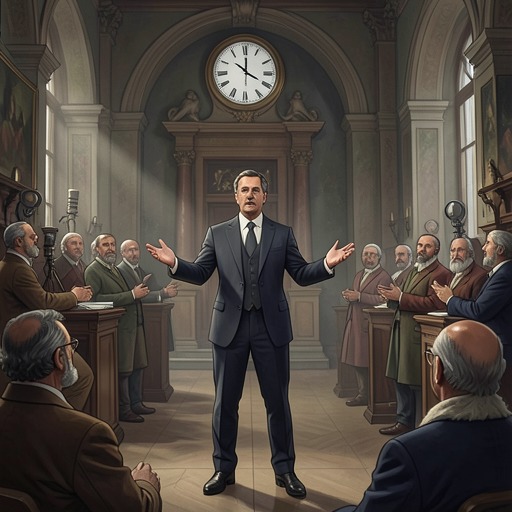
In Pueblo, Colorado, Wilson appeared as a gray man, hardly able to stand. Yet the speech attributed to him there turns toward confidence rather than surrender. He argued that, once the mists of the great question had cleared, people would recognize the truth of justice, liberty, and peace; the American people, he believed, would accept that truth and be led by it toward a quietness and peace the world had never known. The appeal gathers the tour’s central promise into a final public statement: that the country could lead the world toward peace by committing itself to justice and liberty.
The Final Speech and Stroke
The narrative identifies the Pueblo address as Wilson’s last speech. Its hopeful account of truth and peace is immediately shadowed by the physical circumstances of its delivery: he was already described as barely able to stand, with one side of his face twitching. The speech’s confidence and the speaker’s visible debility occupy the same scene. The ideals remain expansive, but the body carrying them has become vulnerable in public view.
On the train to Wichita, Wilson suffered a stroke. He gave up the speaking tour that had been intended to sweep across the country for the League of Nations. Afterward, the narration describes him as ruined and paralyzed, barely able to speak. The sequence gives the tour a decisive break: the campaign ends not with a final debate or a change in its stated purpose, but with Wilson no longer able to continue making the case in person. His appeal for a world led toward peace thus becomes inseparable from the sudden loss of the public voice on which the appeal had depended.
Aftermath and Significance
The consequences extend beyond the tour itself. On the day Wilson gave up the presidency to Harding, a joint committee of the Senate and House sent Henry Cabot Lodge, his lifelong enemy, to make the formal call at the executive office in the Capitol and ask whether the president had a message for Congress. Wilson lifted himself painfully from the arms of his chair and managed a brief reply that he had no further communication to make, followed by a polite farewell. The formal occasion required an answer from the president; what it received was a few words from a man the account has already shown losing the ability to speak.
Wilson died on February 3, 1924. Read across the tour’s scenes, the ending sharpens the contrast between political language and political power. Wilson had tried to save his faith in the League of Nations by talking, and in Pueblo he described justice, liberty, and peace as truths capable of leading the nation and the world. But in Seattle, workers answered his passage with silence, and after Wichita his own speech was drastically curtailed. The tour’s significance lies in that conjunction: an ambitious public argument for international peace, a domestic landscape marked by repression and political antagonism, and a president whose effort to persuade ended in physical incapacity.