Ukrainian Army
AfterburnThe Ukrainian Army is presented as a formidable force whose military strength and position around the Black Sea turn Crimea into a point of acute strategic danger. Its role in the crisis is defined less by a battle already fought than by the scale of its capabilities and the possibility that those capabilities may be brought to bear against the peninsula.
Strength and Strategic Position
During the continuing Russian Civil War, Ukrainians are described as using the disorder to strengthen their position, especially in Crimea. In Nikolai Sergeivich Dmitriev’s assessment, the Ukrainian Army is strong and well-equipped, while Ukrainians control more than half of the old Black Sea Fleet. He judges them the real threat, rather than the Americans: a view that shifts the strategic focus from an external intervention force to a neighboring power with both ground forces and substantial naval resources.
That judgment is Dmitriev’s reading of the balance of power, not evidence that Ukraine has already attacked. The distinction matters later in the political debate over intervention, when the secretary states that Ukraine has not attacked yet, while Scott insists that the wider region is already tearing itself apart. The army’s significance therefore lies partly in the pressure created by its apparent readiness and capacity, before open hostilities between it and the peninsula’s defenders have begun.
Forces Near Crimea
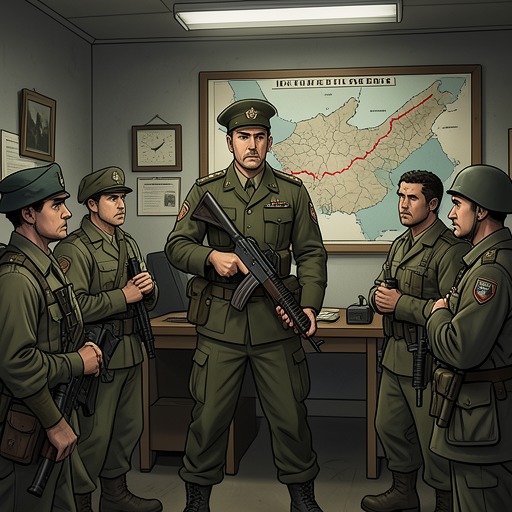
At a map, General Sergei Boychenko points to forces near Odessa and the mouth of the Dnieper River. He tells Dmitriev that intelligence reports show two army groups ready to attack Crimea. The concentration is accompanied by more than one hundred landing craft and a large number of naval vessels, most of them small combatants. The combination suggests a threat involving access across the water as well as the approach of ground formations; it makes Crimea’s exposure a concrete operational concern rather than a remote political possibility.
The account establishes the force’s readiness through reported deployments and assembled transport and naval assets, but does not describe an attack taking place. Boychenko’s briefing gives the danger its immediate shape, while Dmitriev’s earlier assessment supplies its larger context: the Ukrainian Army is not merely a hypothetical opponent, but part of a military balance already altered by Ukrainian control of much of the former fleet.
Regional and Political Consequences
The prospect of fighting around the peninsula threatens to turn the northern Black Sea, from Odessa to Gagra, into a war zone. The narrative warns that such a development could make it difficult, perhaps impossible, for the UN-U.S. force to hinder the advancing forces or deliver the expected attack on the peninsula’s defenders. The Ukrainian Army thus affects the room for action available to outside forces even without being shown in combat: its potential movement could transform intervention into a contest over access and timing.
The surrounding crisis is also framed as a problem of escalation and legitimacy. The UN hopes that a strong military presence can help defuse regional conflicts, while officials disagree over whether intervention can preserve peace when the area is already disintegrating. Against that argument, the Ukrainian Army stands as a material source of pressure—well-equipped, supported by substantial naval resources, and reported ready to move on Crimea—but the evidence stops short of depicting it carrying out the attack that officials fear.