CVBG-14
AfterburnCVBG-14 is the U.S. carrier battle group whose Black Sea operations are defined as much by the logistics of keeping its aircraft airborne as by the battles it fights. Its nuclear-powered carrier does not need fuel for propulsion, but its aircraft consume aviation fuel at a rate that makes the group’s access to replenishment routes a strategic vulnerability; despite that constraint, the group and Marine Expeditionary Unit 25 ultimately win a clear victory at the Battle of Kerch.
Composition and Operational Demands
The group operates around a large carrier and its escorts. The carrier’s nuclear power does not make the formation self-sufficient: aircraft require regular replenishment of expendables, and aviation fuel is the most immediate limit on sustained flight operations. Under ordinary conditions, the carrier needs replenishment every two to three weeks. Its aircraft fuel would last no more than ten days, and less under a heavy flight schedule, a major strike, or an extended battle. The group depends on underway replenishment tankers that follow it at sea. That supply line is therefore more than routine support: if replenishment is interrupted or an opponent can prevent it, the carrier’s combat capacity contracts sharply. The novel makes this dependence a measure of the group’s exposure, even though the carrier itself is nuclear-powered.
Threats and Coordination
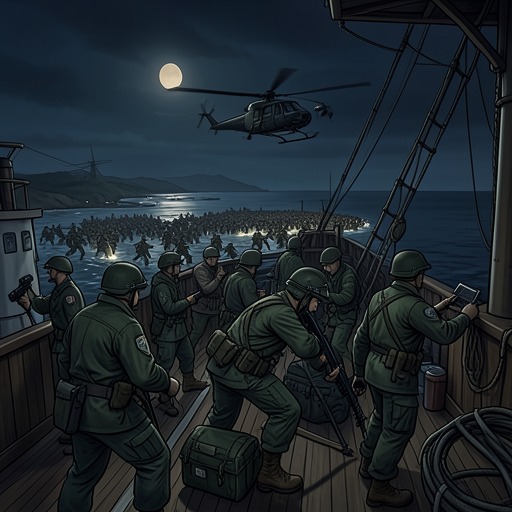
CVBG-14’s operating environment also places its personnel under pressure to make decisions with incomplete information. In a submarine encounter, the rule to fire only if fired upon is not treated as an adequate safeguard: waiting for an enemy submarine to shoot first could allow it to sink or cripple the carrier. The officer facing the decision has only sonar reports amid noisy, echoing water, making the risk one of judgment under uncertainty rather than a clearly identified target. A separate danger arises from gaps between military services and the United Nations mission in Georgia. A U.S. Navy jet shoots down a U.S. Army helicopter on a UN mission, while the fighter crew had not been informed that Army helicopters were operating with the UN team. The episode foregrounds the consequences of incomplete coordination and identification in an electronic battlefield. It does not establish that the carrier group as a whole caused the information failure, but it situates naval air operations within a wider command environment where friendly forces can be mistaken for threats.
Entrapment and the Fuel Crisis
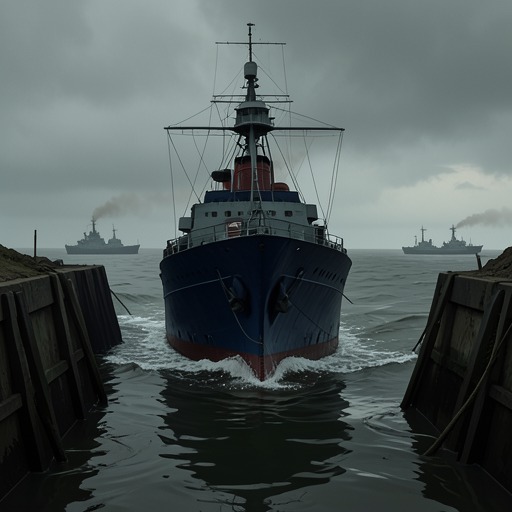
The group’s freedom of action is further restricted by its position in the Black Sea. With passage through the Bosporus Strait closed, the carrier and its escorts risk becoming trapped: under continuous maneuvering and round-the-clock flight operations, the nominal ten-day fuel margin could shrink to two to four days. Beyond that point, the force would be left with a carrier and escorts unable to sustain their intended operations. The strained relationship with Turkey makes outside help from that quarter uncertain, leaving replenishment access—not the carrier’s reactor—as the decisive constraint. Senior officials examine estimates for getting supplies through, underscoring that the problem has to be addressed as a logistical and strategic calculation. The danger becomes concrete during Operation Ranger, when the carrier enters narrow waters between Taman and Kerch to take on fuel. The operation is identified as the raid’s central purpose and as the moment when the carrier is most vulnerable. Nearly three million gallons, about nine thousand tons, of aviation fuel must be pumped aboard; flight-deck operations are suspended during the transfer. The mass of fuel that restores the group’s endurance also makes the replenishment operation a concentrated point of risk.
Battle of Kerch and Outcome
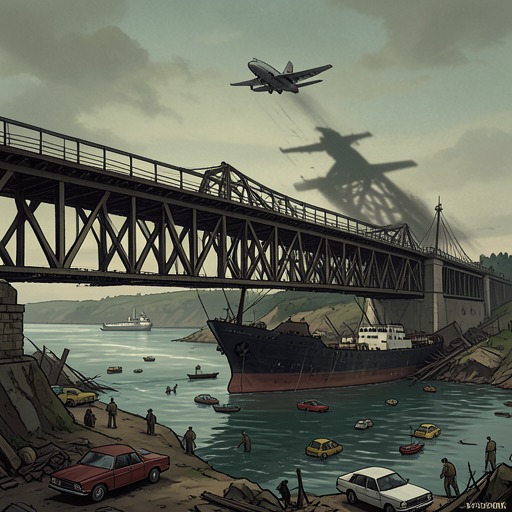
The group’s logistical peril does not prevent it from continuing to operate. In the final campaign, CVBG-14 and Marine Expeditionary Unit 25 achieve what the narrative calls a clear victory at the Battle of Kerch. The subsequent report that the Bosporus Strait is clear to navigate signals a change in the group’s predicament: the passage that had threatened to confine the carrier force is again open. Its victory is therefore paired with a practical consequence for movement and access, not merely a favorable battlefield result. Across these episodes, CVBG-14 is presented as a powerful formation whose reach depends on fragile systems beyond the carrier itself: aircraft fuel, tankers, navigable straits, and accurate communication among forces. Its combat effectiveness and its vulnerability arise from the same fact. The carrier can project air power, but only while the routes and arrangements that sustain it remain available.