Marine Expeditionary Unit 25
AfterburnMarine Expeditionary Unit 25 is a U.S. Marine force deployed into the Black Sea as part of the response to the crisis. Its significance lies in the role proposed for it when the carrier group’s position becomes increasingly precarious: it could help secure and clear the Black Sea end of the Bosporus, a task that connects the group’s immediate logistical predicament to a wider operation around the Turkish Straits.
Deployment and Setting
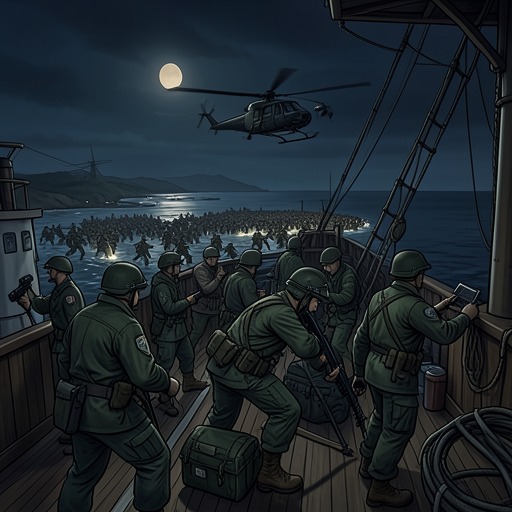
Marine Expeditionary Unit 25 was arranged for movement as the USS Thomas Jefferson and its battle group sailed into the Black Sea, a confined maritime theater described as a potential death trap. The deployment placed the unit inside the same increasingly restrictive operating area as the carrier group, rather than leaving it as a force that could be brought in later without regard to access constraints.
The group’s dependence on replenishment made that setting consequential. Although the USS Thomas Jefferson was nuclear-powered, its aircraft consumed fuel and other expendables; the carrier required replenishment at sea every two to three weeks, and a demanding flight schedule could sharply reduce its margin. The UN replenishment tankers were its only stated supply source. If the Bosporus were closed, the carrier and its escorts risked being trapped in the Black Sea with only a limited period of useful operations remaining.
Proposed Operational Role
At a later planning discussion, Admiral Scott pointed to Marine Expeditionary Unit 25, already in the Black Sea with the USS Guadalcanal and its escorts, as being well placed to seize the Black Sea end of the Bosporus and begin clearing operations. The proposal gave the unit a distinct function in the contemplated response: it was not merely accompanying the carrier group, but could be used to help open or secure the route on which the group’s access and resupply depended.
The plan was presented as a possibility, not as a completed action. Scott also suggested bringing in Marine Expeditionary Unit 21 for operations on the Aegean coast, differentiating that proposed role from the Black Sea task assigned to Marine Expeditionary Unit 25 in the discussion. The distinction made the unit’s position in the Black Sea a practical advantage, while leaving the proposed operation dependent on decisions about access and the use of force.
Political and Logistical Constraints
The proposed clearing operation arose amid limits on foreign military access to Turkey. Turkey was not going to permit foreign forces to be based on its soil, and relations with Ankara had been strained. In the planning discussion, Robert Heideman raised the prospect that Turkey might object to an invasion of its territory; Admiral Scott countered that Turkey could instead provide access to the ships. Marine Expeditionary Unit 25’s presence at the Black Sea end of the straits therefore mattered within a choice between securing access by agreement and attempting to clear it by military means.
The strain on the carrier group sharpened the stakes. With intensive flying, the group’s operational margin could shrink to only two to four days before the USS Thomas Jefferson and its escorts became ineffective and were locked inside the Black Sea by closure of the Bosporus. Later, the carrier faced the task of taking on nearly three million gallons of aviation fuel. These were pressures on the battle group as a whole, not actions attributed directly to Marine Expeditionary Unit 25; they explain why the unit’s proposed position near the straits could matter to the larger effort.
Presence in the Command Process
Marine Expeditionary Unit 25 was represented in a high-level assembly that included the USS Thomas Jefferson’s department heads and the skippers and senior staffs of several squadron ships. Its presence in that gathering placed the unit within the planning process as the commanders considered alternatives, including how to address urgent needs such as evacuating the wounded. The evidence establishes its deployment and the role proposed for it, but does not establish that it carried out the proposed seizure or clearing operation.