Ukrainian Armed Forces
AfterburnThe Ukrainian Armed Forces enter the account through intelligence reports that make them a central potential actor in the contest over Crimea. The Jefferson battle group is told that two Ukrainian national armies are positioned to seize the peninsula from its Russian caretakers; the reported preparations give the threat a concrete military shape, though the available evidence describes readiness and intent rather than a completed advance.
Reported Force Posture
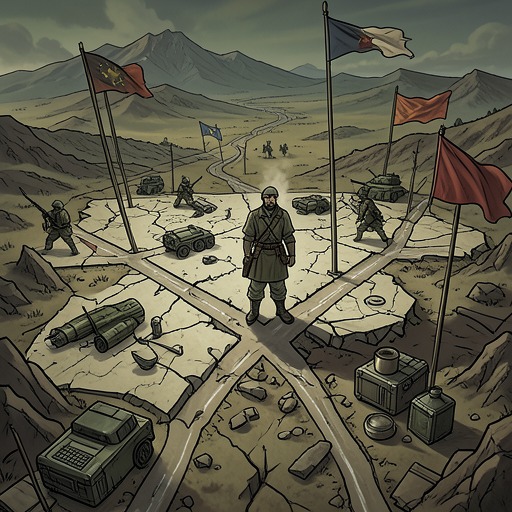
According to the most recent intelligence available to the Jefferson battle group, the Ukrainian Fifth and Seventh National Armies were in position at Odessa and Melitopol, ready to move into Crimea. The report frames their deployment as more than a general possibility: it places forces at named locations and describes them as prepared for an operation against the peninsula. The account does not specify their strength, commanders, equipment, or precise plans, so the military picture remains that of an intelligence assessment rather than a full order of battle.
Crimea and Territorial Stakes
The reported readiness is tied to an explicit territorial objective. During a briefing on Ukrainian priorities, the conquest of the Crimean Peninsula is identified as high on the list. Crimea is thus presented as the focus of a prospective Ukrainian campaign, with its status under Russian control at the heart of the danger perceived by the Jefferson battle group. The material establishes the stakes and the stated assessment of Ukrainian intent, but does not independently verify that an offensive was launched.
Amphibious Preparations
The intelligence picture also includes the gathering of amphibious landing craft at Odessa and at Ocakov and Svobodnyj Port, near the mouth of the Dnieper. These preparations lend credence, in the account, to assessments by the CIA and U.S. Naval sources that a move against Crimea was possible. The landing craft add a maritime dimension to the reported army deployments: the threat is not described solely as forces approaching overland, but as an operation for which amphibious assets were being assembled at several coastal points.
Role in the Wider Crisis
The Ukrainian Armed Forces are characterized less through individual personnel or internal organization than through the strategic pressure their reported posture places on the surrounding intervention. As the United States debates the risks of military authority exercised through the United Nations, and American forces receive operational orders for the Crimean peacekeeping zone, the possibility of a Ukrainian move helps define the volatile setting in which those decisions are made. The evidence does not show the Ukrainian Armed Forces carrying out the projected seizure; their narrative significance here lies in the credible, consequential threat attributed to their deployment.