U.S. Army
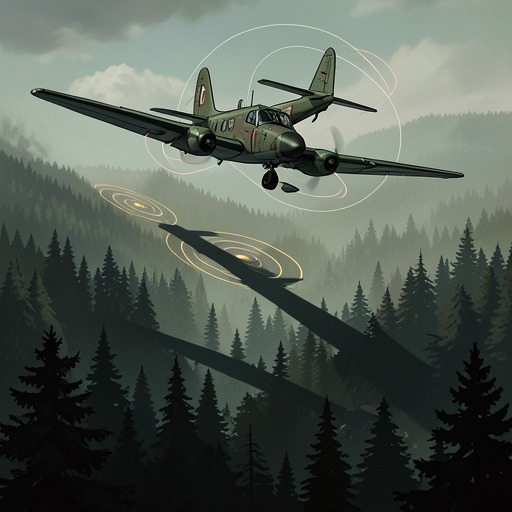
AfterburnThe U.S. Army’s role in the novel is defined by a vulnerable mission at the intersection of United Nations operations and American military command. Army helicopters are sent to Georgia to work with a UN team, but a U.S. Navy aircrew is apparently not informed of their presence. When a Navy jet shoots down an Army helicopter on that mission, the wreckage makes the institutional failure visible: the aircraft bears the words UNITED STATES ARMY, even as the circumstances surrounding its identification remain unclear.
Mission and Command Context
The Army helicopters are described as having been sent into Georgia to support the UN team. That assignment takes place amid a longstanding debate over whether American forces should be placed under the command of UN commanders. The novel presents the question as an enduring policy dispute, not a settled feature of the Army’s mission; the available account does not establish that the Army crews themselves were under UN operational command.
The broader limits on American intervention add another layer to this setting. The National Command Authority had directed that U.S. forces were not to become involved in fighting between the Russian Red and Blue factions, while Marines were to go ashore at Poti only for their specified mission. These restrictions frame the political sensitivity of American deployments, but do not, in themselves, explain the Army helicopters’ orders or their flight into Georgia.
The Shootdown and the Information Failure
The immediate crisis is not presented as a confirmed technical explanation. After the shootdown, an aircrew asks what happened to the helicopter’s identification system. The best available account is that the Navy personnel had not been told that Army helicopters had been sent into Georgia to work with the UN team. The uncertainty matters: the text raises the failure of identification, but points directly to a breakdown in notification rather than establishing a definitive mechanical cause.
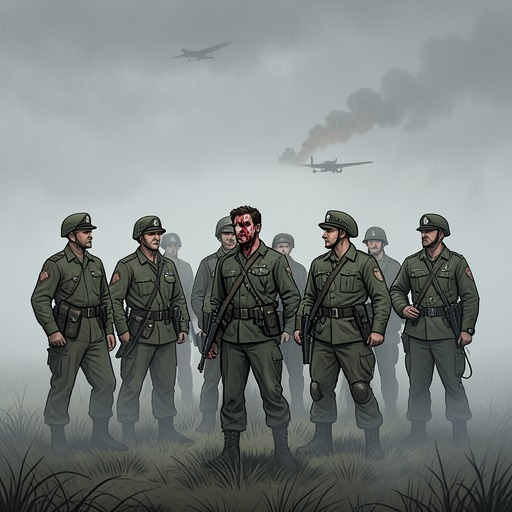
The scene of the crash underscores the cost of that gap. The tail section remains recognizable amid the flames, with UNITED STATES ARMY stenciled in yellow on its olive-drab paint. Nearby, a Russian-made Mi-8 settles to the ground and figures emerge. The juxtaposition places the American loss within a contested operational environment, without making the arriving helicopter’s purpose or the figures’ intentions clear.
Recognition and Historical Echo
Two days after the incident, Samantha Reed addresses a room of officials and acknowledges that a Navy jet has shot down an Army helicopter flying a UN mission. By then, the event is already familiar to people following cable news. The public account transforms a battlefield error into a matter requiring senior political attention, while the underlying question of how the Army aircraft entered the operating picture remains tied to military coordination.
The episode also recalls a 1994 incident in which two U.S. Air Force fighters engaged and destroyed two Army helicopters in the no-fly zone over northern Iraq. The parallel makes the Georgia shootdown more than an isolated mishap: the novel connects it to an earlier case in which friendly aircraft failed to remain distinguishable in a restricted airspace. The repetition shifts attention from individual error alone toward the systems of information and identification on which joint operations depend.
Narrative Significance
The Army is not developed here through a detailed institutional portrait or through the biographies of its helicopter crews. Instead, it enters the narrative as a distinct service whose aircraft are exposed to danger when operational information does not cross service boundaries. The visible Army stencil, the unanswered IFF question, and the later public acknowledgment form a sequence: the wreck identifies whose aircraft was lost, the inquiry reveals how little the Navy aircrew knew, and the political response confirms the incident’s wider significance.
That sequence also sharpens the novel’s command problem. A UN mission may involve American forces, but authority, notification, and responsibility do not automatically align. The Army’s brief appearance therefore gives concrete form to a larger question running through the operation: whether forces can carry out a shared mission safely when the organizations responsible for assigning, directing, and identifying them do not share the same picture.