Reds
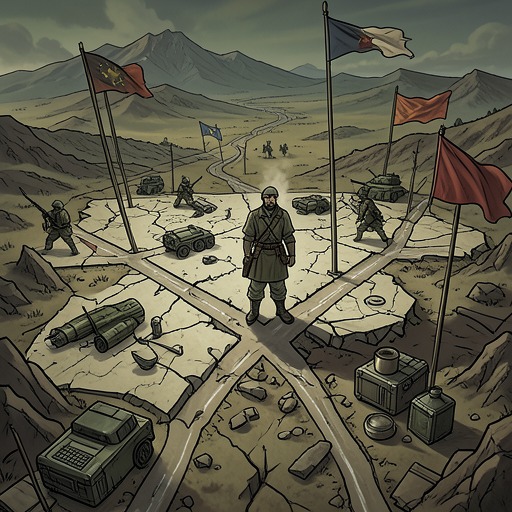
AfterburnThe Reds are the hard-line faction associated with Marshal Krasilnikov, one side in the all-out civil war that followed the disintegration of the revived Union. Their importance lies not only in their opposition to Leonov’s Blues but also in the continued presence of Red and pro-Krasilnikov forces across the former empire, which made the conflict difficult for outside powers to treat as a distant or settled political contest.
Identity and Emergence
A populist leader, Leonov, seized control from discredited hard-liners, and his Popular Democratic Front became known as the Blues. The political shift did not end the hard-line challenge: the Blues were soon locked in combat with Krasilnikov’s Reds. The novel thus presents the Reds as an organized armed faction that persisted after the change in political leadership, rather than as a remnant whose defeat had already been secured.
The civil war forms the wider setting for their emergence as a continuing force. As the revived Union began to disintegrate, the United States intervened in the far north and seized key military facilities on the Kola Peninsula. The narrative places this foreign intervention alongside the internal struggle between the Blues and Reds, showing how the collapse of central authority drew outside powers into a crisis with several overlapping fronts.
Dispersed Forces and Continuing Resistance
The Reds were not confined to a single battlefield. The account describes neo-Soviet units scattered throughout the former empire and controlled by hard-line Reds and pro-Krasilnikov factions. At the same time, fledgling rebel movements were rarely strong enough to break the hard-liners’ influence. This dispersed military presence helps explain why Leonov’s rise did not translate into an immediate end to armed resistance: political change at the center coexisted with hard-line control in other parts of the former state.
The conflict also altered the balance beyond Russia. Ukraine, described as uneasy in its former position as one of the Union’s largest and most productive republics, took advantage of the Russian Civil War to strengthen its position, especially in Crimea. The old dispute between Kiev and Moscow over Crimea and the Black Sea Fleet remained unsettled as Russia fought internally. The Reds are part of this destabilizing context, although the account does not specify their direct role in the Ukrainian or Crimean disputes.
Constraints on Outside Intervention
The United States’ stated policy drew a firm boundary around the factional war: the National Command Authority directed that U.S. forces were under no circumstances to become involved in fighting between the Red and Blue factions. The order establishes the Reds as a party whose conflict with the Blues could not simply be treated as an incidental obstacle to other missions. It also distinguishes intervention in a broader crisis from participation in Russia’s internal struggle.
That restriction gives the Reds significance beyond their own factional aims. Their continued presence meant that rebel movements and outside forces operated amid an unresolved civil war, while U.S. policy expressly withheld permission to fight either side. The Reds therefore represent both the persistence of hard-line power after the political shift to Leonov and a limit on what foreign forces were authorized to do.