United States Navy
AfterburnThe United States Navy’s role in the novel centers on the carrier Jefferson and her battle group: they are sent into the Black Sea as part of a United Nations-backed effort whose political ambitions depend on American naval power. The same force is vulnerable to the region’s closed sea routes and the demands of sustained flight operations, making logistics and uncertain direction from Washington as consequential as combat capability.
Operational Role
The Jefferson and her battle group sail into a landlocked potential death trap because a victory in the affected nations might open the way to a United Nations-brokered peace throughout the Russian Federation. The intervention is presented as a major commitment, not simply a naval visit: the force has arranged for a Marine Expeditionary Unit to be moved to the region, while the carrier group itself supplies a central element of the proposed operation.
The political case for the mission is compared with Operation Restore Hope, the costly and abortive United Nations-backed Marine operation in Somalia. That comparison places the Navy within an intervention whose objectives are ambitious but whose practical and political limits are already visible. Turkey will not permit foreign military forces to be based on its soil, and relations with Ankara are strained enough that the planners cannot count on Turkish assistance.
The carrier group’s purpose is also tied to a proposed settlement involving General Boychenko. In Washington, officials consider the possibility that he will surrender to the United Nations, with the United Nations making the carrier battle group’s participation a condition of its willingness to proceed. Naval power thus serves as both an operational commitment and part of the leverage surrounding a political arrangement.
Sustainment and the Black Sea Trap
The novel makes the carrier’s dependence on aviation supplies a strategic constraint. Although the Jefferson is nuclear-powered and does not need fuel for its own propulsion, her aircraft consume fuel rapidly. A modern carrier requires replenishment of expendables every two to three weeks, and its aircraft fuel would not last more than ten days under ordinary conditions. Heavy flight activity, a major strike, or an extended running battle could reduce that margin further. The battle group’s supply tankers follow it at sea, but that supply chain is vulnerable if an enemy can pin the force in place.
The danger becomes acute when the Bosporus Strait may close. Under continuous maneuvering and round-the-clock flight operations, the estimated ten-day margin could shrink to two to four days. After that, the Jefferson and her escorts would be trapped in the Black Sea with little practical ability to continue operations. The carrier’s nuclear propulsion cannot solve the problem: it is the fuel consumed by its aircraft, and the restricted maritime exit, that define the force’s endurance.
The scale of replenishment is made concrete when suitable aviation gasoline is found. The fuel is judged to meet the Jefferson’s demanding standards, but nearly three million gallons—about nine thousand tons—must still be pumped aboard. Flight-deck operations are suspended during the transfer, showing how a necessary act of sustainment temporarily limits the very air operations the fuel is meant to support.
Command, Coordination, and Support
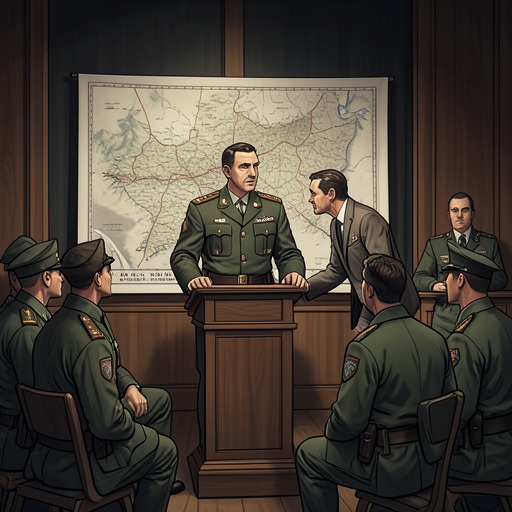
The Navy’s position in the intervention is shaped by a layered command environment. New orders from Washington prompt Admiral Tarrant to tell assembled battle-group officers that their operational area will extend north. The announcement arrives amid tension and anticipation, illustrating how the force’s deployment can change through decisions made beyond the ships themselves.
Coordination failures also expose the risks of operating alongside other services and the United Nations. After an incident involving helicopter identification, personnel ask why the helicopters’ identification system failed; the explanation is that the battle group had not been told that Army helicopters had been sent into Georgia to work with the United Nations team. The episode points to a concrete gap in notification and coordination, rather than a failure of naval equipment alone.
At Yalta, Admiral Tarrant and members of his staff fly in from the Jefferson, and Tarrant is briefed on what has happened there. When casualties require treatment, those present identify a Navy doctor from the carrier as the needed resource. Later, Tarrant and others are to be medically evacuated back to the USS Saipan amphibious assault ship. These movements show the Navy contributing command presence and medical evacuation as well as aircraft and ships.
Strategic Limits
The battle group’s operational estimates become part of high-level discussion when officials ask whether there is any way to get through and resupply forces cut off in the Black Sea. Naval planning therefore reaches from calculations of fuel and access to national decisions about what support can be attempted. At the same time, personnel aboard the Jefferson lack clear direction from Washington; the account contrasts their immediate view of the crisis with the uncertainty of the policy guidance they receive.
Taken together, these details portray the United States Navy as powerful but not self-sufficient. The carrier can bring air power, staff, and medical support into the crisis, yet its capacity depends on replenishment, interservice information-sharing, and political decisions about access and mission. In the Black Sea, the geography that makes the carrier a conspicuous instrument of intervention can also turn it into a force with a narrowing margin of action.