UN Crisis Assessment Team
AfterburnThe UN Crisis Assessment Team was the United Nations’ field assessment body in western Georgia, where its work helped determine whether U.S. Marines could land at Poti without becoming involved in the conflict between the Russian Reds and Blues. Its mandate placed the team at a consequential threshold: military deployment depended on its assessment that both factions were out of the picture and that the Georgian Freedom Party could cooperate with the United Nations mission.
Mandate and Political Limits
The National Command Authority imposed a strict limit on U.S. involvement: under no circumstances were American forces to enter the fighting between the Reds and Blues. Marines could go ashore at Poti only after the UN Crisis Assessment Team demonstrated that both factions were absent from the area, clearing the way for cooperation with the Georgian Freedom Party. The team’s assessment therefore had a direct operational consequence. Until it gave the necessary indication, the planned landing remained conditional.
Field Assessment in Western Georgia
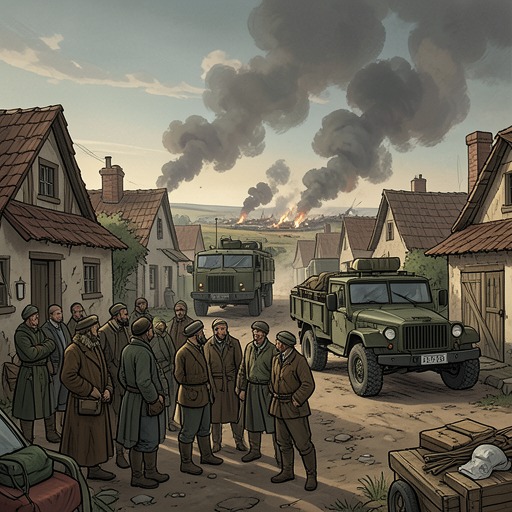
The team had been traveling for more than a week before the Americans arrived, moving from town to town across western Georgia to assess conditions. It was not operating in a settled landscape: towns had been reduced to rubble, while sprawling refugee camps and tent cities were marked by disease. The assessment unfolded amid the visible costs of the conflict, even as its immediate institutional purpose was to establish whether the political and security conditions permitted the proposed mission.
The group being escorted included two U.S. Army officers who had arrived with Paul Dombrowski and Marty Cole, two Marine officers from the 25th Marine Expeditionary Unit, and three British officers. This mix of personnel placed the team’s work alongside the American military presence while it continued its survey; the Americans had arrived after the team was already underway.
Humanitarian and Regional Stakes
The team’s findings mattered within a wider United Nations effort to use a substantial military presence to defuse problems in the region. That ambition extended beyond the immediate question of access to Poti: Turkey had repeatedly threatened to invade Armenia, while the wider area was becoming more dangerous. The team’s assessment was thus part of a broader attempt to determine where an international presence might operate without crossing the U.S. prohibition on involvement in the Russian factional war.
The distinction between assessing conditions and authorizing action shaped the team’s significance. Its movement through devastated towns and disease-ridden camps made the humanitarian emergency concrete, but the decision it informed was also strategic: whether the Marines could enter Georgia, and whether the factions’ position left room for cooperation with the Georgian Freedom Party. In the novel’s account of intervention, the team stands at the junction of need, political restraint, and military permission.