Russian Naval Infantry
AfterburnThe Russian Naval Infantry is depicted as an elite combat force whose identity is marked by both formal military status and a fiercely retained uniform tradition. The text calls it a Guards unit, distinguishes it from army special forces despite their cooperation, and places one reinforced battalion near Kerch as an approaching fleet creates the prospect of an amphibious assault.
Identity and status
The text identifies the Russian Naval Infantry by the Russian term Morskaya Pekhota and describes it as an elite combat unit classified as a Guards unit. That designation gives the force a recognized standing within the military; its identity is also conveyed through the contrast between regulation and practice in how its troops dress.
Russian military uniform doctrine specified steel helmets for naval infantry. Yet the black beret had become so beloved and distinctive that commanders had largely stopped trying to enforce the helmet regulation. The text presents the beret not simply as an item of clothing but as a visible marker of unit identity, one strong enough to persist alongside formal uniform requirements.
Uniform and unit culture
In a scene involving the troops, one man takes off his helmet and pulls a beret from inside his one-piece, light-camouflage uniform; the others quickly do the same. The gesture makes the informal custom collective: the berets are not just carried as personal keepsakes but worn together as an expression of the unit’s shared identity.
The text also specifies the distinctive red triangular patches associated with the Russian marines. Their permission to wear the black berets with these patches is tied to the unit’s Guards status. The resulting uniform practice brings together the official and the customary: the unit retains its authorized insignia while setting aside the helmet doctrine that would otherwise govern its appearance.
Relationship with special forces
The Russian Naval Infantry works closely with naval special-forces units, which provide frogman and reconnaissance capabilities. Cooperation, however, does not erase service distinctions. The text identifies Boychenko’s so-called Bodyguard, the 4th Black Sea Fleet Spetsnaz Brigade, as an army formation rather than a naval one, and places it within the sharp rivalry between army and naval units across the Russian military.
That distinction matters to the organization’s portrayal: proximity in the field and shared operations do not make the formations interchangeable. The Russian Naval Infantry belongs to the naval side of a military whose branches cooperate while also competing for identity and standing. The black beret’s persistence offers a visual counterpart to that institutional boundary.
Deployment near Kerch
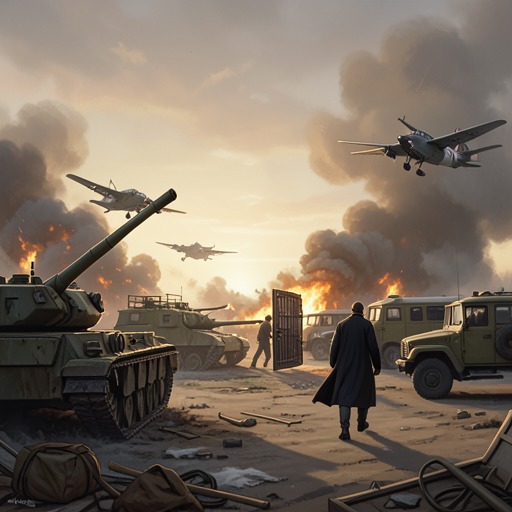
A reinforced battalion under Yuri Nikolaivich Yevtushenko is reported near the Arsincevo refinery and fuel storage complex, south of Kerch, as fleet units approach from the south. The text explicitly limits what the battalion can accomplish: it is not large enough to stop a major amphibious assault. It can, however, disrupt the opposing force’s plans to cross the straits at that point.
The deployment therefore gives the Russian Naval Infantry a consequential but bounded role. Its force is presented not as an impregnable barrier, but as a unit capable of spoiling an enemy plan at a strategically important crossing. The contrast between insufficient strength to block an assault and the ability to interfere with its route defines the battalion’s operational significance in the episode.