UN
AfterburnThe UN is the central international body attempting to contain a spreading crisis that has left governments fragmented, cease-fires elusive, and humanitarian needs urgent. Its role grows from passing resolutions and seeking cooperation to assembling peacekeeping support and directing U.S. forces. That expansion gives the institution the possibility of acting with military force, but also makes its authority dependent on national governments, local access, and the willingness of commanders to serve under an international chain of command.
Mandate and Regional Crisis
The crisis confronting the UN is difficult to address through conventional diplomacy: fighting continues without a clear-cut government able to sign a cease-fire or agree to stop hostilities. The organization has spent months trying to bring about a truce. Its closest achievement is a small enclave in Georgia, nominally an independent nation, amid a wider struggle over effective control.
The UN’s response combines political resolutions with practical intervention. New governments, too weak to dislodge militarist control on their own, apply to the organization for support. The UN attempts to keep pace with the spreading disorder by inserting peacekeepers and taking steps to ensure humanitarian deliveries. Its responsibilities therefore extend beyond monitoring a settlement: in a region where a stable counterpart may not exist, it is also trying to sustain basic relief and create conditions in which peace might become possible.
Resolutions, Enforcement, and the Limits of Access
The UN passes resolutions concerning Armenia and Georgia, then turns to the United States for help enforcing them. Five weeks before the relevant discussion, it passed UN Special Resolution 1026 and sought U.S. military and technological expertise to enforce the newly imposed Georgia No-Fly Zone. The arrangement reveals the practical dependence behind the UN’s formal decisions: it can establish a mandate, but enforcing it requires capabilities supplied by a member state.
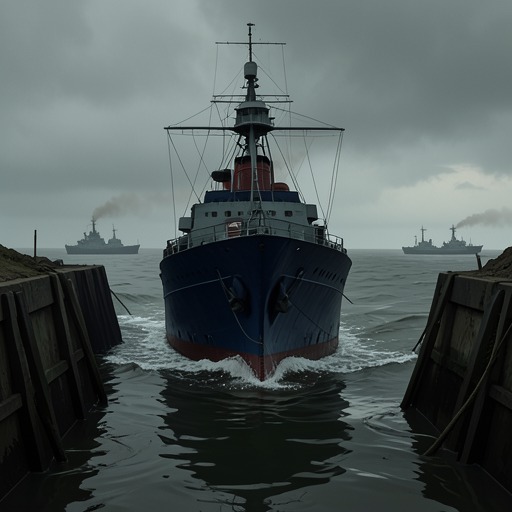
That enforcement effort takes place amid regional dangers that threaten to overwhelm the mission. The UN hopes a strong military presence will help defuse other problems, including Turkey’s repeated threats to invade Armenia to suppress unrest. Meanwhile, the Black Sea region from Odessa to Gagra is becoming increasingly dangerous; if its northern half turns into a war zone, the UN-U.S. effort may become difficult or impossible to sustain. The organization’s attempt to stabilize one crisis is thus exposed to the possibility that adjacent conflicts will close the space in which it can operate.
A United Nations with Military Reach
The prospect of U.S. forces acting at the UN’s request is politically contested. The National Command Authority specifically prohibits U.S. involvement in the fighting between the Reds and the Blues, even as the broader international mission calls for American military support. The novel places that restriction alongside the UN’s growing responsibilities, showing that a humanitarian or peacekeeping mandate does not erase the boundaries imposed by national policy.
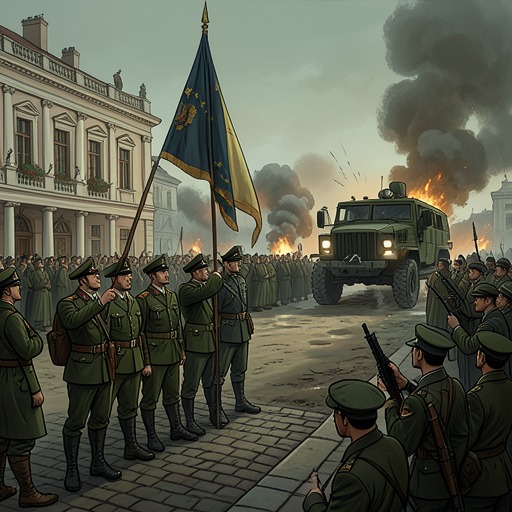
The UN’s authority nevertheless deepens in Crimea. Washington grants its request for operational authority over U.S. forces in the Crimean Peacekeeping Operational Zone. For the duration of the mission, those forces are to operate under UN command unless the President says otherwise. The arrangement is presented as a consequential change in the command relationship, not as a transfer of all national authority: the stated endpoint remains the President’s decision, while the immediate conduct of the mission falls under international operational command.
Authority Under Pressure
The political argument for intervention is itself disputed. One official presents the danger as a reason to intervene in order to maintain peace; Admiral Scott challenges the premise, pointing to an area already coming apart and noting that Ukraine has not attacked. The disagreement captures the difficulty facing the UN’s approach: a deteriorating situation can be used to justify preventive action, but the same instability can make the purpose and limits of that action harder to define.
The UN hopes a strong military presence will help legitimize the idea of an organization with real enforcement power—a United Nations with teeth. Yet the novel shows the conditions attached to that ambition: resolutions need another state’s military expertise, peacekeepers operate amid contested authority, and U.S. forces remain subject to national command limits even when placed under UN operational direction. The organization’s military reach is therefore both an instrument of its peacekeeping project and a continuing test of how far international authority can extend.