Russian Black Sea Fleet
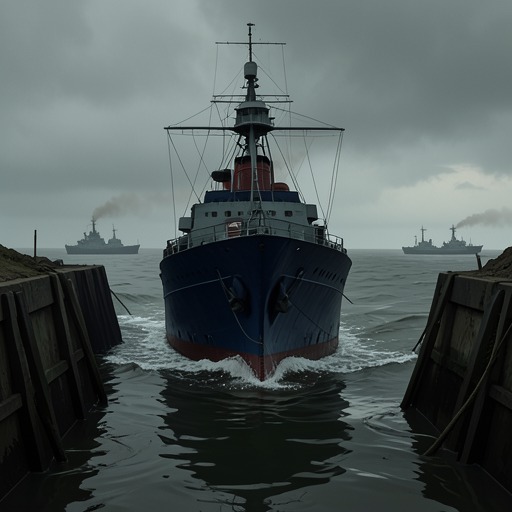
AfterburnThe Russian Black Sea Fleet is both a concentration of naval power and a prize in the fractured struggle over Crimea. Its ships and bases matter to rival factions, but the loyalties of its personnel do not simply mirror the army’s allegiance: most naval personnel choose Dmitriev, while the army remains almost wholly loyal to General Boychenko. The fleet’s divided political setting turns control of its forces into part of the broader contest for the Crimean Military District.
Command and Setting
At the Sevastopol Naval Base, within the Crimean Military District, Dmitriev occupies the office of commander of the Russian Black Sea Fleet. The setting makes the fleet’s command question immediate: it is not merely a force operating in the region, but an institution whose personnel and ships are caught inside a struggle over who has authority there.
General Boychenko, meanwhile, has been assigned responsibility for defending the Crimean Military District against all threats, including the Blues, Ukrainians, and Americans. That broad mandate sets up a sharp contrast between the general’s formal defensive responsibility and the fleet personnel who choose to follow Dmitriev. The evidence establishes this division without suggesting that every naval officer or sailor makes the same choice.
Personnel and Factional Loyalties
Dmitriev’s officers discuss the difficulty of assembling pilots he can trust. The challenge is not simply finding enough people: it is determining which personnel are loyal to him rather than to General Boychenko. His subordinate reports that the majority of naval personnel have opted to follow Dmitriev, whereas the army is loyal to the general almost to a man. The comparison makes the split institutional as well as personal, with the two services tending toward different leaders.
The fleet is therefore not presented as a unified instrument of the district’s command. Its personnel choices create a competing chain of allegiance inside the same military region, while the difficulty of finding reliable pilots shows how that division reaches into the practical formation of an air force. The account leaves the exact number of loyal personnel unspecified, but makes clear that trust and command cannot be assumed from service affiliation alone.
Ships as Strategic Stakes
The fleet’s vessels are among the objects sought in the struggle for control of Ukrainian territory. A faction’s stated interest extends to military supplies and materiel, bases, and ships of the Russian Black Sea Fleet that have not already been seized or defected to its side. The qualification matters: the fleet’s assets are already subject to loss and realignment, so its remaining ships represent both military capability and contested allegiance. The Pobedonosnyy Rodina is singled out among the desired prizes, underscoring the strategic weight attached to major naval assets.
The Wider Naval Theater
The fleet operates within a Black Sea crisis also shaped by international command arrangements and maritime access. Whether American forces should serve under United Nations commanders has been debated for years; during the operation, Washington grants the United Nations operational authority over U.S. forces in the Crimean Peacekeeping Operational Zone, subject to the President’s authority to change that arrangement. Separately, the National Command Authority directs that U.S. forces not enter the fighting between the Red and Blue Russian factions, limiting the Marines’ role at Poti. These are decisions about American forces, not orders to the Russian Black Sea Fleet, but they define the external military and political environment in which control of the fleet matters.
The geography also makes naval endurance dependent on access and supply. A modern American carrier requires replenishment of expendables every two to three weeks; although nuclear-powered, its aircraft consume fuel, and its only stated supply source is the UN replenishment tankers accompanying the battle group. Once the Bosporus Strait is closed, the carrier and its escorts risk being trapped in the Black Sea: after intensive operations, their remaining useful time may shrink to two to four days. Later, nearly three million gallons of aviation fuel—about nine thousand tons—are prepared for transfer aboard the carrier. These details concern the American force rather than the Russian fleet, but show how control of sea routes and the condition of naval logistics sharpen the stakes of the Black Sea contest.