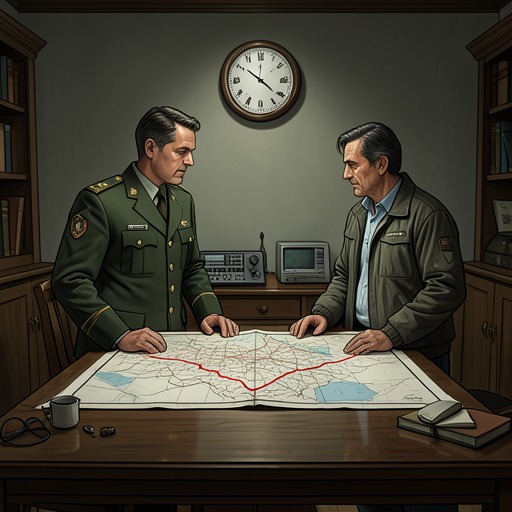
UN Security Council
AfterburnThe UN Security Council becomes the political center of a contested experiment in international military authority: the proposed use of United Nations power to stabilize a crisis while American forces operate under a command beyond their national chain. The arrangement promises a stronger peacekeeping presence, but its reach and risks are unsettled. In Crimea, the question of who may authorize action is also a question of who claims authority over the territory and who must answer for what the forces do there.
Mandate and political rationale
The prospect of placing American forces under United Nations commanders had been debated for years. As the Jefferson prepared to add its air wing to the United Nations presence off Poti, the operation gave that long-running argument immediate military consequence. Advocates saw a stronger deployment as a way to give the organization practical power, rather than leaving it unable to respond to crises.
The case for expanding that power drew on a pointed historical comparison. Supporters argued that the United Nations had been helpless during the Cold War and that early New World Order interventions had produced fiascoes; in their view, placing larger and more capable military units under its authority could strengthen its standing and ability to act. Others saw another foreign commitment as an ill-advised risk, particularly while the President was under pressure over foreign policy and was expected to concentrate on domestic problems. The Council's growing role therefore belonged not only to military planning but also to a dispute over whether international authority could make intervention more legitimate and effective.
The United Nations also hoped that a strong presence might help contain problems beyond the immediate fighting. Turkey had repeatedly threatened to invade Armenia to suppress unrest there. That wider purpose enlarged the stakes of the peacekeeping project: the deployment was meant to steady a region whose crises could spread, not simply to supervise one isolated operation.
Authority and operational limits
The proposed authority did not amount to an unrestricted license to intervene. The National Command Authority had explicitly directed that U.S. forces must not become involved in the fighting between the Reds and the Blues. The Marines were to go ashore at Poti only, keeping their mission within a specified geographic and political boundary even as their presence strengthened the United Nations position.
That limit illustrates the strain built into the arrangement. United Nations authority could be extended over American military forces, but the national government still defined what those forces were not permitted to do. The policy debate was thus about more than transferring command: it also concerned whether international orders, national restrictions, and responsibilities on the ground could remain aligned when the crisis changed.
Crimea and the command question
As the danger around the Black Sea intensified, officials considered the implications of extending United Nations authority to Crimea. The possibility that the northern Black Sea, from Odessa to Gagra, might become a war zone made continued cooperation between the United Nations and the United States increasingly difficult. In a discussion of intervention, Admiral Scott rejected the idea that the region was at peace, while the Secretary of State pointed out that Ukraine had not yet attacked. Their disagreement captured the divide between treating the crisis as a rapidly escalating emergency and insisting that the case for intervention remained constrained by events.
The proposed arrangement carried a territorial implication as well as a military one. One official warned that, if the United Nations accepted it, Crimea would in effect be placed under the authority and protection of the UN Security Council. That was described as unprecedented. The statement presents the Council not merely as a forum for approving a mission but as the institution whose authority could reshape the political status claimed for a contested area.
The command transfer later became operational. The United Nations requested, and Washington granted, operational authority over U.S. forces in the Crimean Peacekeeping Operational Zone. The announcement stated that American forces would operate under United Nations command until the President decided otherwise. National authorization therefore remained a condition of the arrangement, even as day-to-day command for the mission shifted to the international level.
Crisis, coercion, and institutional significance
The escalation surrounding Crimea made the division of authority consequential rather than abstract. The prospect of a widening war zone threatened the feasibility of a joint United Nations–U.S. intervention, while officials differed over whether the existing violence already justified stronger action. In that setting, the Council's contemplated protection of Crimea could serve as a framework for intervention, but it also risked being read as a claim of authority in the midst of conflict.
The wider political crisis further narrowed the space for negotiation. Russian officials described attacks as accidents and stressed their resolve in the face of foreign interference; Admiral Scott, confronted with Dmitriev's demands, characterized them as extortion and argued that they could not simply be accepted. These exchanges do not make the Council the author of every response, but they show the increasingly coercive environment in which international authority and military command had to function.
The UN Security Council's significance in the narrative lies in the gap between institutional ambition and operational control. Giving the United Nations military authority is presented as a possible answer to past institutional weakness, yet the Poti restrictions and the later Crimean command arrangement reveal the qualifications attached to that ambition. The Council's authority depends on national governments agreeing to delegate power, while the force acting under that delegation remains exposed to a fast-changing conflict whose political meaning is disputed.