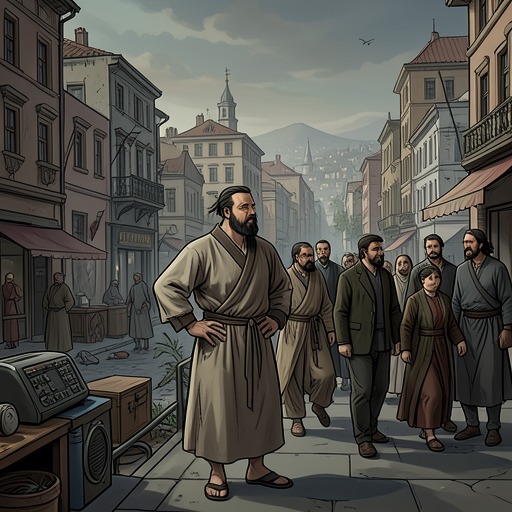
Ji Kangzi
AnalectsJi Kangzi is a leading political figure in Lu whose repeated consultations with Confucius turn him into a focal point for the book’s account of ethical government. His questions concern public obedience, crime, and punishment; the answers repeatedly direct attention away from coercion and toward the conduct of those who govern.
Identity and Political Position
Ji Kangzi appears as a statesman with the power to ask about policy and influence how people are governed. Confucius addresses him as a ruler responsible for the example set before the people, not merely as an individual seeking advice. The exchanges make political authority inseparable from personal conduct: the condition of government is measured by whether the person at its head acts rightly.
His position also belongs to a wider problem of authority in Lu. The account of Ji clan plans to attack Zhuanyu names Ran You and Zilu as advisers serving its chief, and Confucius challenges them for allowing an unjust undertaking to proceed. Though that episode centers on their responsibility, it clarifies the political setting around Ji Kangzi: the power exercised by great households and their ministers can displace proper public order, while those who serve them remain accountable for their choices.
Advice on Governing
When Ji Kangzi asks how to make the people reverent, loyal, and industrious, Confucius prescribes a model of leadership rather than a technique of compulsion. Solemn conduct elicits respect; filial and compassionate conduct elicits loyalty; promoting the good and instructing those who fall short encourages effort. The answer links the people’s response to the behavior and priorities they observe in their leaders.
A related exchange reduces the problem of theft to the ruler’s own example. Troubled by the prevalence of thieves, Ji Kangzi asks how to put a stop to them. Confucius answers that if Ji Kangzi himself were not covetous, people would not steal even if they were offered rewards for doing so. The sharp reversal makes the ruler’s appetite, rather than the thief’s punishment, the point of intervention.
Ji Kangzi also asks whether killing the unprincipled to help the principled would be a sound policy. Confucius rejects the premise that good government requires killing. If the ruler desires what is good, the people will become good; the relation between superior and inferior is like wind passing over grass, which bends beneath it. The image describes influence as an effect of example: authority shapes conduct, but that power places responsibility on the person who leads.
Rectitude, Names, and Responsibility
The broader political teachings associated with Ji Kangzi’s consultations connect good government to rectification. Confucius tells Zilu that when a ruler of Wei awaits his help in administering the government, the necessary first task is to rectify names. If names are incorrect, speech ceases to accord with what is meant; affairs fail, ritual and music do not flourish, and punishments cease to fit their cases, leaving the people without a sure course of action. The argument traces political disorder through a chain from public language to institutions and their consequences.
The same standard appears in the maxim that when a leader’s personal conduct is correct, government proceeds without orders, whereas commands are not followed when the leader’s conduct is not correct. For Ji Kangzi, this supplies a concise measure of the advice he receives: orders and sanctions cannot compensate for a failure of example. It also contrasts with the conduct of a government that tries to secure compliance while leaving its own desires and behavior uncorrected.
Limits of Political Power
Confucius places household and ministerial power within a larger account of political decline. When proper order prevails, ritual, music, and punitive military expeditions proceed from the Son of Heaven; when it fails, those powers pass to regional rulers, then great officers, and finally their subordinate ministers. The further authority descends through these levels, the sooner its holders are expected to lose power: the account gives ten generations for princes, five for great officers, and three for subordinate ministers. These thresholds frame the ambitions of powerful households as signs of institutional disorder, not simply as questions of administrative convenience.
The contrast between upward and downward progress in the superior and mean person, and between learning for self-improvement and learning for others’ approval, further sets a moral standard against which public status can be judged. Confucius’s account of the superior person’s nine reflections makes that standard practical: see clearly, hear distinctly, keep a benign expression and respectful demeanor, speak sincerely, act carefully, ask about doubts, consider the difficulties anger may bring, and consider righteousness when gain appears. These teachings do not record Ji Kangzi’s private response or a change in his policies; instead, they leave his consultations as a continuing test of whether political authority can be brought into line with ethical conduct.