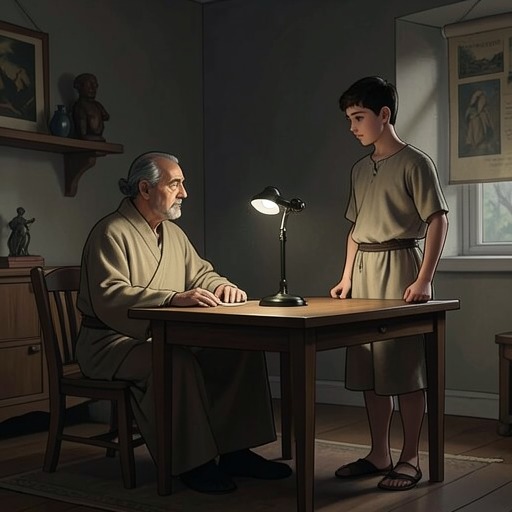
Yan Hui
AnalectsYan Hui stands in the Analects as the exemplary learner: disciplined in conduct, undiminished by hardship, and mourned as irreplaceable when he dies young. The accounts of his learning and death join ethical achievement to personal loss, making the figure who answers the Master’s standards also the one whose absence those standards cannot repair.
Identity and Learning
Asked by Duke Ai which of his disciples loved learning, Confucius named Yan Hui. He distinguished that love by two practices: Yan Hui did not let anger pass from one occasion to another, and he did not repeat a fault. Confucius added that Yan Hui died before his appointed time and that no comparable learner remained. Later, when Ji Kangzi asked the same question, Confucius again named Yan Hui and again stressed that his early death had left no successor in learning.
The repeated answer gives Yan Hui a particular standing among the disciples. His distinction is not described through office, public achievement, or a body of teaching, but through the steadiness of his response to anger and error. The text makes learning visible as ethical self-correction: an offence does not become a continuing grievance, and a mistake does not harden into a repeated pattern.
Poverty and Constancy
Another account measures Yan Hui’s character through deprivation. He lives in a narrow lane with only a single basket of food and a gourd of drink, conditions that other people could not bear without distress. Yan Hui, however, does not let his joy change. The repeated praise of his excellence closes the passage by binding material hardship to constancy of spirit; poverty is not romanticized as an achievement in itself, but serves as the circumstance against which his undiminished joy becomes legible.
That portrait complements the account of his learning. The learner who corrects anger and avoids repeating faults also sustains his joy under privation. Across the two scenes, excellence appears not as a claim Yan Hui makes about himself but as a quality disclosed by how he responds to conditions that might unsettle him.
Place Among the Disciples
Yan Hui appears among the disciples gathered with Zilu, Ran You, and Gongxi Hua while Confucius invites each to describe what he would do if entrusted with recognition. The surviving account records Zilu’s proposal for governing a state under military pressure and famine, Ran You’s plan to make a smaller territory prosperous, and Gongxi Hua’s wish to serve in ceremonial affairs. Yan Hui is not among the speakers recorded in this exchange, so the scene supplies no statement of his political ambitions; it places him within the group without inventing a response for him.
Elsewhere, an account of instruction describes Confucius teaching Yan Hui that a ruler’s correct personal conduct can make government effective without commands. The emphasis falls on conduct as an example that guides others, a principle that accords with the portrait of Yan Hui formed by his own disciplined behavior. The text offers no separate account of how he applied the teaching in office or public life.
Death and Mourning
Yan Hui’s death returns in several accounts as the defining loss of his story. Confucius tells Duke Ai and later Ji Kangzi that the disciple who loved learning has died young and that no one now matches him. The recurrence makes the report more than biographical closure: each answer about learning turns into an acknowledgment of absence.
When Yan Hui dies, his father, Yan Lu, asks Confucius for his carriage so that it can be made into an outer coffin. Confucius refuses. He explains that a father speaks of his own son whether that son was talented or not; his own son, Li, had died with an inner coffin but no outer one, and Confucius had not gone on foot to provide one. Because he had served among the great officers, he says, he could not simply travel on foot. The refusal is thus framed through the same limit Confucius had observed in arranging his own son’s burial, rather than as indifference to Yan Hui.
In another account of the death, Confucius cries out that Heaven has bereaved him. Set beside the measured explanation to Yan Lu, this lament makes explicit the grief that the practical refusal does not cancel. The text leaves Yan Hui’s death as both a private bereavement and the end of the standard by which the Master had identified the learner who loved learning most.