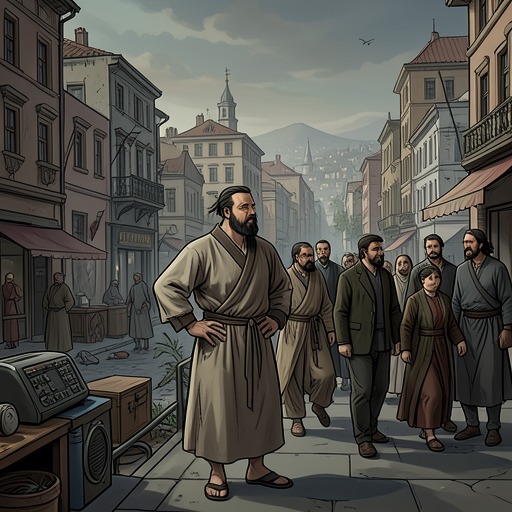
Ran You
AnalectsRan You is a disciple of Confucius whose political service brings the ethical problem of responsibility into concrete focus. He speaks as a prospective administrator, serves the Ji clan, and is repeatedly challenged to measure political action against its consequences for the people and the state.
Identity and Political Service
The text places Ran You among Confucius’ disciples and shows him operating within the politics of the Ji clan. His position gives him access to powerful decision-makers, but it also makes the boundary between adviser and responsible participant consequential: the teachings do not treat service as an excuse to disclaim agency.
In a discussion about appointments, Confucius presents the selection of capable and virtuous officials as a ruler’s practical obligation: employ officers, forgive minor faults, and advance people of talent. That wider administrative standard frames Ran You’s own political activity, which is judged not simply by proximity to authority but by whether service is carried out responsibly.
Government, Names, and Practical Competence
When Zilu asks what Confucius would address first if the ruler of Wei entrusted him with government, Confucius answers that names must be rectified. He traces a chain from incorrect names to disordered speech, from disordered speech to failed affairs, and onward to the collapse of ritual and music, improper punishments, and a people unable to know where to put hand or foot. The argument makes political language part of administration: titles and claims must correspond to duties and actions if public affairs are to work.
A related maxim holds that when a ruler’s own conduct is correct, government proceeds without orders, but when it is not, commands go unheeded. Another distinguishes the superior man’s upward progress from the mean man’s downward progress. These principles set a demanding measure for Ran You’s political world: effective authority rests not on commands alone but on conduct, reliable roles, and ethical direction.
The Ji Clan’s Campaign Against Zhuanyu
The sharpest test comes when the Ji clan plans to attack Zhuanyu. Ran You and Zilu report the plan to Confucius. Confucius addresses Ran You as Qiu and challenges him over the impending action, noting that Zhuanyu had been appointed by the former kings as guardian of the eastern Meng mountain and lay within the state’s territory; it was already a minister of the state, so he asks what could justify attacking it.
Ran You answers that their chief wants the campaign, while he and Zilu do not. Confucius rejects the distancing implied by that defense. A person who occupies a post must use his abilities in that role and withdraw if he cannot perform it; an assistant who fails to support someone in danger or to steady someone who is falling has no purpose. His images sharpen the point: if a tiger or rhinoceros escapes its cage, or a tortoise shell or jade is damaged inside its case, responsibility belongs to those charged with guarding them. The danger arose under their watch.
Ran You then argues that Zhuanyu is fortified and close to Bi, and that failing to take it now will create a danger for later generations. Confucius attacks the use of a predicted future threat as a pretext, insisting that a superior man does not conceal desire behind an excuse. He offers a different account of security: rulers should worry about unequal distribution and instability, not merely scarcity or poverty; fairness removes poverty, harmony prevents a population from being too small, and security prevents the state from toppling.
Accountability and the Work of Rule
Confucius contrasts conquest with the duties of humane government. If distant people do not submit, the response should be to cultivate cultural and moral influence so that they come; once they have come, they should be made secure. He then turns the contrast directly upon Ran You and Zilu: they assist the Ji clan, yet have failed to bring in those at a distance or preserve unity where the state is breaking apart. To plan the use of arms inside the state under those conditions is, he warns, to mistake the location of the Ji clan’s danger: the threat lies within its own walls, not at Zhuanyu.
This confrontation gives Ran You’s role its defining tension. He has enough standing to report and discuss policy, yet Confucius treats that standing as a source of obligation rather than protection. Saying that the chief desires an action does not absolve an adviser who remains in office; nor does invoking future risk settle whether the proposed means are just. The episode connects correct responsibility to correct political purpose: officials must answer for what they enable, while sound rule seeks fairness, harmony, security, and moral influence rather than a campaign of arms.
A Recurring Measure of Conduct
Ran You’s appearances in the book place administrative ability alongside questions of character and judgment. The account of government through rectified names insists that claims and roles must align; the teaching about a ruler’s conduct makes example more effective than commands; and the confrontation over Zhuanyu applies both standards to an adviser’s conduct under pressure. These passages do not narrate a later change in Ran You’s position or give a separate account of the campaign’s outcome. They leave him at the point of challenge, where political service is measured by whether he accepts responsibility for decisions made in the office he holds.