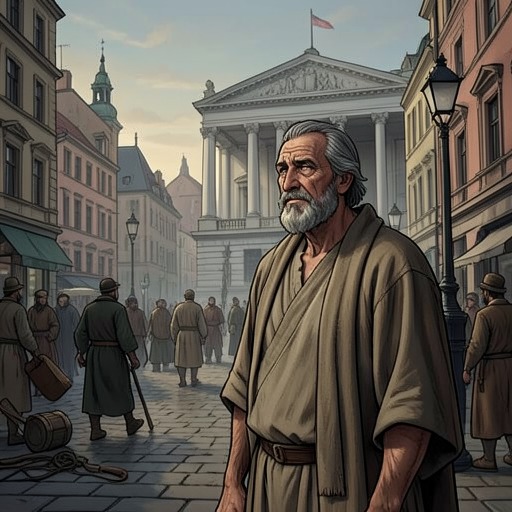
Yang Huo
AnalectsYang Huo is a political figure whose brief encounter with Confucius becomes a pointed argument about whether a person of ability may remain outside public life while the state is disordered. By arranging a meeting through a gift and then confronting Confucius on the road, Yang Huo converts a declined audience into a direct challenge: political responsibility cannot be put off indefinitely, because time itself will not wait.
Identity and Introduction
Yang Huo wishes to see Confucius, but Confucius initially refuses to visit him. Yang Huo then sends a pig as a gift. Confucius chooses a time when Yang Huo is away and goes to pay his respects for it, only to meet Yang Huo on the road. This carefully staged sequence gives their exchange its tension: Confucius has avoided a formal meeting, yet the obligations created by the gift bring the two face to face.
The Roadside Argument
Yang Huo asks Confucius to speak with him and tests his conduct through two questions. Could a person be called benevolent if he kept his precious abilities to himself while leaving his country in confusion? Could a person be called wise if he wanted public employment but repeatedly missed the occasions to take it? Confucius answers no to both. Yang Huo’s challenge joins moral character to political action: benevolence and wisdom are not merely private qualities if they are withheld when public service is possible.
Yang Huo then points to the passage of days and months and the fact that years do not wait. The reminder makes opportunity finite, turning the exchange from an abstract test of virtue into a question of timing. Confucius replies that he will enter office. The account records that decision as the immediate outcome of Yang Huo’s pressure, without describing what office Confucius takes or what follows from the promise.
Political and Narrative Significance
Yang Huo’s role is compact but consequential. He does not offer a theory of government in extended form; instead, he confronts Confucius with the contradiction between wanting to serve and repeatedly missing the chance. His argument gives urgency to the ethical demand that ability be used beyond the self, while the road encounter and the gift make the appeal concrete rather than ceremonial.
The episode also leaves a productive tension unresolved. Confucius first declines the meeting, then goes to acknowledge the gift, and finally says he will serve after Yang Huo’s questions. The text reports that commitment, but does not explain whether it becomes action. Yang Huo therefore functions less as the subject of a developed personal history than as the occasion for a sharp turn in the discussion: refusal gives way to an avowed readiness to enter public life.