Ji clan
AnalectsThe Ji clan is the powerful aristocratic house whose actions provide a recurring test of political legitimacy in the Analects. Its members and agents claim ritual and governmental authority, but the text measures those claims against propriety, responsible service, and the welfare of the state. The result is not a continuous family history but a series of pointed encounters in which status and conduct fail to align.
Identity and Political Position
The clan stands high enough to hold public power and to direct the service of officials, yet its authority is not presented as self-justifying. Confucius objects when the head of the Ji clan stages eight rows of dancers in his courtyard, a form of display the passage treats as an intolerable breach of rank. His question about what such a man might be willing to endure turns a ceremonial violation into a warning about the reach of unchecked power.
Ritual authority is contested again when the clan chief prepares to sacrifice at Mount Tai. Confucius asks Ran You whether he cannot stop him; Ran You replies that he cannot. The rebuke that follows invokes Lin Fang: the mountain, Confucius suggests, should be no less discerning than a person who understands ritual. The issue is not simply an individual ceremony but the presumption that political power can claim a ritual privilege without regard to the order that gives ritual meaning.
The clan’s place in government also appears in Confucius’ account of political decline. When ritual, music, and punitive military expeditions pass from the Son of Heaven to regional rulers, then to great officers, and finally into the hands of their subordinate ministers, the holders of power face progressively shorter prospects of retaining it: ten generations, five, and three. This descending sequence places the Ji clan’s authority within a structural warning. Power moving down through the hierarchy is evidence that proper government has failed, not proof that the new holder has acquired a stable right to rule.
Ritual Claims and the Limits of Rank
The text makes the clan’s public performance of rank especially visible through its use of music and ceremony. Eight rows of dancers in its courtyard are not an incidental extravagance: the form itself marks an authority the clan is not entitled to exercise. Confucius’ sharp response makes ritual an instrument for judging political conduct, since a violation in performance signals that the hierarchy governing public life is being disregarded.
The planned sacrifice at Mount Tai repeats this conflict in a religious setting. Confucius addresses Ran You, an associate of the clan, rather than the chief directly, asking whether the act can still be prevented. Ran You’s answer, that he cannot, reveals the limits of his own influence and the clan’s ability to proceed despite moral objection. Confucius’ appeal to the mountain’s discernment makes the scene a rebuke to those who treat ritual as something power can simply appropriate.
A different problem of ritual and institutional continuity appears when Zigong wants to abolish the sheep offering associated with the beginning of each month. Confucius distinguishes the material cost from the value of the rite: Zigong cares for the sheep, while he cares for the ritual. The episode does not identify the offering as a Ji clan act, but it clarifies the standard by which the clan’s ritual conduct is judged. Ceremonial forms matter as carriers of an ordered practice; they are not disposable merely because a participant focuses on their immediate expense.
Officials, Service, and Accountability
The clan’s power is exercised through officials whose obligations are scrutinized in the text. When Ji Kangzi asks whether Zhong You can serve in government, Confucius describes him as decisive; he calls Zigong intelligent and Ran You versatile. Such evaluations show capable disciples considered for public service under Ji Kangzi, but they do not amount to an endorsement of every policy the clan pursues. The book keeps personal fitness for office distinct from the legitimacy of the patron’s aims.
That distinction is sharpened by Min Ziqian’s refusal of an appointment as governor of Bi. Sent for by the Ji clan, he asks that the offer be declined politely and warns that, if someone comes again with another invitation, he will go live by the banks of the Wan. His response is a deliberate refusal, not an acceptance of the clan’s authority over his service. The conditional threat to leave makes plain that repeated pressure will deepen the break rather than secure his cooperation.
In the account of the contemplated attack on Zhuanyu, Ran You and Zilu visit Confucius and report that their chief intends to act against the state. Confucius challenges Ran You, asking whether the blame does not lie with him. Ran You replies that their chief wants the campaign and that the two ministers do not. Confucius refuses to let that disclaimer settle the matter: an adviser who occupies a post but cannot restrain a dangerous policy has failed in the responsibilities attached to it. He compares that failure to an assistant who cannot support someone tottering or prevent a fall, and asks what such an assistant is for.
Ran You then argues that Zhuanyu is fortified and close to Bi, and that leaving it untouched will create a future danger for the chief’s descendants. Confucius objects not only to the proposed attack but to the attempt to conceal desire behind a protective pretext. He argues that a ruler should be troubled by unequal distribution and insecurity, not simply by scarcity or poverty: fairness prevents poverty, harmony prevents a lack of people, and security prevents political collapse. Where distant people do not submit, the answer should be to cultivate civil virtue and draw them near, then make them secure. By contrast, Ran You and Zilu have failed to attract those beyond the state or preserve unity within it, while their chief plans armed action inside the state. Confucius concludes that the danger to the Ji-sun house is more likely to arise within its own court than from Zhuanyu.
Coercive Power and Political Consequences
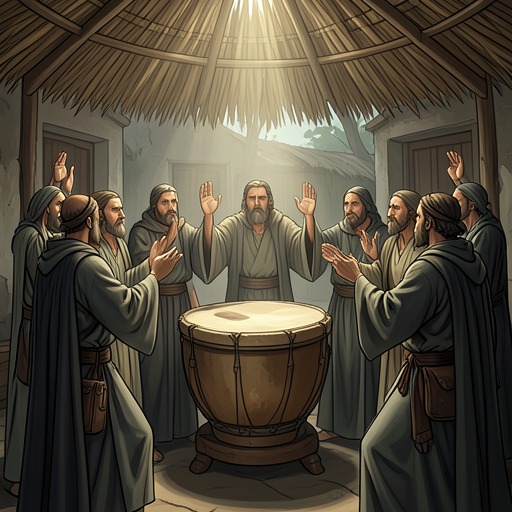
Another episode presents the Ji clan as a source of official wealth and coercion. Confucius says that the clan is richer than the Duke of Zhou, while Ran You, acting for it, gathers levies and increases its resources. He responds by declaring Ran You no longer one of his followers and telling the younger disciples that they may beat the drum and attack him. The passage’s sharp language turns an administrative practice into an ethical rupture: service that enriches a powerful house through extraction has, in Confucius’ judgment, crossed a line that warrants public denunciation.
The clan’s actions are also set against the question of what makes a ruler’s command effective. Confucius says that when a ruler’s own conduct is correct, people act without orders; if it is not, they do not follow even when ordered. That principle gives the book’s criticisms of the Ji clan a practical dimension. Political effectiveness cannot be secured by title or command alone; the conduct of those who exercise authority determines whether orders carry weight.
The same standard appears in the exchange about the ruler of Wei, who is waiting for Confucius to assist in government. Asked by Zilu what should be done first, Confucius answers that names must be rectified. If names are incorrect, speech will not accord with reality; if speech fails, affairs cannot succeed; ritual and music will not flourish; punishments will not be appropriate; and people will not know where to put hand or foot. The chain makes political language accountable to action. Applied to aristocratic government, it underscores the gap between occupying a role and fulfilling its duties, a gap exposed by the Ji clan’s use of power and its ministers’ excuses.
The Clan as a Political Warning
The Ji clan is more than the target of isolated reproaches. Its episodes connect ritual presumption, political overreach, and the failure of advisers into a single diagnosis of disorder. The eight rows of dancers display rank without warrant; the attempted Mount Tai sacrifice reveals the vulnerability of ritual to appropriation; the projected attack on Zhuanyu shows internal insecurity being answered with force; and Ran You’s levies expose the material interests that can bind an official to a powerful household.
The text’s recurring measure is not whether the Ji clan can command, appoint, sacrifice, or extract resources, but whether those actions conform to the obligations attached to authority. In the wider account of political decline, power progressively leaving the Son of Heaven and passing through princes and great officers to their subordinates carries a corresponding erosion of durability. The clan’s prominence therefore sharpens the book’s central institutional warning: when title and practice part company, ritual loses force, counsel becomes an alibi, and the apparent security of a powerful house gives way to the danger accumulating within its own walls.