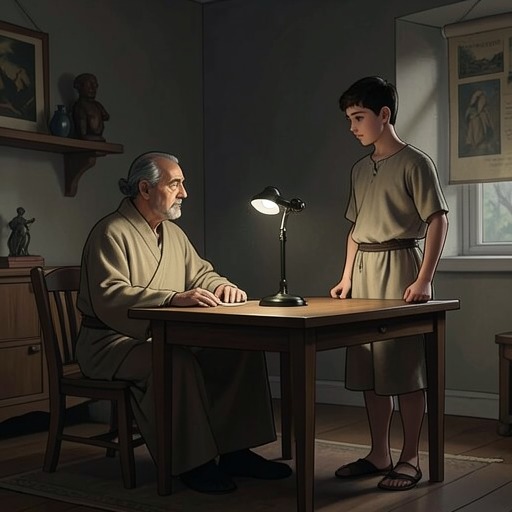
Yan Lu
AnalectsYan Lu is identified in the account of Yan Hui’s death as Yan Hui’s father. His request that Confucius surrender his carriage to pay for an outer coffin shell brings a practical expression of mourning into conflict with Confucius’s obligations and standards of propriety; the answer invokes the Master’s own loss of his son, Kong Li, and the burial arrangements he accepted for him.
Identity and Appearance
Yan Lu appears here not through a biography or a sequence of deeds but in a single consequential family scene. The text identifies him as the father of Yan Hui, the disciple whose death prompts the episode, and records his appeal to Confucius after that loss. No further background or later actions are given.
The Request After Yan Hui’s Death
Yan Lu asks for Confucius’s carriage so that it can be sold and the proceeds used to obtain an outer shell for Yan Hui’s coffin. The request is concrete: he seeks a particular possession for a particular funerary purpose. In the account, the bereaved father’s appeal is answered not by a general reflection on death but by a decision about whether the carriage can be given up.
Confucius’s Refusal and Its Rationale
Confucius refuses to part with the carriage. He explains the refusal by recalling that his own son, Kong Li, had a coffin but no outer shell. He would not walk on foot to obtain one for Kong Li, he says, because his former service among the high officers meant that walking on foot was not proper for him. The comparison does not erase the difference between the two fathers’ positions: Yan Lu has asked for help with his son’s burial, while Confucius grounds his answer in both his own experience of loss and the proprieties attached to his standing.
Significance in the Episode
The exchange leaves Yan Lu’s request and Confucius’s refusal together, without reporting Yan Lu’s response or the eventual form of Yan Hui’s burial. Its force lies in that unresolved juxtaposition: the need for a costly funerary provision meets a boundary Confucius will not cross, even when the bereaved petitioner is the father of his beloved disciple. The account also places the Master’s conduct under the same standard he applies to Yan Lu, since he cites the restraint he observed at Kong Li’s burial rather than claiming an exception for himself.