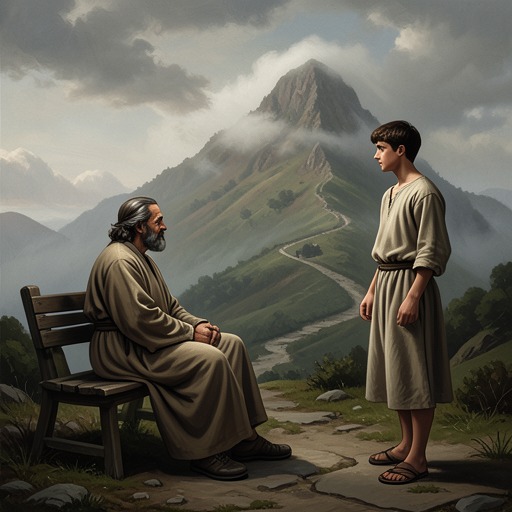
Jie Ni
AnalectsJie Ni is a farmer who urges Zilu to abandon the effort to reform a disordered world and withdraw from public life instead. In a brief encounter over a river crossing, his contrast with Confucius becomes a compact statement of the book’s central dispute about whether political disorder calls for engagement or retreat.
Identity and Introduction
Jie Ni appears working in a field with Chang Ju when Confucius passes by and sends Zilu to ask for the ford. The exchange begins as a practical request, but Jie Ni redirects it toward the identity and purpose of the travelers. He asks Zilu who he is; when told that he is Zhong You, Jie Ni recognizes him as a disciple of Confucius of Lu.
The scene gives Jie Ni no biography beyond this moment: he is presented through his labor, his questions, and his answer to the crisis of the age. Chang Ju has already answered Zilu with a pointed remark that Confucius knows the ford. Jie Ni’s response develops the encounter into an argument about what it means to seek a way through disorder.
The Argument for Withdrawal
Jie Ni describes disorder as a flood spreading across the whole world and asks who could possibly change its course. His image makes political confusion seem not like a local difficulty to be corrected, but an encompassing condition against which an individual reformer is powerless. He then contrasts following someone who withdraws from one ruler or situation with following those who withdraw from the world altogether, and recommends the more complete retreat.
The contrast is directed at Confucius’s continuing involvement in public affairs. To Jie Ni, refusing particular rulers does not go far enough if the world itself remains corrupt; withdrawal from society is the more consistent response. His position is expressed through a question and comparison rather than a developed account of a different political order.
Gesture and Conflict with Confucius
Jie Ni does not suspend his work to pursue the debate. After making his case, he bends to cover the seed and carries on without stopping. The gesture gives the argument a physical conclusion: while Zilu has been sent to seek a passage and carries a question back to his teacher, Jie Ni returns to the task immediately before him.
Zilu reports the encounter to Confucius, who responds with a sigh. Confucius rejects the premise that one can live apart from human beings, asking in effect with whom he could associate if not with people. He acknowledges that, if right principles prevailed throughout the world, there would be no need for him to try to change it. The exchange therefore leaves the two positions in clear opposition: Jie Ni takes pervasive disorder as a reason to retreat, while Confucius treats human society as the necessary sphere of responsibility.
Narrative Role and Significance
Jie Ni functions as a countervoice to Confucius’s public vocation, not as a convert or opponent who is persuaded. His brief appearance places a substantial choice inside an ordinary roadside encounter: the search for a ford opens onto the question of whether anyone can alter the course of a world imagined as a flood. His return to planting ends the discussion without resolving it, preserving the tension between withdrawal and engagement.