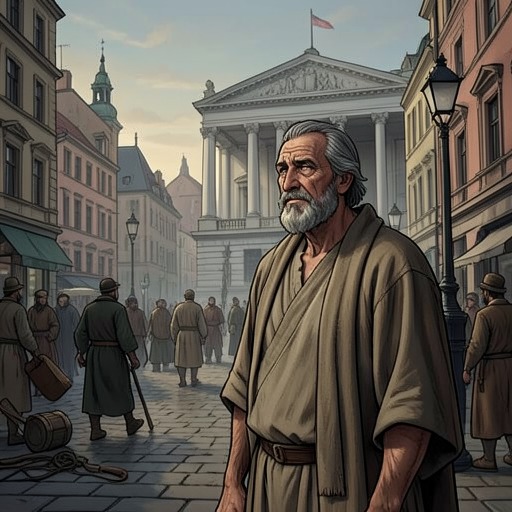
Bi Xi
AnalectsBi Xi is a rebel occupying Chung-mau whose invitation draws Confucius into a brief but pointed exchange with Zilu about political engagement and moral integrity. Though Bi Xi appears only as the absent inviter, the episode makes his summons a test of whether contact with a compromised political actor necessarily compromises the person who answers it.
Identity and Political Context
Bi Xi is described as holding Chung-mau in rebellion. The account gives no further biography or explanation of his revolt; his significance lies in the invitation and in the ethical question it raises. His name enters the discussion not through an encounter in the text, but through Zilu’s objection to Confucius’s willingness to go.
The Invitation and Zilu’s Objection
When Bi Xi invites Confucius to visit, Confucius is inclined to accept. Zilu recalls Confucius’s earlier teaching that a superior man should not associate with someone who does evil in his own person. Since Bi Xi is in rebellion and holds Chung-mau, Zilu asks what it would mean for Confucius to go to him. The challenge is presented as a tension between a general moral rule and a particular opportunity for action, rather than as evidence that Confucius has already visited.
Confucius’s Answer and the Gourd Image
Confucius acknowledges that he used the teaching Zilu cites, then distinguishes moral firmness from vulnerability to one’s surroundings. He invokes the images of something hard that can be ground without becoming thin and something white that can be steeped in dark liquid without becoming black. The comparison answers Zilu’s concern by presenting integrity as capable of surviving contact with corruption; it does not establish that Bi Xi is innocent or that the rebellion is acceptable.
Confucius closes with the image of a gourd that cannot simply remain hanging unused. In this context, the image counters withdrawal from every compromised setting: a person with capacities for public engagement should not be rendered useless by avoiding all such contact. The passage records his inclination and his defense of it, but does not say whether he ultimately goes to Chung-mau.
Narrative Significance
The episode leaves its practical outcome unresolved and concentrates instead on the reasoning behind Confucius’s response. Bi Xi’s invitation supplies a concrete political test for the distinction between engaging a troubled situation and endorsing it. The paired images—hardness preserved through grinding, whiteness preserved through dark immersion—make the answer turn on the possibility of maintaining character amid pressure, while the gourd image insists that integrity need not mean permanent inaction.