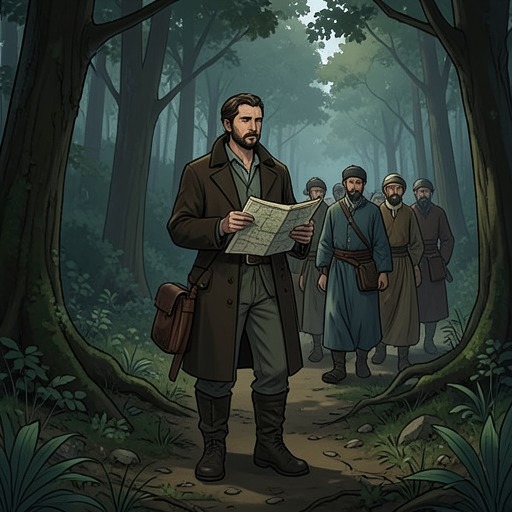
Colonial “civilizing” mission
BarkskinsThe colonial “civilizing” mission in the novel is a program of remaking Indigenous people and their territories in the image of European settlement: forests should be cleared, land cultivated, people trained for commercial work, and society arranged according to colonial ideas of order. Its proponents present these changes as improvement, education, or benevolence. Set against Mi’kmaq relationships to land, knowledge, and community, however, the program reveals how paternal language can accompany dispossession and cultural assimilation.
Land as a Project of Improvement
The mission is articulated early through Monsieur Trépagny’s defense of clearing the forest. When René asks why settlers do not build in the natural meadows, Trépagny answers that they have come to subdue what he calls an evil wilderness. He also invokes New France’s river-to-forest land strips: each settler is to receive fertile soil, high ground above floods, and woodland for timber and fuel. In this explanation, a particular colonial property arrangement appears not merely practical but equitable, while the forest is land awaiting human transformation. René’s question exposes the choice embedded in that logic: the settlers need not clear every wooded place simply to find a house site, but clearing is itself made part of the purpose of settlement.
The same improvement ideal recurs in reports of Wobik’s expansion. René is described not as a landowning farmer but as a woodcutter who keeps a few cows and sheep, cuts firewood, and makes potash. The farms appearing around his home are counted as proof that the settlement has progressed by destroying wilderness. That description also notes what the progress costs: Mari grieves the loss of woodland clearings where medicinal plants once grew, and speaks increasingly against the settlers. Her knowledge and mourning give the supposedly empty or unproductive forest a history of use and value that the language of improvement suppresses.
Instruction, Work, and Colonial Benevolence
The mission also operates through offers of education and skilled employment. Albert Bone says he hires some Indigenous workers and presents his support for Jinot as a way to repair historical injustice. He accommodates Jinot’s limp, offers him training in forging, tempering, grinding, and filing, and asks him to learn every part of axe manufacture. Yet Bone’s account of the opportunity is inseparable from an expectation that Indigenous people leave the forest for trades that colonial society deems useful. He hopes Jinot will become the first Indigenous businessman within that society, and urges him to recognize business opportunities among his own people. Jinot is unsettled by this benevolent attention: Bone’s assistance opens a path into paid work, but it also imagines Indigenous advancement as entry into the colonizer’s economic order.
On the journey to Boston, Bone makes the connection between vocational instruction and land transformation explicit. He tells Jinot that the sooner Indigenous people adopt useful trades, the sooner the woodlands will become civilized and productive, and says Jinot must learn how to deal with businessmen. The novel sets that lesson against Jinot’s preference for the forge, where workers communicate through gestures, and his discomfort with Bone’s solicitous interest. The contrast makes the offer more complicated than simple generosity: instruction can provide practical skills while defining the forest, Indigenous livelihoods, and even communication itself as things to be replaced or redirected.
Bone’s position is not a rejection of Indigenous people; rather, it separates them from the land and shorelines they have inhabited. For him, a place becomes fully real when its trees are gone, houses stand close together, and European crops grow in cultivated soil. His proclaimed regard for Indigenous workers therefore coexists with an account of productivity that denies independent value to their existing territories. The novel makes this tension central to the civilizing ideal: a person may be welcomed into colonial commerce precisely as the world that sustains that person’s community is transformed.
Order, Settlement, and the Colonial Gaze
The logic reaches beyond individual instruction into schemes for organizing whole societies. In Boston, Bone praises Edward Wakefield’s plan for systematic colonization in New Zealand. He admires its rejection of random settlement and its intention to establish society with a correct hierarchy of classes from the outset. The projected order is presented as scientific and rational; the disorder attributed to existing colonial societies becomes an argument for designing settlement more deliberately. The episode extends the civilizing mission from changing forests and livelihoods to arranging populations and social rank.
Bone’s judgments about Māori people reveal the limits of his apparent sympathy. He questions an inflammatory account that depicts them as violent, and tells Jinot that they may be defending their land from unfair seizure. Yet he still expects them, with kind treatment, to recognize the attractions of white people’s inventions. His critique of unfair seizure does not unsettle the broader assumption that colonized people should eventually accept the settlers’ way of life. Sympathy modifies the method of persuasion, but not its destination.
The novel places this paternal confidence beside the testimony of people who understand the consequences of colonial expansion. Père Crème tells a French official that the Mi’kmaq love the country being taken from them and their children, whom French goods and forceful ways are corrupting. He stresses that they have lived on the land for generations and suffer as it is appropriated. His appeal challenges the official’s imperial calculation, which treats Indigenous people chiefly as useful fighters in a contest for territory and sea access. Even within colonial institutions, the language of national strategy can make the inhabitants’ attachment to their country seem secondary to European possession.
Mi’kmaq Knowledge and Refusal
Against the claim that colonial order is the only form of knowledge, the novel gives weight to Mi’kmaq practices and accounts of the living world. Mari teaches René how to fish for eels, weaving three traps, supplying bait, and showing him where to set them; the catch becomes a regular part of their life. Elsewhere, she explains that eel fishing belongs to the knowledge of river people. Such teaching is practical and specific, not an abstract belief opposed to useful work. It demonstrates expertise grounded in place, even as colonial observers often reduce Indigenous knowledge to a curiosity or an instrument to be collected.
Père Crème’s letter describes Mi’kmaq time as shaped by seasons of hunting and ripening berries, and their understanding of trees, plants, fish, moose, and bears as persons and equals. He admits that his own explanations of trees as material for houses and ships, and his exhortations to cultivate grain, do not persuade them. His account records a genuine conflict between ways of inhabiting the world: colonial instruction identifies cultivation and construction as order, while Mi’kmaq relations with plants and animals cannot be reduced to resources awaiting use. The letter also unsettles the assumed direction of teaching when Père Crème acknowledges that he sometimes feels the Mi’kmaq are teaching him.
As settlement presses further into Mi’kmaq territory, Sosep describes its effects through concrete losses: settlers’ animals destroy food, boats and nets take fish, and introduced plants overwhelm local ones. He recognizes that many newcomers may not intend harm, but stresses the imbalance between a numerous incoming population and a small Indigenous one. His warning that the people must hold Mi’kmaq ways in mind and live in two worlds frames cultural continuity as an active response to encroachment, not as a return to an untouched past. The woods that were once open to them are no longer theirs to cross without hindrance; preserving a Mi’kmaq world in thought and daily life becomes a means of survival.
Assimilation’s Costs and the Mission’s Contradictions
The civilizing project’s promise of education is finally set against the experience of Indigenous children at the Shubenacadie residential school. Lobert sends Egga there believing that reading and writing will lead to better work than cutting trees. The school’s apparent educational purpose conceals a different reality: the children’s culture and language undergo a sustained assault, and Egga is made to work rather than attend classes. The episode makes the distance between the mission’s rhetoric and its practice unmistakable. Education is presented to families as opportunity, while the institution works to weaken the cultural continuity that might sustain a different future.
Across these encounters, the novel does not treat colonial “civilization” as a single policy or a merely private prejudice. It is a recurring framework that links property and forest clearance to labor training, settlement design, and schooling. Its advocates may differ in temperament and may claim sympathy for Indigenous people, but their measures of progress repeatedly place European productivity and social order above Indigenous sovereignty, knowledge, and ways of life. Against that framework, Mi’kmaq characters’ teachings, objections, and insistence on carrying their world forward expose both the violence of the supposed improvement and the persistence of alternatives.