Forest commodification and industrial logging
BarkskinsForest commodification and industrial logging is the novel’s long account of how forests become commodities: first imagined as an inexhaustible source of wealth, then cut, transported, milled, and sold through expanding regional and international markets. The process joins commercial ambition to technological change, while distributing its costs unevenly among landscapes and workers. The forest’s supposed permanence gives way to depleted stands, damaged waterways, dangerous labor, and the gradual replacement of older ways of life.
From forest to commodity
The commercial logic appears early in Charles Duquet’s search for wealth that might outlast the fur trade. Watching beaver pelts accumulate in the warehouses and recognizing that animals could disappear while markets swung between scarcity and surplus, he rejects fur and other living resources as unstable foundations for a lasting fortune. He turns instead to timber. The forest, he believes, is vast, renewable, and valuable to Europe for ships, houses, and fuel. He intends to earn what he can from furs before shifting into the supposedly permanent business of wood, and raises the possibility of bringing the Trépagny brothers with him. His plan rests on a consequential mistake: he treats forest renewal as assurance of endless supply rather than as a process with limits and timescales.
Duquet’s commercial imagination is also connected to trade routes beyond New France. On a voyage that takes him to India, he observes Captain Verdwijnen exchanging ceramics and silks for food and spices, and acquiring Patna opium for medicinal trade in Amsterdam. Duquet considers whether a three-cornered route could serve a lumber merchant. The scene places timber within a wider system of shipping and exchange: forests are not merely cut locally but drawn into circuits linking producers, transporters, and distant buyers.
Markets, ownership, and conflict
As timber becomes valuable, possession of trees and the right to cut them become sources of dispute. In a business discussion with James Duke, Edward Duke describes declining supplies of large, first-rate white pine alongside the persistent problem of people cutting timber without authorization. He lists the expenses required to run the enterprise, from tools and blacksmithing to the construction and maintenance of river booms and locks. These costs reveal the infrastructure beneath the apparently simple act of felling a tree: timber must be held together, moved downstream, and brought to mills before it can reach a market.
Edward portrays timber theft as widespread and difficult to stop. Those accused range from settlers and failed businessmen to shingle makers and clapboard sawyers; some continue cutting after prosecution, while moonlit nights offer cover for unauthorized felling. His account also connects land clearing to fire. He says some men deliberately burn the margins of valuable woods and then seek to acquire the damaged land cheaply, while fires escaping from settlers’ clearings can consume adjoining timber. The conflict is therefore not only over individual trees. It concerns control of land, the means of extracting value from it, and who bears the losses when fire spreads.
Industrial expansion and altered landscapes
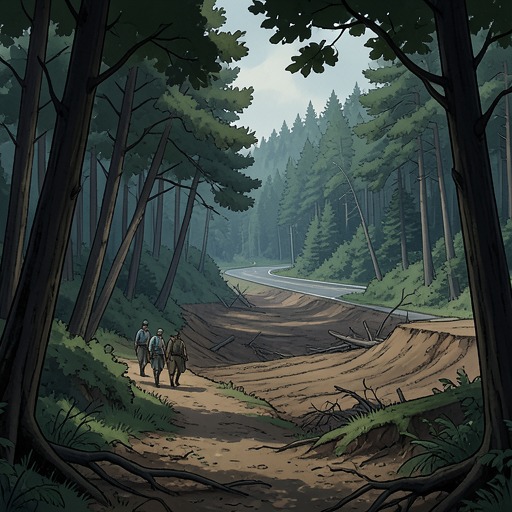
The novel’s account of Maine’s lumber economy presents forest loss as a broad historical change rather than a single catastrophe. As the state fills with lumbermen, jobbers, land agents, and Boston buyers, the remaining pine stands grow scarce and remote. Commercial attention extends to spruce, hackmatack, hemlock bark, and hardwood. Hundreds of thousands of acres become stumps and cut-over ground; formerly shaded streambanks are exposed to sunlight, and silted pools and gravel bars make conditions less favorable for trout. Logging towns expand around saloons, hotels, eateries, mills, and the movement of timber, while mills run through the night and the risk of fire remains constant. Bangor boasts of its place in the lumber trade as cut wood is hauled to the wharf.
The pressure to improve production accompanies that expansion. Small circular saws enter shingle mills, larger circular saws are promoted as replacements for older up-and-down and gang saws, and steam engines promise further increases in power. A forty-eight-inch circular saw operates at a mill on the Kenduskeag, while another mill is rumored to cut four thousand board feet in an hour. These developments make the industrial scale of logging visible: machinery increases the volume and speed of conversion, but does not make the forest’s loss less real. Amboise Sel and Jinot Sel dislike the pace of change. After a season on the heavily cut Penobscot, working among farmer-loggers, they move north to New Brunswick, where they find older-style camps and other Mi’kmaq living as woodsmen. Their people increasingly depend on settlers’ goods and food, making wage work a condition of livelihood even as traditional subsistence recedes.
Labor, transport, and risk
The production chain depends on workers whose conditions contrast sharply with the wealth sought by timber merchants. In one lumber camp, men rise before daylight, eat salt pork and tea, and walk to the cutting ground with sharpened axes. They return in near darkness to crowded quarters, where they sleep on the dirt floor beneath shared blankets. The work is organized around long days, cold, and the expectation of returning to the cut as soon as there is enough light. The camp’s rough material conditions are not incidental to the timber economy: they are part of a labor system that draws on men with few alternatives and treats physical danger as an ordinary cost of production.
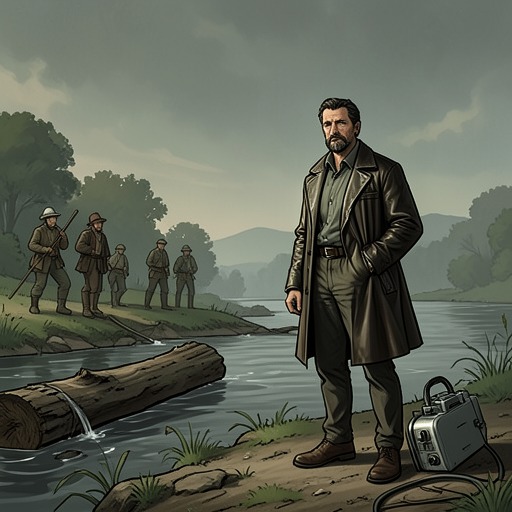
River driving is presented as especially hazardous. A camp boss explains that water moves the logs and powers the mills, so companies must accept the expense of getting timber downriver. The work is assigned to Indigenous men, including Mi’kmaq and Montagnais workers, who maneuver among the moving logs while others rely on their labor to move the harvest toward the sawmill. The allocation reflects both the industrial system’s dependence on river transport and its unequal distribution of risk. Wooden crosses along riverbanks mark the danger, and injuries and deaths are recurrent features of the work.
Across generations, the Sels encounter successive changes in tools and transport: the poll axe yields to the double-bitted axe, the crosscut saw, circular saws, and long band saws; oxen give way to horses, then to donkey engines and Shay-geared locomotives. As roads reach forests beyond navigable waterways, trucks and roads displace river drives. These innovations do not simply make old work faster. They reorganize where logging can take place, what skills are required, and how much forest can be reached and removed. The novel describes machinery as helping turn the removal of the continent’s remaining ancient forests from a daydream into an accomplished industrial possibility.
Transoceanic extraction and lasting significance
The same commercial pattern appears in New Zealand, where Sydney merchants establish shore stations at harbors with deep water and accessible timber. These stations combine logging camps with trading posts dealing in flax, spars, and lumber. Warehouses, sawmills, chandlers, and small shipyards bring European enterprises to the coast; after taking the most valuable timber, they move to the next promising site, leaving burned stumps and extensive waste. Cutting shifts from kahikatea to kauri, and felled trees cover the ground before the accumulated material is burned to clear the land. The description makes the link between overseas demand and local ecological loss explicit: the newcomers value what can earn a profit without needing to understand the wider forest they are transforming.
The business continues to seek new supplies across oceans. When Duke and Breitsprecher ship their best pine to Sydney, a buyer there expresses interest in kauri and in finding a partner to establish efficient logging camps in New Zealand. The proposed arrangement extends the company’s search for timber beyond North America and ties distant forests to the same language of supply, efficiency, and commercial opportunity. New Zealand timber enters an international trade rather than remaining a local resource, while the consequences of cutting are borne in the places from which it is taken.
Together, these episodes make forest commodification both an economic history and a record of unequal environmental change. The idea of limitless forest underwrites investment and expansion; mills, roads, riverworks, ships, and machinery enable it to operate at larger scales. Workers face hazardous conditions, Indigenous communities are drawn into wage labor and assigned particularly dangerous river work, and forest and water systems bear the cumulative effects of cutting and fire. The novel’s contrast is not simply between old tools and new machines, or between local and foreign markets. It is between a business horizon that treats timber as perpetually available and a landscape that registers depletion, damage, and social change.