Māori views of forests and sacred landscapes
BarkskinsMāori views of forests and sacred landscapes describe a world in which forests are living relations, sacred places, and responsibilities held across generations—not merely timber awaiting extraction. The novel gives this understanding a concrete setting in New Zealand, where Arana, Kahu, and Aihe guide Etienne Sel and Joseph Dogg through a damaged kauri landscape and into the forest of Tāne. Their accounts make ecological knowledge inseparable from Māori authority, spiritual life, and the question of who may decide what happens to the land.
Land, authority, and customary care
The Māori understanding that the visitors encounter begins with a distinction between land as a marketable asset and land as a collectively held relationship. Arana warns Etienne and Joseph Dogg that Māori have sacred places that should not be disturbed, and directs them to his Māori kin for guidance. The warning matters in the immediate setting: the men have arrived while kauri are being felled, and the forest is already marked by the demands of commercial logging.
On the excursion, Arana and Kahu explain that land belongs to Māori tribes and clans, who keep forests intact for birds and cut trees judiciously. This account presents forest use as a matter of communal custodianship, not an unlimited right to remove timber. Aihe complicates any idealized picture by pointing out that some chiefs are greedy and sell relatives’ land to settlers of the New Zealand Company. The tension does not erase the customary principle; it shows how it is placed under pressure from both internal decisions and outside commercial power.
Sacred geography is visible in particular features of the landscape. Kahu identifies gnarled pohutukawa trees as sacred, while springs emerge from the ground and the forest rises in the distance like a great wave. The landscape is not presented as interchangeable wilderness: specific trees and waters carry significance, and the people who know them have responsibilities toward them.
The forest of Tāne and a living world
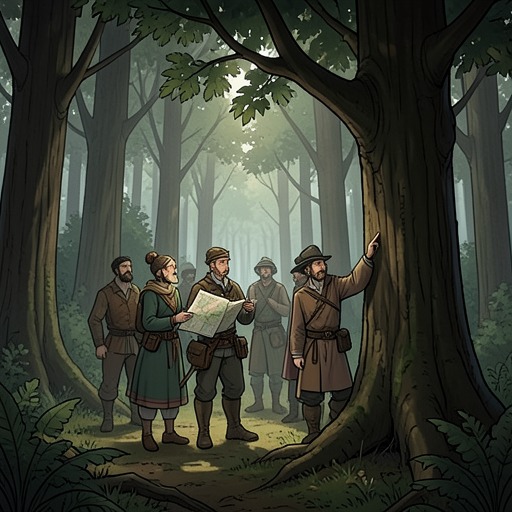
The visitors enter what Kahu calls the forest of Tāne. There the canopy forms layers, with the tallest trees making a roof over lesser growth. Kahu’s guidance turns the walk into an encounter with an organized, living community rather than a storehouse of separate commodities. The forest’s relations can be difficult for outsiders to read: Joseph Dogg is unsettled by the rata, which begins high in another tree, sends roots down toward the ground, and eventually incorporates its host into its own trunk.
Māori stories give this ecological world a sacred history. After a storm, the travelers see mist rising from folded hills. Aihe explains it through the story of Papatuanuku, the earth mother, and Ranginui, the sky father: their children separate them to let in light, and Tāne holds them apart with trees. The story makes the forest’s presence part of the world’s creation, not an accidental backdrop to human activity. Its spiritual account sits alongside practical knowledge of weather, plants, and place, rather than replacing it.
Knowledge of the forest is also embodied and shared. Arana proposes that Kahu lead the excursion because she knows the forest with all her senses; he describes her eyesight through the image of a small bird able to find invisible insects. Kahu anticipates rain before it arrives, reading signs in the forest, and Aihe points out the dangerous ongaonga plant as well as a small insect. Their knowledge is learned through attention to living particulars and conveyed by walking, showing, and storytelling—not only through written description.
Jinot, kauri, and the cost of extraction
The Māori account meets the consequences of logging at a huge kauri stump. Arana identifies it as the tree Jinot Sel was cutting when his damaged leg failed, and points to Jinot’s remaining axe marks in the outer rings. For Etienne, touching the greying wood makes the stump the surviving evidence that Jinot had been there. The tree is at once a record of labor, a place of loss, and a being whose significance exceeds its use as timber.
Arana recalls that Jinot was skilled with an axe and made a chair with it, but did not want to cut kauri. Jinot had described the trees as powerful, a view Arana says his people shared. He also says that Jinot had wanted to return to his family but had no money and had been brought to the work by Mr. Bone. This account joins personal separation to the extractive economy: Jinot’s skill made him useful to the logging operation, while his own understanding of the trees set him apart from the purpose for which he was employed.
The landscape around the stump exposes the physical extent of that purpose. The travelers pass through stumps and logging slash, and the giant cut surface dominates the scene. Kauri are prized by woodsmen for their great, knotless bodies; the market’s valuation of the tree is thus made explicit. Yet Arana’s recollection of Jinot’s reluctance and belief in the trees’ power contests the notion that timber quality exhausts what a forest is.
Colonial pressures and unequal knowledge
The novel places the New Zealand encounter in conversation with earlier colonial attitudes toward Indigenous life. In a letter, Père Crème describes Mi’kmaq people as living according to the abundance of animals, fruits, and fish, and notes their regard for trees, plants, fish, moose, and bear as equals. He contrasts this with European expectations that trees should serve human construction and that people should cultivate fields and order their days through agriculture. His account shows how a relational understanding of the more-than-human world was made to look like idleness when judged by colonial standards.
Other passages underline that this dismissal accompanies dispossession. Père Crème tells a colonial authority that the Mi’kmaq love their country and their children, and suffer as their land is taken and their ways disrupted. When the Sel family returns toward its country, Sosep warns that the French king has given their lands to the British; Theotiste answers that the land was not the king’s to give. Against that history, the Māori account of tribal and clan authority over land is not simply a cultural description: it is a claim about who belongs to a place and who has the right to govern its use.
The scenes also distinguish between ecological knowledge as living practice and knowledge extracted for outside use. Kahu and Aihe teach through a guided encounter in which the visitors are asked to observe places, species, and stories in context. Elsewhere in the novel, a visiting doctor collects wild vegetable specimens to send to the Jardin des Plantes. Set beside the Māori walk, that episode sharpens the difference between knowledge rooted in reciprocal responsibility and specimens removed for distant study. The contrast does not require the visitors to be wholly ignorant; it makes clear that recognition depends on listening to those whose knowledge is tied to the land.
Stewardship across generations
The Māori account of forest care resonates with later disputes in the novel over logging and replanting. Armenius Breitsprecher recognizes that Duke & Sons intends to clear the continent and condemns the waste, soil damage, erosion, and destruction of forest life that accompany the assumption that another forest will always be available. His judgment names the commercial logic that the New Zealand scenes expose at the level of a single kauri: extraction treats the next stand of trees as an answer to the loss of this one.
Dieter Breitsprecher proposes a different timescale. He argues for managing cutover land and replanting, and tells the Māori hosts that a seedling cannot replace an ancient kauri within a human lifetime, yet people should plant for the health of the world and those not yet born. That principle does not collapse the difference between planting trees and protecting an intact sacred forest. Rather, it makes the scale of loss legible: a new seedling is not an immediate substitute for an old kauri, and responsible care must account for time beyond a manager’s career or a company’s quarterly return.
The concept’s significance lies in this contrast of relationships to the forest. Commercial timbering measures trees by saleable qualities and treats cutting as a decision available to whoever can command the work. Māori stewardship, as the novel presents it, joins use to limits, authority to communal ties, and ecological understanding to sacred meaning. The forest of Tāne therefore challenges the idea that nature exists solely for human purposes, while the kauri stump makes the cost of ignoring that challenge visible in the landscape and in the lives of people drawn into the logging trade.